Top Qs
Timeline
Chat
Perspective
Anti-Submarine Warfare Shallow Water Craft
Class of ships of the Indian Navy From Wikipedia, the free encyclopedia

Remove ads
The Anti-Submarine Warfare Shallow Water Craft (ASW-SWC) is a class of anti-submarine warfare (ASW) water craft currently being built for the Indian Navy, by Cochin Shipyard (CSL) and Garden Reach Shipbuilders & Engineers (GRSE).[2] They were conceived as a replacement to the ageing Abhay-class corvettes of the Indian Navy, and are designed to undertake ASW duties — including subsurface surveillance in littoral waters, search-and-attack unit (SAU) missions and coordinated anti-submarine warfare operations with naval aircraft.[16] They were also designed to provide secondary duties – including defense against intruding aircraft, minelaying and search-and-rescue (SAR).[17]
_at_sea.jpg)
Equipped with sophisticated sensors and ordnance, the vessels also possess the capabilities to interdict and destroy subsurface targets — primarily hostile submarines, within the vicinity of coastal waters.[16] A total of 16 vessels are being built for the Indian Navy, jointly by CSL and GRSE under the Make in India initiative.[8] The Indian Navy plans to have all 16 vessels in active service by 2026.[8]
Remove ads
History
Summarize
Perspective
Background
In December 2013, the Defence Acquisition Council (DAC) –- the main acquisition panel subordinate to India's Ministry of Defence (MoD), approved the procurement of sixteen anti-submarine warfare (ASW) vessels capable of operating in shallow waters, at a cost of ₹13,440 crore (equivalent to ₹230 billion or US$2.7 billion in 2023), to replace the ageing Abhay-class corvettes of the Indian Navy – which were commissioned between 1989 and 1991.[18][19]
In June 2014, the MoD issued a tender, worth USD2.25 billion under the 'Buy and Make India' category to private-shipyards – including Larsen & Toubro (L&T), ABG Shipyard, Pipavav Defense and Offshore Engineering, Goa Shipyard (GSL) and Garden Reach Shipbuilders & Engineers (GRSE), for the procurement of the 16 anti-submarine vessels.[20]
In October 2017, Cochin Shipyard (CSL) and Garden Reach Shipbuilders & Engineers (GRSE) emerged as the first and the second-lowest bidder in the tender, respectively.[21]
Purchase
On 29 April 2019, the MoD and GRSE signed a contract valued at ₹6,311 crore (equivalent to ₹78 billion or US$930 million in 2023) for eight anti-submarine vessels, to be delivered between 2022 and 2026.[22] The contract stipulated that the first vessel had to be delivered within 42 months of the date of signing, with the remaining seven vessels delivered at regular intervals.[23][24]
On 30 April 2019, the MoD and CSL signed a similar contract, valued at ₹6,311 crore (equivalent to ₹78 billion or US$930 million in 2023) for the construction of the remaining eight vessels – within a deadline of 84 months.[25] Under this contract, the first ship was also expected to be delivered within a span of 42 months, with subsequent deliveries of two ships per year.[26][27] CSL has partnered with Kakkanad-based Smart Engineering & Design Solutions (India) Pvt Ltd to design the ships and make them lighter than the Arnala class. By the development of the Mahe-class, SEDS has become India's first private firm to design warships for the Indian Navy.[17]
Construction
Arnala-class
GRSE formed a Public Private Partnership alliance with Larsen & Toubro involving its Kattupalli Shipyard to undertake the entire ASW SWC project along with the Survey Vessel (Large) Project.[1]
On 31 December 2020, GRSE initiated the construction of the stipulated vessels under its agreement with the steel-cutting ceremony of the first of the eight vessels at the Kattupalli Shipyard, near Chennai.[28][29]
In July 2021, GRSE initiated the construction of two more vessels under its contract, with their respective steel-cutting ceremonies,[citation needed] while the keel of the first vessels (which had begun construction in December, 2020) was laid on 6 August 2021.[1]
By March 2025, the Contractor Sea Trials (CST) of INS Arnala and INS Androth was completed by GRSE along with INS Himgiri. As per a press release, "CST is considered the final stage of construction, when a vessel’s seaworthiness is tested". The release also stated that Arnala was to be delivered to the Navy soon.[30]
INS Arnala was delivered to the Indian Navy on 8 May 2025 at Kattupalli Shipyard.[31] The ship, named after Arnala fort, was to commissioned on 18 June 2025.[5] The ship has an indigenous content of over 88%[32] with equipment from Bharat Electronics, Mahindra Defence, and Larsen & Toubro among others.[33]
The last warship of the class, Ajay, was launched on 21 July 2025 by Priya Deshmukh, wife of Vice Admiral Kiran Deshmukh, Indian Navy's Chief of Materiel.[34][35] The second ship of the class, Androth, was delivered on 13 September 2025,[36][37][32] and commissioned on 6 October 2025 in Visakhapatnam.[38]
Mahe-class
On 1 December 2020, CSL initiated the project's construction, with the steel-cutting of the first ASW-SWC vessel, Mahe (BY 523) at Kochi.[39]
CSL initiated the steel-cutting of the fourth and fifth vessels of the series, on 1 December 2021.[40]
The deliveries of eight vessels by CSL is expected between August 2025 and June 2028.[41]
The first ship of the class, Mahe, was delivered to the Indian Navy on 23 October 2025[42] and was commissioned on 24 November 2025 at the Naval Dockyard (Mumbai).[43]
Remove ads
Design
Summarize
Perspective
The Cochin Shipyard (CSL) and Garden Reach Shipbuilders and Engineers (GRSE) were contracted for the design, development and construction of eight ships each.
The Arnala-class of ships were designed entirely by GRSE's in-house design team.[31] The shipyard also received the Raksha Mantri Award 2022 for designing "the most silent ship" of the Indian Navy. The award for the INS Arnala ship and the subsequent Arnala-class light corvettes.[44][45] The entire special quality low-magnetic steel for eight of the Arnala-class ships of GRSE have been supplied by SAIL from its steel plants in Bokaro, Bhilai and Rourkela.[46][47]
Arnala-class has a displacement of 900 tonnes[48] with a gross tonnage of 1,490 tonnes.[49] By dimensions, the ship measures 77.6 m (255 ft) by length and 10.5 m (34 ft) by width. Arnala offers a maximum speed of 25 kn (46 km/h; 29 mph) and a maximum range of 1,800 nmi (3,300 km) at a speed of 14 kn (26 km/h). The ships have a standard accommodation for seven officers and 50 sailors and has a provision to carry an RHIB.[50]
Meanwhile, the Mahe-class of ships assigned to CSL were developed by a collaboration of two other entities.[51][52] The basic design of the ships have been sourced from Kochi-based Smart Engineering & Design Solutions (SDES) followed by detailed design by the shipyard. Additionally, Finland-based Surma provided the signature management software and design inputs for combat survivability features.[53] The ships are being constructed as per the classification rules of Det Norske Veritas (DNV).[54][55]
_an_ASWSWC_class_corvette_at_sea_(cropped).jpg)
Mahe-class has a displacement of 896–1,100 t (882–1,083 long tons).[56] By dimensions, the ship measures 78 m (256 ft) by length and 11.36 m (37.3 ft) by width with a draft of 2.7 m (8 ft 10 in). The ships offers a maximum speed of 25 kn (46 km/h; 29 mph) and a maximum range of 1,800 nmi (3,300 km) at a speed of 14 kn (26 km/h) with an endurance of 14 days.[57][58][59]
These classes are considered as the largest warship of the Indian Navy to be designed and propelled by pump-jet technology. The warships are equipped with three marine diesel engines, developing a power output of 6 MW,[59] coupled with a water jet each.[50] The vessels are also reported to possess several features of stealth – including a reduced radar cross-section (RCS), a low acoustic signature and a low infrared signature.[60] Both of the ship classes have indigenous content of over 80%, with equipment and materials being sourced from Bharat Electronics, Mahindra Defence, and Larsen & Toubro among others.[61][62]
While the majority of the specifications and configurations are similar, multiple design differences including the placement of the 30 mm gun deck, ASW rocket launcher mount and deflectors, main mast, funnel and LWT launcher along with hoist crane and the design of the stern.[58]
Armament
The weapons suite of the ships is designed to support its intended anti-submarine warfare operations in shallow waters. The anti-submarine weapons that equip the ship includes a forward-mounted RBU-6000, a triple 324 mm lightweight torpedo tube each on port and starboard equipped with Advanced Light-Weight Torpedo (ALWT) at the aft and anti-submarine mine-laying rails. Behind the torpedo tubes, two Mahindra Defence Systems-supplied[63][64][65] torpedo decoy launching systems (DLS), as a part of the Integrated Anti-Submarine Warfare Defence Suite (IADS).[50][58]
For surface warfare and self-defence, the ship employs a Naval Surface Gun (30 mm),[66] which serves the role of main gun as well as two OFT 12.7 mm M2 Stabilized Remote Controlled Gun (SRCG) as general-purpose machine guns. The SRCG is the Indian variant of Elbit Systems' Remote Controlled Naval Weapon Station (RCNWS).[67][58]
Sensors
As part of its sensor suite, the ships are equipped with Abhay compact active hull-mounted sonar (HMS), a towed low-frequency variable-depth sonar (LFVDS) procured from a joint venture firm between Indian CFF Fluid Control Ltd. and German Atlas Elektronik, a division of ThyssenKrupp Marine Systems (TKMS) along with an underwater acoustic communication system (UWACS).[50][58]
The Abhay active sonar system — developed by DRDO's Naval Physical and Oceanographic Laboratory (NPOL) and manufactured by Bharat Electronics Limited (BEL) — includes transducer array, data acquisition system, power amplifier and the dual multi-function console (DMFC). The system utilises advanced adaptive signal and information processing techniques to detect, track and classify of targets.[68] The compact system helps in the application of the systems onto smaller category of naval warships like Shallows Water Crafts, Light Frigates & Patrol Vessels by replacing legacy Russian sonar. Earlier, hull-mounted sonars were only limited to frigates and destroyers.[50]
Additionally, the Arnala-class corvettes are equipped with two navigation radars, an electronic warfare suite which employs Radar Electronic Support Measures (R-ESM) and Communications ESM (C-ESM) or COMINT and is equipped for Satellite Communications (SATCOM). As part of its network-centric warfare suite, the entire sensors and weapon suite is integrated into the combat management system (CMS) and the ship is equipped with integrated bridge system (IBS), an expandable bathy theromograph (XBT), an automatic identification system (AIS), an echo sounder and an automatic weather observation system (AWOS). The ship employs an integrated ASW complex (IAC) which computes fire control solutions and facilitates firing of ASW weapons including torpedoes and rockets. The IAC was developed by BEL and DRDO.[50]
The ships are also equipped with Electronic Support Measures (ESM), Electronics Intelligence (ELINT) and a combat management system.[58]
Capabilities
Being vessels primed for anti-submarine warfare (ASW), the ASW-SWC vessels were conceived to undertake multiple missions, including "search-and-attack-unit" (SAU) roles, low-intensity maritime operations (LIMO), subsurface surveillance in littoral-waters and coordinated ASW operations with maritime-patrol aircraft (MPA).[2] In addition, the vessels also possess the capability subsurface surveillance and interdiction, within the vicinity coastal waters.[5] The vessels can also be deployed for search-and-rescue (SAR) missions in littoral waters.[5][69] The corvettes are meant for operations within 200 nmi (370 km; 230 mi) of the coastline.[11]
In their secondary role, the vessels will be able to lay mines, to protect domains of crucial importance, such as naval bases and commercial ports, from enemy submarines.[70]
Remove ads
Ships of the class
either scheduled or estimated dates
Gallery
 INS Mulki and INS Malpe launched
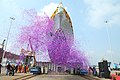 INS Arnala launch
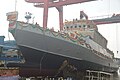 INS Androth launch
 Androth during contractor trials.
 INS Andoth During sea trials
 INS Anjadip Launched


See also
References
External links
Wikiwand - on
Seamless Wikipedia browsing. On steroids.
Remove ads