Top Qs
Timeline
Chat
Perspective
Equisetum arvense
Species of horsetail From Wikipedia, the free encyclopedia

Remove ads
Equisetum arvense, commonly known as field horsetail or common horsetail, is a species of vascular plant in the horsetail family Equisetaceae. Like all horsetails, it is a type of fern. It is native throughout the arctic and temperate regions of the Northern Hemisphere. It has two distinct growth forms, a fertile spore-bearing stem and a sterile green stem. It is sometimes confused with mare's tail, Hippuris vulgaris.


Remove ads
Description
Summarize
Perspective
Equisetum arvense is a perennial herbaceous plant that spreads by means of an underground rhizome. The slender, felted rhizome freely forks and bears stem tubers. The species is dimorphic, that is, it exhibits two distinct growth forms, both arising from the same rhizome. Fertile spore-bearing stems begin to appear in April. After shedding its spores, a fertile stem promptly whithers and dies. Sterile green stems appear around the same time but last throughout the summer until the first frosts of autumn.[2][3][4]
The erect or prostrate sterile stems are 10–90 cm (3.9–35.4 in) tall and 3–5 mm (0.12–0.20 in) diameter, with jointed segments around 2–5 cm (0.79–1.97 in) long with whorls of side shoots at the segment joints; the side shoots have a diameter of about 1 mm (0.039 in). Some stems can have as many as 20 segments. The solid and simple branches are ascending or spreading, with sheaths that bear attenuate teeth. The off-white fertile stems are of a succulent texture, 10–25 cm (3.9–9.8 in) tall and 3–5 mm (0.12–0.20 in) diameter, with 4–8 whorls of brown scale leaves and an apical brown spore cone. The cone is 10–40 mm (0.39–1.57 in) long and 4–9 mm (0.16–0.35 in) broad.[2] The fertile stems are typically precocious and appear in early spring.[5] It has changed little from its ancestors of the Carboniferous period.
E. arvense is a nonflowering plant, multiplying through spores. It absorbs silicon from the soil, which is rare among herbs.[citation needed] It has a very high diploid number of 216 (108 pairs of chromosomes).[2]
Remove ads
Taxonomy
Linnaeus described field horsetail with the binomial Equisetum arvense in his Species Plantarum of 1753.[6] The specific epithet arvense is from the Latin "arvum", meaning "ploughed", referencing the growth of the plant in arable soil or disturbed areas. The common name "common horsetail" references the appearance of the plant that when bunched together appears similar to a horse's tail.[7]
Many species of horsetail have been described and subsequently synonymized with E. arvense. One of these is E. calderi, a small form described from Arctic North America.[8]
Names
Some other common names include bottle-brush, devil's-guts, foxtail-rush, horse pipes, horsetail fern, meadow-pine, pine-grass, and snake-grass.[9] It is also known as marestail, primarily in the UK,[10] but this common name is also used for the flowering aquatic plant Hippuris vulgaris and the common North American weed Erigeron canadensis.[11][12]
Remove ads
Distribution and habitat
Equisetum arvense grows in a wide range of conditions, in temperatures less than 5 °C (41 °F) to greater than 20 °C (68 °F) and in areas that receive annual rainfall as low as 100 mm (3.9 in) and as great as 2,000 mm (79 in). It commonly occurs in damp and open woodlands, pastures, arable lands, roadsides, disturbed areas, and near the edge of streams. It prefers neutral or slightly basic clay loams that are sandy or silty, especially where the water table is high, though it can occur occasionally on slightly acid soils.[7]
The plant is widespread in the Northern Hemisphere, growing as far as 83° North in North America and 71° North in Norway, Sweden, Finland, and Russia and as far south as Texas, India and Iran. It is less widespread in the Southern Hemisphere, but it occurs in Argentina, Brazil, Chile, Madagascar, Indonesia, and Australia.[7] It was introduced into New Zealand in the 1920s where it was identified as an invasive species by Ella Orr Campbell in 1949.[13] It is listed on the National Pest Plant Accord, prohibiting its sale, spread and cultivation.[14]
Toxicity
Equisetum arvense is toxic to livestock, particularly horses.[15] It is difficult to control due to its extensive underground rhizomes,[16] which can penetrate the soil up to 6 feet (1.8 m) deep. Fire, mowing, or slashing are ineffective since new stems quickly grow from the rhizomes. Some herbicides remove aerial growth but regrowth quickly occurs albeit with a reduction in frond density.[7]
Remove ads
Uses
Summarize
Perspective

Medicine
The plant contains several substances that can be used medicinally. It is rich in silicon (2-3%),[citation needed] potassium, calcium, manganese, magnesium and phosphorus, phytosterols, dietary fiber, vitamins A, E and C, tannins, alkaloids, saponins, flavonoids, glycosides and caffeic acid phenolic ester. The buds are eaten as a vegetable in Japan and Korea in spring. All other Equisetum species are toxic.[citation needed] In polluted conditions[citation needed], it may synthesize nicotine.[17]
Recent research has shown limited evidence of anti-inflammatory, diuretic, antimicrobial, and antioxidant properties. [18]
Craft production
It was also once used to polish pewter and wood (gaining the name pewterwort) and to strengthen fingernails. It is also an abrasive. It was used by hurdy-gurdy players to dress the wheels of their instruments by removing resin build up.[19]
Horticultural and agricultural
In horticulture and agriculture, an aqueous extract of E. arvense has been approved for use as a fungicide in the European Union and the United Kingdom (since Brexit).[20] Horsetail extract can be used to prevent fungal pathogens on crops including:[21]
- Damping off (Pythium) and powdery mildew on cucumbers.
- Various fungal diseases of fruit trees, including scab (Venturia inaequalis), mildew, and peach leaf curl (Taphrina deformans).
- Both downy and powdery mildew on grapevines.
- Early blight (Alternaria solani) and Septoria blight (Septoria lycopersici) on tomatoes.
- Grey mould, powdery mildew, red core, and anthracnose fruit rot (Colletotrichum acutatum) in strawberries.
- Early blight, late blight, and powdery mildew on potatoes.
Equisetum is used in biodynamic farming (preparation BD 508) in particular to reduce the effects of excessive water around plants (such as fungal growth). The high silica content of the plant reduces the impact of moisture.[22]
Traditional medicine
E. arvense has been used in traditional Austrian herbal medicine internally as tea, or externally as baths or compresses, for treatment of disorders of the skin, locomotor system, kidneys and urinary tract, rheumatism and gout.[citation needed]
Externally it was traditionally used for chilblains and wounds.[23]
In Finnish traditional medicine, E. arvense (Finnish: peltokorte) has been especially valued for its high concentration of silicic acid and has been seen to help and been used in a number of ways:
- Green summer shoots, dried, as a remedy.
- Seen as preventing inflammation, strengthening skin and immune system.
- A decoction of E. arvense has been used internally to treat all kinds of lung diseases and externally to treat rashes and hard-to-treat wounds.[24]
In Iran, infusion of its shoots is believed to be a remedy against diabetes and obesity.[25]
Remove ads
Gallery
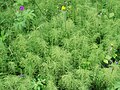 Equisetum arvense in Iceland
 Fertile shoots, in late April
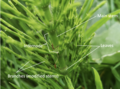 A sterile stem of Equisetum arvense, showing its leaves, stems and internodes
 Stem print of Equisetum arvense showing surface structure and stomata, 400x


References
External links
Wikiwand - on
Seamless Wikipedia browsing. On steroids.
Remove ads