Top Qs
Timeline
Chat
Perspective
Tuba
Brass instrument From Wikipedia, the free encyclopedia

Remove ads
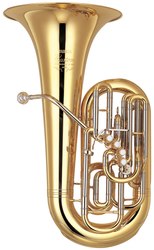
The tuba (Latin, "trumpet";[1] UK: /ˈtjuːbə/;[2] US: /ˈtuːbə/) is a large brass instrument in the bass-to-contrabass range with a wide, bugle-like conical bore and between three and six (usually four or five) valves. It first appeared in 1835 in Prussia as the Baß-Tuba, an application of five valves to a bugle scaled up to 12-foot (12′) F, providing a fully chromatic contrabass range with a deep, full timbre.[3][4] Subsequently, the Paris maker Adolphe Sax developed the E♭ and B♭ band tubas with piston valves as members of his saxhorn family by the 1850s, and Václav František Červený in Austria-Hungary developed contrabass tubas in 16′ C and 18′ B♭ with rotary valves in the 1870s.
 | This article needs additional citations for verification. (October 2019) |

As with any brass instrument, sound is produced with a lip vibration or "buzz" in the mouthpiece. A person who plays the tuba is called a tubaist or tubist,[5] or simply a tuba player. In British brass bands and military bands, they are known as a bass player.
Remove ads
History
Summarize
Perspective
The early history of the tuba was the search for a practical valved brass instrument with a bass and contrabass voice, suitable for use in bands and the orchestra brass section.[6] Before the emergence of the first valves in the 1820s, brass instruments were either restricted to a single harmonic series like the natural trumpet or bugle, or used a slide like the trombone, or used keys and tone holes like the keyed bugle or serpent.
Origins


Euphonium ancestors: serpent, late 18th century, left; ophicleide by Gautrot, mid-19th century, right. Museo Civico di Modena; University of Edinburgh
For the earliest low-pitched brass instruments, none of these solutions were ideal. Natural instruments can only approach diatonic or chromatic scales in their high register, bass trombones had long slides with handles which were unwieldy for rapid passages, and the timbre of the serpent was often criticized.[7]
To replace the serpent and its various upright derivatives, the Paris-based maker Jean Hilaire Asté invented the ophicleide in 1817, extending the keyed bugle into the bass register with a folded, bassoon-like form.[8] It was a sufficient improvement, in both intonation and timbre, that it was widely adopted in brass and military bands. It was also used in the orchestra particularly by French composers, most notably Hector Berlioz.[9] Although the ophicleide was initially successful, and serpents were still being used in bands and church ensembles, neither instrument could play much below C₂ into the contrabass range.[9]
The first tubas
In Prussia, the military bandmaster Wilhelm Friedrich Wieprecht required an instrument capable of a secure contrabass compass for his bands, and with the Berlin-based instrument maker Johann Gottfried Moritz invented the Baß-Tuba in F (Prussian patent 9121, granted 12 September 1835). It used five Berlinerpumpen valves (forerunners of the modern Périnet piston valves) to provide a chromatic compass down to F₁, its first fundamental or pedal tone.[10] Berlin valves, invented by Wieprecht two years earlier, were capable of operating on the wider bore tubing of larger instruments than the earlier Stölzel and Vienna valve designs. This contributed to the Baß-Tuba being the first successful contrabass valved brass instrument.[11] The first tenor tuba was invented in 1838 by Moritz's son, Carl Wilhelm Moritz, which was a forerunner of the euphonium.[12]
Paris-based instrument maker Adolphe Sax, like Wieprecht, was interested in marketing families of instruments ranging from soprano to bass, and developed his saxhorn series of brass instruments, pitched in E♭ and B♭. Sax's instruments gained dominance in French military bands, and later in Britain and America. Their widespread success was a result of the movements of popular instrument makers, notably Gustave Auguste Besson, who moved from Paris to London, and Henry Distin, who started manufacturing them in London, and later moved his business to the United States.[13][14] The saxhorns in E♭ and B♭ constitute almost the whole instrumentation of the modern British brass band, with the addition of cornets, trombones and a flugelhorn.[15] Modern E♭ and B♭ band tubas are not far removed from their contrabass saxhorn ancestors, differing only in having a wider conical bore and often adding a compensating fourth valve.
The helicon is thought to have first appeared in Russia in the mid-1840s, and first patented in 1848 in Vienna by Stowasser. Like the Ancient Roman buccina, its tubing is wrapped under the right arm with the bell resting on the player's left shoulder. The helicon also became popular throughout Europe and North America, particularly for its suitability for marching and mounted bands.[16]
Early American tubas

.jpg)
Early American tubas: Over-the-shoulder bass saxhorn in E♭ built c. 1870s, left; sousaphone in low B♭ built c. 1925, right. Metropolitan Museum of Art; Musikinstrumenten-Museum Berlin
In the United States saxhorns had become popular by the mid-19th century, particularly in military and brass bands. In 1838, the New York maker Allen Dodworth patented his "over-the-shoulder" (OTS) instruments, with bells pointing backwards over the player's left shoulder, that included an E♭ bass model.[17] This design allowed soldiers, usually marching behind the band, to better hear the music.[18] Demand for bugles and OTS saxhorns grew, particularly in the early 1860s during the American Civil War, and tens of thousands were made in the United States or imported from Europe. After the war, the bands and their music remained popular, and manufacturing demand remained strong.[19] From these ensembles and musicians emerged the American drum and bugle corps tradition,[20] and the mixed-winds concert bands popularised by Patrick Gilmore and John Philip Sousa.[21]
In 1893, Sousa, unhappy with the sound from his BB♭ contrabass helicon tubas, had the Philadelphia instrument maker J. W. Pepper build a helicon with an upward-pointing bell, to better diffuse the sound. This sousaphone model was later made by the American manufacturers Holton and C. G. Conn, who some time in the early 20th century turned the bell forward to create the iconic modern form.[22]
The tuba in Italy
The Italian word cimbasso, thought to be a contraction of the term corno basso (lit. 'bass horn'), first appeared in scores as c. basso or c. in basso in the 1820s. Initially the cimbasso was a form of upright serpent or bass horn, but over the course of the 19th century the term was used loosely to refer to the lowest bass instrument available in the brass family, including the ophicleide and early Italian valved instruments such as the pelittone and bombardone.[23] The Italian opera composer Giuseppe Verdi, dissatisfied with the sound of these instruments, commissioned a valved contrabass trombone, built in the 1880s for his late operas.[24] By the early 20th century this instrument, which he and Giacomo Puccini called simply the trombone basso in their scores, had disappeared from Italian orchestras, replaced by the tuba. The modern cimbasso, commonly called for in film and video game soundtracks, was revived from Verdi's instrument, via the German contrabass trombone in F, in the early 1980s.[25]
Remove ads
Role
Summarize
Perspective
An orchestra usually has a single tuba, though an additional tuba may be requested. It serves as the bass of the orchestral brass section[26] and it can reinforce the bass voices of the strings and woodwinds. It provides the bass of brass quintets and choirs (though many small brass ensembles will use the euphonium or bass trombone as the lowest voice). It is the principal bass instrument in concert bands, brass bands and military bands, and those ensembles generally have two to four tubas. It is also a solo instrument.
Tubas are used in marching bands, drum and bugle corps and in many jazz bands (see below). In British style brass bands, two E♭ and two B♭ tubas are used and are referred to as basses.[27][28]
Well known and influential parts for the tuba include:
- Modest Mussorgsky (orch. Ravel): Pictures at an Exhibition – Bydło, Night on Bald Mountain
- Richard Strauss: Also sprach Zarathustra, Eine Alpensinfonie, Till Eulenspiegel, Ein Heldenleben
- Shostakovich: All symphonies, except the Fourteenth
- Stravinsky: The Rite of Spring, Petroushka
- Edgard Varèse: Déserts
- Richard Wagner: Die Meistersinger von Nürnberg, Lohengrin, Ride of the Valkyries, Faust Overture
- Sergei Prokofiev: Fifth Symphony, Romeo and Juliet
- George Gershwin: An American in Paris
- Silvestre Revueltas: Sensemayá, La noche de los mayas, Homenaje a Federico García Lorca
- Gustav Holst: The Planets
- Gustav Mahler: Symphonies Nos. 1, 2, 5, 6, and 8
- Ottorino Respighi: Fountains of Rome, Pines of Rome
- Hector Berlioz: Symphonie fantastique, Hungarian March
- Paul Hindemith: Symphonic Metamorphosis
- Johannes Brahms: Symphony No. 2
- Anton Bruckner: Symphonies Nos. 4, 7, and 8
Concertos have been written for the tuba by many notable composers, including Ralph Vaughan Williams (Tuba Concerto), Edward Gregson, John Williams, Alexander Arutiunian, Eric Ewazen, James Barnes, Joseph Hallman, Martin Ellerby, Philip Sparke,[29] Kalevi Aho, Josef Tal, Bruce Broughton (Tuba Concerto), John Golland, Roger Steptoe, David Carlson, Jennifer Higdon (Tuba Concerto), and Marcus Paus (Tuba Mirum).
Remove ads
Types and construction
Summarize
Perspective

Tubas are found in various pitches, most commonly in F, E♭, C, or B♭. The key of a tuba depends on the fundamental pitch of the instrument, or fundamental note in the series of overtones (also called partials) available without any valves being pressed. Tubas in different keys use different lengths of tubing. The main tube of a B♭ tuba is approximately 18 feet (5.5 m) long, while that of a C tuba is 16 feet (4.9 m), of an E♭ tuba 13 feet (4.0 m), and of an F tuba 12 feet (3.7 m). The instrument has a conical bore, meaning the bore diameter increases as a function of the tubing length from the mouthpiece to the bell. The conical bore causes the instrument to produce a preponderance of even-order harmonics.
A tuba with its tubing wrapped for placing the instrument on the player's lap is usually called a concert tuba or simply a tuba. Tubas with the bell pointing forward (pavillon tournant) instead of upward are often called recording tubas because of their popularity in the early days of recorded music, as their sound could more easily be directed at the recording microphone. When wrapped to surround the body for cavalry bands on horseback or marching, it is traditionally known as a helicon. The modern sousaphone, named after American bandmaster John Philip Sousa, is a helicon with the bell pointed up (in the original models as the J. W. Pepper prototype and Sousa's concert instruments) and then curved to point forward (as developed by Conn and others). Some ancestors of the tuba, such as the military bombardon, had unusual valve and bore arrangements compared to modern tubas.
Most music for the tuba is written in bass clef in concert pitch, so tuba players must know the correct fingerings for their specific instruments. Traditional British-style brass band parts for the tuba are usually written in treble clef, with the B♭ tuba sounding two octaves and one step below and the E♭ tuba sounding one octave and a major sixth below the written pitch. This allows musicians to change instruments without learning new fingerings for the same written music. Consequently, when its music is written in treble clef, the tuba is a transposing instrument but not when the music is in bass clef.
The lowest pitched tubas are the contrabass tubas, pitched in C or B♭, referred to as CC and BB♭ tubas respectively, based on a traditional distortion of a now-obsolete octave naming convention. The fundamental pitch of a CC tuba is 32 Hz, and for a BB♭ tuba, 29 Hz. The CC tuba is used as an orchestral and concert band instrument in the U.S., but BB♭ tubas are the contrabass tuba of choice in German, Austrian, and Russian orchestras. In the United States, the BB♭ tuba is the most common in schools (largely due to the use of BB♭ sousaphones in high school marching bands) and for adult amateurs. Many professionals in the U.S. play CC tubas, with BB♭ also common, and many train in the use of all four pitches of tubas.[30]

The next smaller tubas are the bass tubas, pitched in F or E♭ (a fourth above the contrabass tubas). The E♭ tuba often plays an octave above the contrabass tubas in brass bands, and the F tuba is commonly used by professional players as a solo instrument and, in America, to play higher parts in the classical repertoire (or parts that were originally written for the F tuba, as is the case with Berlioz). In most of Europe, the F tuba is the standard orchestral instrument, supplemented by the CC or BB♭ only when the extra weight is desired. Wagner, for example, specifically notates the low tuba parts for Kontrabasstuba, which are played on CC or BB♭ tubas in most regions. In the United Kingdom, the E♭ is the standard orchestral tuba.
The euphonium is sometimes referred to as a tenor tuba and is pitched in B♭, one octave higher than the BB♭ contrabass tuba. The term "tenor tuba" is often used more specifically to refer to B♭ rotary-valved tubas pitched in the same octave as euphoniums. The "Small Swiss Tuba in C" is a tenor tuba pitched in C, and provided with 6 valves to make the lower notes in the orchestral repertoire possible. The French C tuba was the standard instrument in French orchestras until overtaken by F and C tubas since the Second World War. One popular example of the use of the French C tuba is the Bydło movement in Ravel's orchestration of Mussorgsky's Pictures at an Exhibition, though the rest of the work is scored for this instrument as well.
A very small number of larger subcontrabass tubas exist as novelty instruments. Two in 36′ B♭, an octave below the B♭ contrabass, were built by Gustave Besson on the suggestion of Patrick Gilmore, but were not completed until after his death in 1892. One survives in the Harvard University Band, where it was restored and features occasionally in concerts.[31] Another with four valves was exhibited by maker Bohland & Fuchs in 1928, 280 centimetres (110 in) in height with a 130-centimetre (50 in) bell, weighing 91 kilograms (200 lb).[32] In 1956, British musician Gerard Hoffnung used a 32′ C subcontrabass tuba, built c. 1899 by German maker Rudolf Sander, in the first of his comedy Hoffnung Music Festivals.[31] In 2010, a fully playable Riesentuba in 36′ B♭ with four rotary valves was built and resides in the Markneukirchen Musical Instrument Museum, Germany.[33]
Size vs. pitch
In addition to the length of the instrument, which dictates the fundamental pitch, tubas also vary in the overall width of the tubing sections. Tuba sizes are usually denoted by a quarter system, with 4⁄4 designating a normal, full-size tuba. Larger rotary instruments are known as kaiser tubas and are often denoted 5⁄4. Larger piston tubas, particularly those with front action, are sometimes known as grand orchestral tubas (examples: the Conn 36J Orchestra Grand Bass from the 1930s, and the current model Hirsbrunner HB-50 Grand Orchestral, which is a replica of the large York tubas owned by the Chicago Symphony Orchestra). Grand orchestral tubas are generally described as 6⁄4 tubas. Smaller instruments may be described as 3⁄4 instruments.

No standards exist for these designations, and their use is up to manufacturers, who usually use them to distinguish among the instruments in their own product line. The size designation is related to the larger outer branches and not to the bore of the tubing at the valves, though the bore is usually reported in instrument specifications. The quarter system is also not directly related to bell size, though there is typically a correlation. 3⁄4 tubas are common in American grade schools for use by young tuba players for whom a full-size instrument might be too cumbersome. Though smaller and lighter, they are tuned and keyed identically to full-size tubas of the same pitch, although they usually have 3 rather than 4 or 5 valves.
Valves
Tubas are made with either piston or rotary valves. Rotary valves, invented in Prussia by Joseph Riedl, were first used on tubas by Václav František Červený of Graslitz in the 1850s. Modern piston valves were developed by François Périnet, and replaced the Berlin valves on early saxhorn family instruments promoted by Adolphe Sax around the same time. Pistons can be top-action, oriented vertically so the buttons are operated at the top of the instrument, or front-action or side-action, oriented horizontally so the buttons are at the front of the instrument, operated from the side.
Piston valves require more maintenance than rotary valves. They require regular oiling to keep them freely operating, while rotary valves are sealed, and seldom require oiling. Piston valves are easy to dismantle and reassemble, while rotary valve disassembly and reassembly is much more difficult and generally left to instrument repair technicians.
Tubas generally have from three to six valves, though some rare exceptions exist. Three-valve tubas are generally the least expensive and are mostly used by amateurs, and the sousaphone usually has three valves. Among advanced players, four and five valve tubas are by far the most common choices, with six-valve tubas being relatively rare except among F tubas, which mostly have five or six valves.

The valves add tubing to the main tube of the instrument, thus lowering its fundamental pitch. The first valve lowers the pitch by a whole step (two semitones), the second valve by a semitone, and the third valve by three semitones. Used in combination, the valve tubing is too short and the resulting pitch tends to be sharp. For example, a BB♭ tuba becomes (in effect) an A♭ tuba when the first valve is depressed. The third valve is long enough to lower the pitch of a BB♭ tuba by three semitones, but it is not long enough to lower the pitch of an A♭ tuba by three semitones. Thus, the first and third valves used in combination lower the pitch by something just short of five semitones, and the first three valves used in combination are nearly a quarter tone sharp.
The fourth valve lowers the pitch by a perfect fourth, so it can be used in place of the combination of the first and third valves. When tuned properly it helps solve the issue of valve combinations being too sharp. Using the fourth valve with the first three valves allows the musician to extend the instrument's range down to the fundamental pitch. As with other valve combinations that lengthen the tubing considerably, some of these lower notes can be sharp.
A fifth and sixth valve, if fitted, are used to provide alternative fingering possibilities to improve intonation, and are also used to reach into the low register of the instrument where all the valves will be used in combination to fill the first octave between the fundamental pitch and the next available note on the open tube. The fifth and sixth valves also give the musician the ability to trill more smoothly or to use alternative fingerings for ease of playing. This type of tuba is what is most found in orchestras and wind bands around the world.
The bass tuba in F is pitched a fifth above the BB♭ tuba and a fourth above the CC tuba, so it needs additional tubing length beyond that provided by four valves to play securely down to a low F as required in much tuba music. The fifth valve is commonly tuned to a flat whole step, so that when used with the fourth valve, it gives an in-tune low B♭. The sixth valve is commonly tuned as a flat half step, allowing the F tuba to play low G as 1-4-5-6 and low G♭ as 1-2-4-5-6. In CC tubas with five valves, the fifth valve may be tuned as a flat whole step or as a minor third depending on the instrument.
Compensating valves
Some tubas have a compensating system to allow accurate tuning when using several valves in combination, simplifying fingering and removing the need to constantly adjust slide positions. The most popular of the automatic compensation systems was invented by Blaikley (Bevan, 1874) and was patented by Boosey (later, Boosey and Hawkes, which also, later still, produced Besson instruments). The patent on the system limited its application outside of Britain, and tubas with compensating valves are primarily popular in the United Kingdom and British Commonwealth countries.
The Blaikley design plumbs the instrument so that if the fourth valve is used, the air is sent back through a second set of branches in the first three valves to compensate for the combination of valves. This does have the disadvantage of making the instrument significantly more "stuffy" or resistant to air flow when compared to a non-compensating tuba. This is due to the need for the air to flow through the valves twice. It also makes the instrument heavier. But many prefer this approach to having additional valves – or to the manipulation of tuning slides while playing – to achieve improved intonation within an ensemble.
Most modern professional-grade euphoniums also now feature Blaikley-style compensating valves.[34]
Resonance and false tones
Some tubas have a strong and useful resonance that is not in the well-known harmonic series. For example, most large B♭ tubas have a strong resonance at low E♭ (E♭1, 39 Hz), which is between the fundamental and the second harmonic (an octave higher than the fundamental). These alternative resonances are often known as false tones or privileged tones. Adding the six semitones provided by the three valves, these alternative resonances let the instrument play chromatically down to the fundamental of the open bugle (which is a 29 Hz B♭0). The addition of valves below that note can lower the instrument a further six semitones to a 20 Hz E0. Thus, even three-valved instruments with good alternative resonances can produce very low sounds in the hands of skilled players; instruments with four valves can play even lower.
The lowest note in the widely known repertoire is a 16 Hz double-pedal C0 in the William Kraft piece Encounters II, which is often played using a timed flutter tongue rather than by buzzing the lips. The fundamental of this pitch borders on infrasound and its overtones define the pitch in the listener's ear.
Materials and finish
The tuba is generally constructed of brass, which is either unfinished, lacquered or electro-plated with nickel, gold or silver. Unfinished brass will eventually tarnish and thus must be periodically polished to maintain its appearance.[35]
Manufacturers
There are many types of tubas that are manufactured in Europe, the United States, and Asia. In Europe, the predominant models that are professionally used are Meinl-Weston (Germany) and Miraphone (Germany). Asian brands include the Yamaha Corporation (Japan) and Jupiter Instruments (Taiwan). Holton Instrument Company and King Musical Instruments are some of the most well known brands from the United States.[36]
Remove ads
Variations
Summarize
Perspective
Some tubas are capable of being converted into a marching style, known as "marching tubas". A leadpipe can be manually screwed on next to the valves. The tuba is then usually rested on the left shoulder (although some tubas allow use of the right shoulder), with the bell facing directly in front of the player. Some marching tubas are made only for marching, and cannot be converted into a concert model.
In North America, most marching bands use the sousaphone, which is designed to be easier to hold and play while marching.[37] The earlier helicon is still used by bands in Europe and other parts of the world. Drum and bugle corps players generally use marching tubas or contrabass bugles.
Standard tubas can also be played whilst standing and marching, which is the usual practice in British brass bands and military bands. With the comfort of the player in mind, companies have provided harnesses that sometimes use a strap joined to the tuba with two rings, a 'sack' to hold the bottom of the tuba, or numerous straps holding the larger parts of tubing on the tuba. The strap(s) goes over the shoulder like a sash or sit at the waist, so the musician can play the instrument in the same position as when sitting.
Remove ads
Jazz

The tuba has been used in jazz since the genre's inception. In the earliest years, bands often used a tuba for outdoor playing and a double bass for indoor performances. In this context, the tuba was sometimes called "brass bass", as opposed to the double bass (string bass). Many musicians played both instruments.
This practice was mostly used in the New Orleans jazz scene. The tuba was used most frequently with the Louis Armstrong groups and prominent in the album Hot Five.
In modern jazz, it is not unknown for their players to take solos. New Orleans style brass bands like the Dirty Dozen Brass Band and the Rebirth Brass Band use a sousaphone as the bass instrument. Bill Barber played tuba on several Miles Davis albums, including the sessions compiled as the Birth of the Cool and Miles Ahead. New York City-based tubist Marcus Rojas performed frequently with Henry Threadgill.[38] Starting in 1955, Stan Kenton made his fifth trombonist double on tuba, namely on ballads to make use of the tuba's distinct warm, enveloping sound.[39]
Remove ads
See also
References
Bibliography
External links
Wikiwand - on
Seamless Wikipedia browsing. On steroids.
Remove ads