Top Qs
Timeline
Chat
Perspective
Deodoro da Fonseca
President of Brazil from 1889 to 1891 From Wikipedia, the free encyclopedia

Remove ads
Manuel Deodoro da Fonseca (Brazilian Portuguese pronunciation: [mɐnuˈɛw deoˈdɔɾu da fõˈsekɐ]; 5 August 1827 – 23 August 1892) was a Brazilian politician and military officer who served as the Head of Provisional Government and the first president of Brazil. He was born in Alagoas in a military family, followed a military career, and became a national figure. Fonseca took office as provisional president after heading a military coup that deposed Emperor Pedro II and established the First Brazilian Republic in 1889, disestablishing the Empire. After his election in 1891, he stepped down the same year under great political pressure when he dissolved the National Congress. He died less than a year later.
 | You can help expand this article with text translated from the corresponding article in Portuguese. (March 2024) Click [show] for important translation instructions.
|
 | This article includes a list of general references, but it lacks sufficient corresponding inline citations. (May 2020) |
.jpg)

Remove ads
Early life
Summarize
Perspective
Birth and family
Fonseca was born on 5 August 1827 in the city of Alagoas in the Empire of Brazil. He was the son of Lieutenant Colonel Manuel Mendes da Fonseca and his wife, Rosa Maria Paulina da Fonseca. Simmons notes that the origin of the Fonseca family could possibly be dated back to Dutch Brazil.[1]
Mendes Fonseca is an obscure figure, whose only information comes from Ministry of War archives. His original surname was Galvão, but took on his mother's surname, Fonseca, instead, likely as the result a family argument. He started off his military career by joining the infantry corps of Recife on 25 September 1806. His military career spanned four periods of Brazilian politics: The Viceroyalty of Brazil; the Kingdom of Brazil; the First reign of Pedro I; and the Regency period.[2]
He was the military officer in charge of the province of Alagoas in 1831. During the last days of Emperor Pedro I's reign, he was promoted to Lieutenant Colonel, and took charge of the 16th Infantry Battalion. A few years after the emperor's abdication, he was suspected of remaining loyal to Pedro I and lost his military rank. He regained the government's trust in 1836, and took command of Imperial troops during the revolt of the Cabanada. In 1839, he participated in a failed rebellion against the transfer of the provincial capital from Alagoas (the city) to Maceió. He was put under trial following his defeat on 13 November, and imprisoned for 6 months until his release on 26 May 1840.[3] The populace of Alagoas elected him to a public office as appreciation for his efforts to prevent Alagoas from being replaced as the provincial capital. His military career ended in 1946, and he retired to private life soon after.[4]
Júnior believes that the 1839 revolt was a truamatizing event for young Deodoro, influencing his later indecision in the days leading up to the Proclamation of the Republic.[5]
Remove ads
Military career
In 1843, Deodoro entered military school, following in the footsteps of his 7 siblings who had distinguished themselves in military service. The Fonseca family has been referred to by historians as the "Seven Swords of Alagoas"[6]
Political career
Summarize
Perspective
As Governor of Rio Grande do Sul, Fonseca was courted by republican intellectuals such as Benjamin Constant and Ruy Barbosa in the café society of São Paulo. In 1886, alerted that the imperial government was ordering the arrest of prominent republicans, Fonseca went to Rio de Janeiro and assumed leadership of the army faction that supported the abolition of slavery in Brazil.
Emperor Pedro II had advocated the abolition of slavery for decades, freeing his own slaves in 1840, but he believed slavery should be done away with slowly to avoid damaging the Brazilian economy. The government, nominally headed by his daughter, Isabel, Princess Imperial of Brazil, abolished slavery entirely in 1888, during her third regency while her father was away from the country. Enraged oligarchs played a role in the subsequent coup d'état. Fonseca's prestige placed him at the head of the military coup that deposed the emperor on 15 November 1889, and he was briefly the head of the provisional government that called a Constituent Congress to draft a new constitution for a republic. Soon, however, he was in conflict with the civilian republican leaders. His election as president on 25 February 1891, by a narrow plurality, was backed with military pressure on Congress.
Provisional Government and Presidency of Brazil
Summarize
Perspective
The Fonseca administration, divided by political and personal animosity between Fonseca and Vice President Floriano Peixoto, encountered strong opposition within Congress, which chose a policy of obstruction. During the first months of his presidency, he permitted his ministers almost unrestricted control of their ministries.[7] Arbitrary presidential decrees, such as the concession of the port of Torres to a private company and Decree 528, which opened the country to further immigration except by Africans, as well as the disastrous conduct of economic policy during the bubble of the Encilhamento, strengthened the resistance in Congress, which coalesced around Peixoto and soured public opinion. That also caused republicans in the South to withdraw their support from the marshal and provisional government.[8] The situation reached a crisis stage when Fonseca dissolved the National Congress and declared a "state of emergency" on 3 November 1891. A group of deputies opposed the decision and found support among the high-ranking officers of the Navy, including Admiral Custódio José de Melo. The marshal found himself on the brink of a civil war. On 23 November 1891, he signed a resignation to no one in particular and turned over the presidency to Peixoto.
Remove ads
Death
He died in Rio de Janeiro on 23 August 1892. He was stricken with perilous bouts of dyspnea, popularly referred to as "shortness of breath", and was buried in a family grave in the Caju Cemetery. However, in 1937, his remains were unearthed and transferred to a monument in Praça Paris, Rio de Janeiro.
Gallery
- Deodoro da Fonseca in art

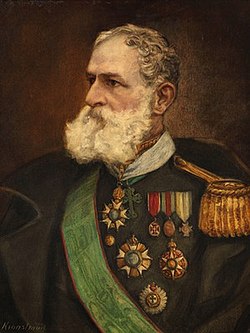 Marshal Fonseca in 1889, by Bror Kronstrand
 Fechamento do Congresso by Angelo Agostini (1892)
 Tomb monument of Deodoro da Fonseca in Rio de Janeiro.
 Marechal Deodoro da Fonseca engraved by Modesto Brocos (1890)


,_da_Coleção_Brasiliana_Iconográfica.jpg)
In popular culture
Fonseca has been portrayed twice by Brazilian actor and voice actor Castro Gonzaga in the miniseries Abolição (1988) and República (1989) respectively.
See also
Notes
References
Bibliography
External links
Wikiwand - on
Seamless Wikipedia browsing. On steroids.
Remove ads