Top Qs
Timeline
Chat
Perspective
Holevo's theorem
Upper bound on the knowable information of a quantum state From Wikipedia, the free encyclopedia
Remove ads
Holevo's theorem is a result in quantum information theory. It is sometimes called Holevo's bound, since it gives an upper bound on the accessible information, which is amount of information that can be known about a quantum state. It was first published by Alexander Holevo in 1973.
Statement
Setting
Suppose Alice wants to send a classical message to Bob by encoding it into a quantum state, and suppose she can prepare a state from some fixed set , with the i-th state prepared with probability . Let be the classical register containing the choice of state made by Alice. Bob's objective is to recover the value of by measuring a POVM on the state he received. Let be the classical register containing Bob's measurement outcome, which is a random variable whose distribution depends on Bob's choice of measurement.


Holevo's theorem bounds the amount of correlation between the classical registers and , independently of Bob's measurement choice, in terms of the Holevo information. The Holevo information does not depend on the measurement choice, and so this gives a bound which does not require optimizing over all possible measurements.
Precise statement
Define the accessible information between and as the (classical) mutual information between the two registers maximized over all possible choices of Bob's measurements: where is the classical mutual information of the joint probability distribution given by . There is no known formula for the accessible information in general. However, there is always an upper bound where is the ensemble of states Alice uses to send information, and is the von Neumann entropy. The quantity is called the Holevo information or Holevo χ quantity.

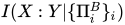


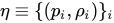


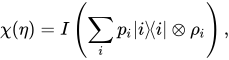
The Holevo information is also equal to the quantum mutual information of the classical-quantum state corresponding to the ensemble:where the quantum mutual information of the bipartite state . Holevo's theorem can also be stated as a bound on the accessible information in terms of the quantum mutual information of a classical-quantum state.


Remove ads
Proof
Summarize
Perspective
Consider the composite system that describes the entire communication process, which involves Alice's classical input , the quantum system , and Bob's classical output . The classical input can be written as a classical register with respect to some orthonormal basis . By writing in this manner, the von Neumann entropy of the state corresponds to the Shannon entropy of the probability distribution :





The initial state of the system, where Alice prepares the state with probability , is described by


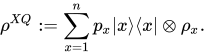
Afterwards, Alice sends the quantum state to Bob. As Bob only has access to the quantum system but not the input , he receives a mixed state of the form . Bob measures this state with respect to the POVM elements , and the probabilities of measuring the outcomes form the classical output . This measurement process can be described as a quantum instrument




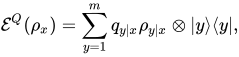
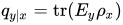
where is the probability of outcome given the state , while for some unitary is the normalised post-measurement state. Then, the state of the entire system after the measurement process is



![{\displaystyle \rho ^{XQ'Y}:=\left[{\mathcal {I}}^{X}\otimes {\mathcal {E}}^{Q}\right]\!\left(\rho ^{XQ}\right)=\sum _{x=1}^{n}\sum _{y=1}^{m}p_{x}q_{y|x}|x\rangle \langle x|\otimes \rho _{y|x}\otimes |y\rangle \langle y|.}](http://wikimedia.org/api/rest_v1/media/math/render/svg/eb7bd4c52bfd1108927565e64519860aeae18c50)
Here is the identity channel on the system . Since is a quantum channel, and the quantum mutual information is monotonic under completely positive trace-preserving maps,[1] . Additionally, as the partial trace over is also completely positive and trace-preserving, . These two inequalities give






On the left-hand side, the quantities of interest depend only on

with joint probabilities . Clearly, and , which are in the same form as , describe classical registers. Hence,




Meanwhile, depends on the term


where is the identity operator on the quantum system . Then, the right-hand side is

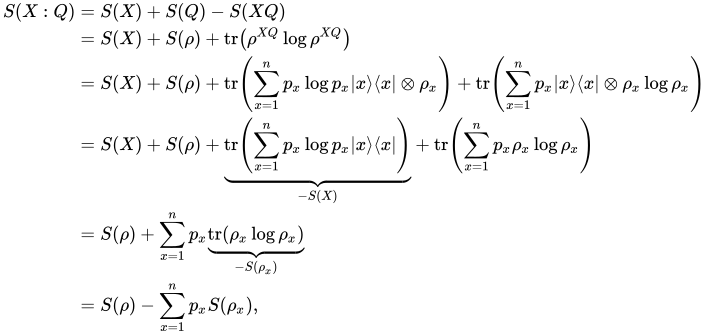
which completes the proof.
Remove ads
Comments and remarks
In essence, the Holevo bound proves that given n qubits, although they can "carry" a larger amount of (classical) information (thanks to quantum superposition), the amount of classical information that can be retrieved, i.e. accessed, can be only up to n classical (non-quantum encoded) bits. It was also established, both theoretically and experimentally, that there are computations where quantum bits carry more information through the process of the computation than is possible classically.[2]
See also
References
Further reading
Wikiwand - on
Seamless Wikipedia browsing. On steroids.
Remove ads