Top Qs
Timeline
Chat
Perspective
IMC Electric bus
Electric bus that charges from overhead wires while driving From Wikipedia, the free encyclopedia

Remove ads
IMC electric bus (In-Motion Charging electric bus[1]), also known as a battery trolleybus or trolleybus with extended autonomous run, is an electrically powered public transport vehicle that draws power from an overhead contact network (catenary) via trolley poles while simultaneously charging an on-board traction battery. This technology allows the vehicle to operate continuously: drawing power and charging while under the overhead wires, and operating as a battery electric bus on sections of the route lacking this infrastructure.[2]
.jpg)
This concept is an evolution of the traditional trolleybus, developing from vehicles with small auxiliary power units for emergency use to modern systems where vehicles can cover significant distances autonomously, often between 15 to 70 kilometres (9.3 to 43.5 mi).
IMC systems are being actively implemented by major metropolises (e.g., Beijing, Saint Petersburg, Mexico City) and in transport networks across developed countries (e.g. Switzerland, Germany, The Netherlands). Modern In-Motion Charging systems can offer significant cost advantages over fully battery-electric bus networks[3]. Studies indicate that upgrading existing trolleybus infrastructure to IMC can reduce capital costs for rolling stock by approximately 50% and lower operational expenses by around 20% over a 15-year lifecycle compared to new battery-electric bus fleets.[4]. When building an IMC system from scratch with partial overhead lines, capital expenditures can still be roughly 10% lower than a fully battery-based system, due to reduced battery capacity requirements and a smaller fleet size[5]
Remove ads
Terminology
The term In-Motion Charging (IMC) was introduced as a branding concept by Erik Lenz of Vossloh Kiepe (now Kiepe Electric) in 2014 during the trolley:motion conference in Hamburg.[6] The terminology was intended to improve the public perception of trolleybuses by highlighting their key advantage over static-charging electric buses: the ability to recharge batteries while transporting passengers, eliminating stationary charging times.
In Germany, the term BOB (Batterie-Oberleitungs-Bus, Battery-Overhead-Bus) is also used by some operators, such as in Solingen. In Arnhem (Netherlands), the concept is often referred to as Trolley 2.0.
In Russia and CIS countries, these vehicles are often referred to as a Trolleybus with Extended Autonomous Run (Russian: Троллейбус с увеличенным автономным ходом, abbreviated as TUAH) or simply an Electrobus with dynamic charging.[7]
Remove ads
History
Summarize
Perspective
Off-wire power developments
.jpg)
The concept of a trolleybus operating away from wires dates back to the early 20th century. While the word trolleybus originates from 1882, when Werner von Siemens presented an early electrically powered vehicle, the idea of off-wire capability evolved over time.
In the United States, the Public Service Company of New Jersey, in conjunction with the Yellow Coach Manufacturing Company, developed "All Service Vehicles" (ASVs) between 1935 and 1948. These were trackless trolleys capable of operating as gas-electric buses when off-wire.
From the 1980s onward, systems such as Muni in San Francisco, TransLink in Vancouver, and Beijing, among others, began purchasing trolleybuses equipped with auxiliary batteries or diesel engines to allow them to bypass route blockages or travel short distances without overhead lines.
Dual-mode buses

Before the maturation of high-capacity lithium batteries, dual-mode buses were common. These vehicles used overhead wires for electric power and a separate diesel engine for off-wire travel.
- Seattle: King County Metro used special-order articulated Breda buses in the Downtown Seattle Transit Tunnel from 1990 to 2005.
- Boston: The Massachusetts Bay Transportation Authority (MBTA) used dual-mode buses on the Silver Line (Waterfront) route from 2004 until 2023, when they were replaced by diesel hybrids and battery-electric buses.[8]
Shift to IMC
With the development of battery technology (specifically Li-ion) in recent years, the focus shifted from diesel auxiliary units to purely electric autonomy. In Shanghai, experiments began in 2006 with "capacitor energy storage" electric buses that charged at stops. By the 2010s, the "TROLLEY project" in Central Europe was established to promote sustainable trolleybus strategies, leading to the widespread adoption of In-Motion Charging to extend routes without installing additional overhead wires.[9] In 2018, Solaris Bus & Coach unveiled the "Trollino 24", a double-articulated 24-meter IMC bus designed for high-capacity routes, setting a benchmark for future BRT-style electric transit.[10]

Remove ads
Technology
Summarize
Perspective

IMC trolleybuses are equipped with a high-capacity traction battery adapted to the route's specific requirements. The vehicle typically operates with a mix of wire connection and battery power (e.g., 60% of the time on the wire and 40% on battery).
- Charging: Charging occurs dynamically while the vehicle is in motion under existing overhead wires. Current transfer can reach power levels of up to 500 kW (e.g., the IMC500 system).[11]
- Range: Modern units can travel significant distances off-wire, often in excess of 15 kilometres (9.3 mi).[12]
- Advantages: Unlike stationary charging electric buses (Opportunity Charging or Overnight Charging), IMC does not require long charging stops at terminals or the construction of dedicated charging stations in public spaces.[13] It allows for the electrification of bus routes by extending existing trolleybus lines.
Comparison with other electric buses
Some operational issues have been noted in systems such as Saint Petersburg and Barnaul, where overheating of the contact wire can occur due to high charging currents if the vehicle is moving too slowly or is stationary while charging.
Remove ads
Implementation strategies and operational models
Summarize
Perspective
There are two fundamentally different approaches to the implementation of IMC, depending on whether the city has a trolleybus overhead contact network.
Existing overhead wire networks
Route extension
This is the most common entry point for IMC technology. Transit operators utilize existing overhead wire networks to charge the vehicle, then lower the poles to extend service into new neighborhoods, suburbs, or developments where installing wires is difficult or too expensive. This model allows for the organic growth of the network using existing infrastructure.
- Bobruisk: A prime example of successful implementation in a smaller city. In 2023, Route 4 was launched using IMC technology to serve a new micro-district. The buses charge while driving under the old city network and switch to battery power to cover the non-electrified loop in the new residential area, saving significant infrastructure costs.[14]
- Gdynia: The operator used IMC to extend line 31 to the Ergo Arena and line 29 to the Fikakowo district, areas previously unreachable by electric transit due to a lack of wiring.[15]
- Saint Petersburg: The city has expanded its network using this model. By late 2023, over 13 routes were operating as "Tuakh" (IMC), linking existing metro stations and wired routes to new housing developments on the periphery without laying continuous new overhead wires.[16]
Diesel replacement
In this model, operators identify diesel bus routes that overlap significantly with existing trolleybus wires. By switching these lines to IMC vehicles, the bus can run under the wires for the shared portion of the journey (charging the battery) and run autonomously for the unique, non-wired section of the route. This eliminates diesel emissions without requiring new infrastructure.
- Esslingen: The city integrated bus lines 113 and 118 into the electric network. Buses use the existing catenary in the city center and switch to battery power to serve the districts of Berkheim and Zollberg.[17]
- Minsk: The city has adopted a systematic policy of replacing diesel bus routes with IMC trolleybuses to utilize its extensive existing infrastructure. For example, in 2021, bus routes 56 and 90 were converted to trolleybus operation using vehicles with extended autonomous range, and in 2022, trolleybus route 22 was extended to replace bus routes 38 and 123.[18]
- Zürich: The city's transit operator, VBZ, converted the busy diesel bus line 83 to electric operation in 2020 using battery-trolleybuses. The vehicles run under overhead wires for charging between Milchbuck and Hardplatz, then operate entirely on battery power to reach the Altstetten railway station, eliminating the need for fossil fuel buses on this corridor.[19]
Re-electrification and new systems
Some cities that previously abandoned trolleybuses are returning to the technology via IMC, as it requires less visual clutter (fewer wires) and lower capital investment than traditional systems.
- Prague: After dismantling its original network in 1972, Prague began re-electrifying in 2017 using a "dynamic charging" model. Overhead wires are installed only on steep hills (where energy consumption is highest) and at charging hubs, while the rest of the route is driven on battery power. This strategy was used to electrify the bus line to the airport (Line 59) using high-capacity, bi-articulated IMC buses.[20]
- Şanlıurfa: Opened in April 2023, this is one of the newest trolleybus systems in the world. The 7.7 km line (Line 63) operates in the city center. Tests were conducted publicly without catenary connection to demonstrate the battery capabilities before the official launch. It joins other modern "Trambus" systems in Turkey that utilize high-capacity electric buses with overhead charging infrastructure.[21]
Bus Rapid Transit (BRT)
IMC is increasingly used for high-capacity, high-frequency corridors. The combination of overhead wires (for guaranteed power during acceleration and hill climbing) and batteries (for flexibility) makes IMC a strong competitor to light rail.
- Beijing: Between 2015 and 2016, several Bus Rapid Transit (BRT) lines were converted from diesel to dual-source trolleybuses. The vehicles charge while running in the dedicated BRT lanes and use batteries to navigate complex intersections or depot movements.[22]
- Mexico City: The city has engaged in a massive renewal of its fleet with Yutong IMC buses. A standout project is Line 10 (Trolebús Elevado), a BRT system running on a dedicated elevated viaduct. The IMC capability ensures that service continues even if there is a localized power cut or a need to bypass a stalled vehicle.[23]
- Pescara: The "Filovia di Pescara" (Line V1) connects Pescara with Montesilvano using a dedicated right-of-way (BRT) for much of the route. The system was designed specifically for IMC operation: approximately 75% of the 8.15 km route is equipped with overhead wires for charging, while the terminals at both ends (Pescara terminal and Montesilvano convention center) are wire-free, traversed using battery power. The system uses Van Hool ExquiCity vehicles.[24]
Remove ads
Global adoption
Summarize
Perspective
Asia
- China: China has been a leader in adopting battery trolleybuses. Beijing and Shanghai operate extensive fleets. In Beijing, BRT lines were converted from diesel to dual-source trolleybuses between 2015 and 2016.[25] The city of Baoding launched a system exclusively based on battery trolleybuses.
- Saudi Arabia: In 2011, the King Saud University in Riyadh established a system with 12 articulated trolleybuses for campus transport.
- Iran: Tehran has operated a trolleybus system since 1992, which has seen periods of closure and reopening. The fleet has included Škoda 15Tr vehicles, though recent reports suggest a shift toward battery-electric buses in 2024.
Europe
Germany
- Solingen: The municipal utility (SWS) tested four "Battery-Overhead-Buses" (BOB) from Solaris and Kiepe Electric beginning in June 2018. These vehicles were capable of charging under overhead wires and operating on battery power for non-electrified sections, allowing for the conversion of diesel lines to electric operation. The maiden voyage with passengers took place on 16 June 2018.[26] These buses were deployed on Line 695, a 14.3 kilometres (8.9 mi) route where only 2.8 kilometres (1.7 mi) is wired. Electric operation on Line 695 officially launched on 31 October 2019.[27] Following this success, SWS ordered additional vehicles, and by early 2024, new Solaris Trollino 12 buses were introduced on lines 691 and 694 (previously diesel-operated) and lines 685 and 686. To support this, charging funnels were installed at the Aufderhöhe bus station for intermediate stationary charging.[28]
 The "BOB" bus at the Solingen municipal utility grounds during its maiden voyage (2018)
 Control units and battery
 Central control unit for switching on/off
 Operation mode selection (600 V = Overhead wire)
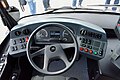 Driver's cockpit
 Power consumption display under full load
 Central unit for video storage (above the driver)


- Esslingen am Neckar: With a fleet renewal in late 2015, Esslingen integrated bus line 113 into the trolleybus network in May 2016 without building new overhead lines. The line operates in combined wire and battery mode; buses switch to battery power to serve the Berkheim district, utilizing reactivated infrastructure from former duo-bus lines for rewiring.[29] Similarly, line 118 was converted to IMC operation, allowing buses to serve sections that are only wired in one direction by running on batteries for the return leg. The city plans to expand the network to 100% electric mobility by 2040, with further expansions planned for the Pliensauvorstadt and Zollberg districts.[30]

- Eberswalde also utilizes IMC technology.
- Other cities: In 2020, Berlin announced plans for a new trolleybus system with 190 battery trolleybuses,[31] though plans were shifted toward battery-only buses in early 2023.[32]
Switzerland
Zürich, Geneva, and Lucerne operate extensive networks. For example, the "Swiss Trolley Plus" by Carrosserie Hess was tested in Zürich.
Czech Republic
Cities like Prague, Plzeň and Ostrava have integrated battery trolleybuses to extend routes into areas without wires.[33] In Prague, the electrification of bus line 119 to the airport (rebranded as trolleybus line 59) utilizing 24-meter IMC vehicles is a prominent project.
Italy
- Lecce opened a dual-mode system in 2012.
- Rimini operates the Metromare BRT system using IMC technology.
- Milan is progressively updating its fleet with IMC vehicles (e.g., Solaris Trollino) to cover route sections without overhead wires or during diversions.
- Pescara is launching its "La Verde" (V1) line using Van Hool Exqui.City IMC trolleybuses.
North and South America
- USA & Canada: San Francisco (Muni), Seattle (King County Metro), and Dayton operate large fleets of trolleybuses with battery off-wire capability (replacing older dual-mode diesel units). Vancouver also utilizes these systems.
- Argentina: Cities like Rosario and Córdoba have imported Trolza vehicles with autonomous capabilities to extend range beyond the wires.
- Mexico: Mexico City has aggressively expanded its trolleybus network, including the elevated Line 10, using Yutong battery trolleybuses.[34]
Russia and Belarus

The region has seen rapid development of "Trolleybuses with Extended Autonomous Run" (TUAH).
- Saint Petersburg: Launched a major initiative in 2017 to expand the network without installing new overhead lines. By late 2023, over 13 routes and 200 vehicles were operating, linking metro stations to new housing developments.[35]
- Belarus: Manufacturers BKM Holding and MAZ produce IMC buses used domestically (Minsk, Gomel, Vitebsk, Grodno) and exported abroad. Minsk has utilized IMC technology to return trolleybus service to the entire length of Independence Avenue.
- Other Cities: Novosibirsk, Krasnodar, Cheboksary, and Khabarovsk have actively purchased and deployed IMC vehicles to extend routes to suburbs. The city of Bobruisk relaunched its Route 4 in 2023 using MAZ-203T70 vehicles, serving as an example of successful IMC implementation in a smaller city to bridge gaps in infrastructure.
Remove ads
Manufacturers
Major manufacturers of IMC buses and propulsion systems include:
- Kiepe Electric (Germany/USA) – Provides electrical systems for chassis manufacturers.
- Solaris Bus & Coach (Poland) – Produces the Trollino series, including the 24-meter double-articulated version.
- Carrosserie Hess (Switzerland) – Produces the lighTram series.
- Van Hool (Belgium) – Produces the Exqui.City series.
- BKM Holding (Belarus) – Produces the 32100D and Olgerd series.
- MAZ (Belarus) – Produces the MAZ-203T series.
- PC Transport Systems (Russia) – Produces the Admiral series.
- Yutong (China).
- Trolza (Russia) – Defunct, formerly a major supplier of the Megapolis series.
Remove ads
See also
References
Wikiwand - on
Seamless Wikipedia browsing. On steroids.
Remove ads