Top Qs
Timeline
Chat
Perspective
Julian Oktawian Zachariewicz-Lwigród
Polish architect and renovator From Wikipedia, the free encyclopedia

Remove ads
Julian Oktawian Zachariewicz-Lwigród (17 July 1837 – 27 December 1898), commonly referred to as Julian Zachariewicz, was a Polish architect and renovator of Armenian descent.[2][3] Zachariewicz was a graduate of the Royal Polytechnic Institute in Vienna,[4] and a professor and rector (1881–1882) of the Lemberg Polytechnic.[5] Father of architect Alfred Zachariewicz and intellectual Julian Edwin Zachariewicz.

Remove ads
Life
Summarize
Perspective
He was born in Lemberg, Austrian Empire (Polish: Lwów, now Lviv, Ukraine) into the family of Georgiy Zakharievich, an Armenian[3] and Yuzepa Grosman, a German Lutheran.
In 1858, he graduated from the Vienna University of Technology. Until 1870, he held numerous positions as a qualified engineer in the Austrian State Railways.
In the 1860s, he worked for the Lviv-Chernivtsi Railway in various positions, ranging from railway engineer in Vienna, Timisoara, and Lviv to traffic manager in Chernivtsi. While working for this railway, he designed the railway station in Iasi.[6]
In 1871, he was offered the post of director of the newly-established Faculty of Civil Engineering at the Lviv Technical Academy (now Lviv Polytechnic). As a consequence, he returned to Lviv and worked as professor at the academy and was appointed dean of the Faculty of Civil Engineering. Between 1877–1878 and 1881–1882 he served as rector of the Lviv Polytechnic.
In 1877, he received the "Ritter" title of Austrian nobility (Grade II) with the predicate "von Lwigród". He designed the main building of the Lemberg Polytechnic as well as a separate building of the Faculty of Chemistry. The main building of the polytechnic, known as the "Mother of Polish Technical Universities", was designed in the eclectic Neo-Renaissance style that was fashionable at the time.
Zachariewicz made a number of journeys across Germany and Austria before designing the polytechnic, in order to familiarise himself with the newest innovations relating to the construction of this type of building. He also designed numerous public buildings and private residences, including the Iași railway station (1869–70), the Czernowitz Synagogue,[4] the Galician Savings Bank in Lviv, Church of Franciscan Sisters in Lviv, Jan Styka's villa, and the Tyszkiewicz Villa in Vilnius. He also carried out the renovation of the Church of the Holy Family in Tarnów as well as controversial[citation needed] renovations of the Church of Our Lady of the Snow in Lviv and the Church of John the Baptist in Lviv.
In 1894, he supervised (alongside Franciszek Skowron) the construction of more than 100 pavilions for the General National Exhibition in Lviv.[7] He was also a member of the statutory exhibition commission.[8] He is the author of the book Zabytki sztuki w Polsce (Works of Art in Poland) published in 1895.[9][10][11]

He died in Lemberg and was interred at the Lychakiv Cemetery.
From April 13 to May 15, 1905, drawings of wooden architecture samples made by Zachariewicz were exhibited at the Czapski Palace in Krakow.[12] In 1910, a bust of Julian Zachariewicz by Juliusz Beltowski was installed in the lobby of the main building of the Lviv Polytechnic, which was solemnly unveiled on September 11, the final day of the Fifth Congress of Technicians in Lviv.[13] The same year, Zachariewicz's projects were exhibited at the first architectural exhibition in Lviv.[14] From 1901 to 1946, a street was named after Zachariewicz, which is now called Arkhitektorska Street. In 1992, another street in Lviv was named in his honor.
Remove ads
Gallery


 Main building of Lviv Polytechnic
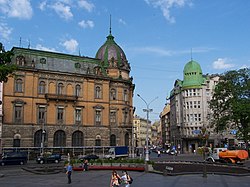 Galician Savings Bank, Lviv
 St. Mary's Church in Stryi
 Psary Palace
 Jan Styka House, Lviv
 Zachariewicz coat of arms

.jpg)


See also
References
Bibliography
Wikiwand - on
Seamless Wikipedia browsing. On steroids.
Remove ads