Top Qs
Timeline
Chat
Perspective
Khaki drill
Type of fabric and the military uniforms made of it From Wikipedia, the free encyclopedia

Remove ads
Khaki drill (KD) is the British military term for a type of fabric and the military uniforms made from them.[1]
 | This article includes a list of general references, but it lacks sufficient corresponding inline citations. (March 2011) |
History
Summarize
Perspective
Khaki colour uniforms were first introduced in 1848 in the British Indian Army Corps of Guides.[1] As well as the Corps of Guides, other regiments in India soon adopted the uniform and eventually it was used throughout the British military.
Khaki drill was worn as a combat uniform from 1900 to 1949 and was most often used in desert and tropical service. A variant, still referred to as khaki drill or KD, is worn by the British Armed Forces in non-combatant warm-weather countries where the British are actively serving (e.g. personnel stationed at RAF Akrotiri in Cyprus will wear any of four working variants of this uniform). Generally, KD was a series of different uniform patterns of light khaki cloth, generally cotton, first worn by British and British Empire soldiers in the Boer War. Canada developed its own pattern after the First World War, and the uniform was commonly worn in Canada, with officers again having the option of finer garments privately purchased. In the Second World War, Canadians serving in Jamaica and Hong Kong wore Canadian-pattern KD; the I Canadian Corps troops in Italy wore KD supplied in theatre by the British, generally of British, Indian, or US (War Aid) manufacture.
Remove ads
North Africa and the Mediterranean
In the early part of the North African Campaign and the Mediterranean theatre, British troops wore KD shorts or slacks with long-sleeved Aertex-fabric shirts. The paler tan shade of KD was more suited to desert or semi-desert regions than the "dark khaki" or brown serge used in British Battledress. When the Allies moved up through Italy, however, two-piece khaki denim battledress overalls were increasingly preferred. By 1943, the KD shirt began to be replaced by a more durable cotton KD bush jacket.
Remove ads
Far East
In the Far East, the British found themselves at war with the Japanese while equipped with the impractical KD uniform. Shirts and trousers had to be dyed green as a temporary expedient until more suitable jungle clothing became available. A new tropical uniform in Jungle Green (JG) was quickly developed – a JG Aertex battledress blouse, a JG Aertex bush jacket (as an alternative to the blouse) and battledress trousers in JG cotton drill. In the hot and humid conditions of Southeast Asia, JG darkened with sweat almost immediately.[2][page needed]
Post Second World War
The khaki battledress was used until the late 1960s, and various uniform items in KD, JG and olive green (OG) remained on issue to soldiers serving in the Mediterranean, Middle East or tropics after the war. By the end of the 1940s, however, stocks were becoming depleted, and a new 1950-pattern tropical uniform was made available in both KD and JG. It was poorly designed, with an ill-fitting bush jacket in the much-maligned Aertex, and suspender buckles that dug into the hips when marching in full kit. Eventually the much more practical Gurkha regiments' JG shirt was copied, replacing the 1950-pattern bush jacket. All the same, troops still sought out the older, wartime, issues of the better KD, JG and OG kit.
Remove ads
Gallery
 The Black Watch in the Battle of Magersfontein, 1899, showing an early version of the khaki drill jacket, combined with kilts
 Soldiers of the 1st Battalion of the West Yorkshire Regiment (Prince of Wales's Own) in Egypt, 1931-1933
 Soldiers in khaki drill receive a briefing at Eighth Army Headquarters in Italy, September 1943.
 British Commonwealth infantry manning a sandbagged defensive position near El Alamein, 17 July 1942
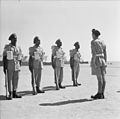 Caribbean Regiment soldiers in Egypt
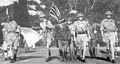 Lt Gen. Arthur Percival, led by a Japanese officer, walks under a flag of truce to negotiate the capitulation of Allied forces in Singapore, on 15 February 1942. All wear standard KD with shorts.
 The 2/5th Royal Gurkha Rifles (Frontier Force) in JG marching through Kure soon after their arrival in Japan in May 1946 as part of the Allied forces of occupation

_in_Egypt_1931-1933.jpg)


Remove ads
Notes
References
External links
Wikiwand - on
Seamless Wikipedia browsing. On steroids.
Remove ads