Top Qs
Timeline
Chat
Perspective
Conformal radius
From Wikipedia, the free encyclopedia
Remove ads
In mathematics, the conformal radius is a way to measure the size of a simply connected planar domain D viewed from a point z in it. As opposed to notions using Euclidean distance (say, the radius of the largest inscribed disk with center z), this notion is well-suited to use in complex analysis, in particular in conformal maps and conformal geometry.
 | This article needs additional citations for verification. (November 2025) |
A closely related notion is the transfinite diameter or (logarithmic) capacity of a compact simply connected set D, which can be considered as the inverse of the conformal radius of the complement E = Dc viewed from infinity.
Remove ads
Definition
Summarize
Perspective
Given a simply connected domain D ⊂ C, and a point z ∈ D, by the Riemann mapping theorem there exists a unique conformal map f: D → D onto the unit disk (usually referred to as the uniformizing map) with f(z) = 0 ∈ D and f′(z) ∈ R+. The conformal radius of D from z is then defined as
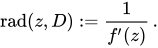
The simplest example is that the conformal radius of the disk of radius r viewed from its center is also r, shown by the uniformizing map x ↦ x/r. See below for more examples.
One reason for the usefulness of this notion is that it behaves well under conformal maps: if φ: D → D′ is a conformal bijection and z in D, then .

The conformal radius can also be expressed as where is the harmonic extension of from to .


Remove ads
A special case: the upper-half plane
Summarize
Perspective
Let K ⊂ H be a subset of the upper half-plane such that D:= H\K is connected and simply connected, and let z ∈ D be a point. (This is a usual scenario, say, in the Schramm–Loewner evolution). By the Riemann mapping theorem, there is a conformal bijection g: D → H. Then, for any such map g, a simple computation gives that
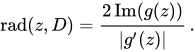
For example, when K = ∅ and z = i, then g can be the identity map, and we get rad(i, H) = 2. Checking that this agrees with the original definition: the uniformizing map f : H → D is
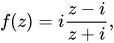
and then the derivative can be easily calculated.
Remove ads
Relation to inradius
Summarize
Perspective
That it is a good measure of radius is shown by the following immediate consequence of the Schwarz lemma and the Koebe 1/4 theorem: for z ∈ D ⊂ C,

where dist(z, ∂D) denotes the Euclidean distance between z and the boundary of D, or in other words, the radius of the largest inscribed disk with center z.
Both inequalities are best possible:
- The upper bound is clearly attained by taking D = D and z = 0.
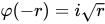
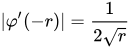
- The lower bound is attained by the following “slit domain”: D = C\R+ and z = −r ∈ R−. The square root map φ takes D onto the upper half-plane H, with and derivative . The above formula for the upper half-plane gives , and then the formula for transformation under conformal maps gives rad(−r, D) = 4r, while, of course, dist(−r, ∂D) = r.

Remove ads
Version from infinity: transfinite diameter and logarithmic capacity
Summarize
Perspective
When D ⊂ C is a connected, simply connected compact set, then its complement E = Dc is a connected, simply connected domain in the Riemann sphere that contains ∞,[citation needed] and one can define

where f : C\D → E is the unique bijective conformal map with f(∞) = ∞ and that limit being positive real, i.e., the conformal map of the form

The coefficient c1 = rad(∞, D) equals the transfinite diameter and the (logarithmic) capacity of D; see Chapter 11 of Pommerenke (1975)[1] and Kuz′mina (2002).[2]
The coefficient c0 is called the conformal center of D. It can be shown to lie in the convex hull of D; moreover,

where the radius 2c1 is sharp for the straight line segment of length 4c1. See pages 12–13 and Chapter 11 of Pommerenke (1975).[1]
Remove ads
The Fekete, Chebyshev and modified Chebyshev constants
Summarize
Perspective
We define three other quantities that are equal to the transfinite diameter even though they are defined from a very different point of view. Let

denote the product of pairwise distances of the points and let us define the following quantity for a compact set D ⊂ C:


In other words, is the supremum of the geometric mean of pairwise distances of n points in D. Since D is compact, this supremum is actually attained by a set of points. Any such n-point set is called a Fekete set.

The limit exists and it is called the Fekete constant.

Now let denote the set of all monic polynomials of degree n in C[x], let denote the set of polynomials in with all zeros in D and let us define


- and


Then the limits
- and


exist and they are called the Chebyshev constant and modified Chebyshev constant, respectively. Michael Fekete and Gábor Szegő proved that these constants are equal.[citation needed]
Remove ads
Applications
The conformal radius is a very useful tool, e.g., when working with the Schramm–Loewner evolution. A beautiful instance can be found in Lawler, Schramm & Werner (2002).[3]
References
Further reading
External links
Wikiwand - on
Seamless Wikipedia browsing. On steroids.
Remove ads