Top Qs
Timeline
Chat
Perspective
Ruhmeshalle (Munich)
Building in Schwanthalerhöhe, Upper Bavaria, Germany From Wikipedia, the free encyclopedia

Remove ads
The Ruhmeshalle (German pronunciation: [ˈʁuːməsˌhalə], lit. 'Hall of Fame') is a Doric colonnade with a main range and two wings, designed by Leo von Klenze for Ludwig I of Bavaria. Built in 1853, it is situated on an ancient ledge above the Theresienwiese in Munich and was built as part of a complex which also includes the Bavariapark and the Bavaria statue.[1] It is built of Kelheim limestone and is 68 metres long and 32 metres deep.
 | You can help expand this article with text translated from the corresponding article in German. (February 2012) Click [show] for important translation instructions.
|
 | This article includes a list of general references, but it lacks sufficient corresponding inline citations. (August 2019) |
With the construction and exhibition of busts of important people from Bavaria, including the Palatinate, Franconia and Swabia, King Ludwig intended to create a hall of fame that honors laudable and distinguished people of his kingdom, as he did also in the Walhalla memorial for all of Germany.
In 1944, a bombing raid caused several busts' destruction.
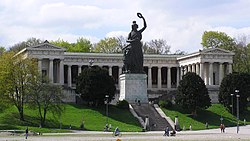 The Ruhmeshalle with the statue of Bavaria by Ludwig Schwanthaler
 Aerial photograph: Ruhmeshalle and Bavaria monument (2009)
 Interior of the Ruhmeshalle


Remove ads
See also
- Befreiungshalle (Hall of Liberation, Kelheim, Germany)
- Heldenberg Memorial (Austria)
- Hermannsdenkmal (Hermann monument, Teutoburg Forest, Germany)
- Walhalla (memorial) in Donaustauf
References
External links
Wikiwand - on
Seamless Wikipedia browsing. On steroids.
Remove ads