Top Qs
Timeline
Chat
Perspective
Shantinatha
16th Tirthankara in Jainism in current cycle of Jain cosmology From Wikipedia, the free encyclopedia

Remove ads
Śāntinātha (Sanskrit: शान्तिनाथ) or Śānti is the sixteenth tīrthaṅkara of Jainism in the present age (Avasarpini).[2] According to Jain beliefs, he was one of the three tirthankaras to have also held the status of a Chakravarti (universal monarch) and a Kamadeva (being of supreme beauty) in the same lifetime. He is traditionally revered as the deity of peace (Shanti) and is invoked by devotees to avert calamities and epidemics.

Jain texts describe his life as a transition from imperial sovereignty to total renunciation. Born in Hastinapur to King Vishvasena and Queen Aćira of the Ikshvaku dynasty, he is said to have ruled for 25,000 years. As a Chakravarti, traditional accounts state he possessed the "fourteen jewels" (ratna) and "nine treasures" (nidhi), symbolizing absolute material dominion, before renouncing his empire to become a Jain monk. After sixteen years of asceticism, he is believed to have attained Kevala Jnana (omniscience) and subsequently achieved Moksha (liberation) at Shikharji.
Along with Rishabhanatha, Neminatha, Parshvanatha and Mahavira, Shantinatha is considered one of the five most worshipped tirthankaras in the Jain tradition. He is the central figure in the Shantikarma rituals, performed to bring peace and ward off negative karmic influences. His legacy is preserved in major literary works like the Shantipurana (c. 10th century) by the poet Ponna and in significant architectural monuments. Prominent sites dedicated to him include the UNESCO World Heritage Shantinatha temple, Khajuraho, the Shantinatha Temple, Deogarh, the colossal statues at Gopachal, and major temple complexes at Hastinapur and Sonagiri.
Remove ads
Legendary Biography
Summarize
Perspective
According to Jain cosmology, Shantinatha is the 16th tirthankara of the Avasarpiṇī (the present descending time cycle).[2][note 1] He holds a unique position in Jain universal history as one of the three beings to attain the triple status of tirthankara, Chakravarti (Universal Monarch), and Kamadeva (Being of Supreme Beauty) within a single lifetime.[6]
His successor, Kunthunatha, is said to have been born 1/2 palya after him.[7]
Previous incarnations

Jain tradition holds that the soul of Shantinatha accumulated merit through a series of virtuous past lives before his final birth. Traditional accounts, such as Hemachandra's Trishashti-Shalakapurusha-Charitra, describe his life as King Srisena, a benevolent ruler who had two wives, Abhinanditā and Śikhinanditā. Abhinanditā is described as the mother of his two sons Induṣeṇa and Binduṣeṇa.[8][page needed] In next birth, he is described as being born as Yugalika in Uttar Kurukshetra and after that as a Deva in Saudharma heaven.[8][page needed]
In next birth as Amitateja, prince of Arkakirti, who later became a Jain monk under the influence of Acharya Abhinandana.[8][page needed] followed by birth as a heavenly deva in 10th heaven Pranat (20 sagars life span)[note 2] After that he was born as Aparajit Baldeva in East Mahavideha (life span of 84,00,000 purva)[note 3] and then as a heavenly Indra in 12th heaven Achyuta (22 sagars life span). In the subsequent birth, he ruled as Vajrāyudha Chakri, the son of tirthankara Kṣemaṅkara in the East Mahavideha region, where he eventually renounced his throne to become a Jain ascetic with his father becoming an Arihant.[9] He is said to have been named Vajrāyudha as his mother, Lakṣmīvatī's, dreamed of a thunderbolt as one of the fourteen auspicious dreams indicating that he would become a Vajrin (Indra).[8][page needed] After that he was born as a heavenly deva in Navgraivayak heaven (25 sagars life span).[8][page needed]
His most significant previous incarnation was as King Megharath, son of Dhanarath in East Mahavideha.[10][11][12] In a famous legend depicted frequently in Jain art, King Megharath demonstrated absolute compassion by saving a pigeon from a pursuing falcon (who was a deity named Sarupa testing his vow).[9][13] He did this by slicing off his own flesh equal in weight to the bird to satisfy the falcon's hunger, symbolizing the ultimate commitment to ahimsa.[14] Following this life, he was reborn as a heavenly deva in Sarvartha Siddha heaven (33 sagars life span) before descending for his final incarnation.[8][page needed]
Birth and Early Life
Shantinatha was born in the ancient capital of Hastinapur to King Vishvasena and Queen Aćira of the Ikshvaku dynasty.[6] His birth occurred on the 13th day of the dark half of the Jestha month.[15] Tradition states that his mother saw the auspicious dreams (fourteen according to the Śvetāmbara tradition and sixteen according to the Digambara tradition) foretelling the birth of a tirthankara.[8][page needed]
He was named Shantinatha ("Lord of Peace") because his presence in the womb was believed to have pacified a raging epidemic and quelled all misery in the kingdom.[6] Chronologically, he was born three sagara (ocean-measured time units) less three-quarters palya after the fifteenth tirthankara, Dharmanatha.[7]
Reign as Chakravarti
Before embarking on his spiritual conquest, Shantinatha achieved the zenith of material power. Standing 40 dhanusha (approximately 120 feet) tall, he spent 25,000 years as a youth and ascended the throne at the age of 25,000.[7][16] He ruled for 50,000 years, during which he conquered the six distinct divisions of the earth, establishing a global empire.[17] He married a beautiful princess Yaśomatī.[9]
As the fifth Chakravarti, canonical texts attribute to him the possession of the "14 jewels" (ratna) and "nine treasures" (nidhi).[9][15] These assets included animate and inanimate symbols of sovereignty, such as the divine wheel (chakraratna), the state elephants and the divine horses.[16] His reign is traditionally characterized as a Golden Age of justice and is associated with the Shantikarma rituals, which are performed to ward off diseases, famine, and foreign invasions.[14][18] During his time, an epidemic of epilepsy broke out and he helped to control it.[16]
Renunciation and Omniscience

Despite possessing absolute material dominion, Shantinatha renounced his empire upon realizing the transient nature of worldly power.[15] He adopted the life of a Jain monk, engaging in rigorous penance for sixteen years.[14] He meditated under a nandi tree, abstaining from food and sleep, until he destroyed the ghati (obscuring) karmas.[15] On the ninth bright day of the month of Pausha, he attained Kevala Jnana (omniscience).[14]
After achieving kevala jnana he visited Somanasapur, and was offered first ahara (food) by King Dharma Mitra and his wife.[19]
Nirvana and moksha
He is said to have lived 1 lakh (100,000) years and spent many years spreading his knowledge.[9][7] On the 13th day of the dark half of the month Jyestha (May–June), he attained nirvana at Sammed Shikharji,[14][15][note 4] known contemporaneously as the Parasnath Hills in northern Jharkhand.[22]
The yaksha and yakshi of Shantinatha are Kimpurusha and Mahamanasi according to Digambara tradition and Garuda and Nirvani according to Śvētāmbara tradition.[14]
Disciples
According to Jain texts, Cakrayudha Svami was the leader of the Shantinatha disciples.[15][6]
Remove ads
Legacy
Summarize
Perspective
Worship

Śhāntinātha being an idea of peace and tranquillity, it is believed that chanting the name Śhāntinātha averts calamities and epidemics and bestows welfare to worshippers.[23] In the Śvetāmbara tradition, Nirvāṉi, the yakshi of Śhāntinātha, is also associated with Shantinatha as Śhānti-devī in prayers for peace.[14] During the last rites, recitation of Namokar Mantra and hymns to the Jina and Śhāntinātha are performed.[24]
Shanti Snaatra Puja is a special prayer for universal peace and the welfare of all living beings. During the prayer, offerings are made 27 or 108 times to Shantinatha.[25] The Laghnu-Shanti-stavaa, compiled by Manadeva suri in the 7th century, is a hymn to Shantinatha full of tantric usage and identify Shantinatha as Siva, the Lord of Shanta.[26] According to Jinaprabha Suri, the temples dedicated to Shantinatha existed in Kishkindha, Lanka and Trikuta.[14]
According to Santistava compiled by Acharya Manadevasuri, an Acharya of the Śvetāmbara sect in the third century, mere recitation of Shantinatha's name negates all bad omens, brings peace and protects devotees from problems.[27] Santistava is considered by Śvetāmbaras as one of the four most beautifully written stavans (hymn[28][29]).[30] Jinastotrāņi is a collection of hymn dedicated to Shantinatha along with Munisuvrata, Chandraprabha, Neminatha, Mahavira, Parshvanatha and Rishabhanatha. Other Śvetāmbara hymns that are dedicated to Shantinatha are the Ajit-Shanti Stotra (a hymn dedicated to Shantinatha and the 2nd Tirthankara Ajitanatha) and the Bruhad-Shanti Stotra (a hymn dedicated to Shantinatha that is recited during the Snaatra Puja as per the Śvetāmbara tradition). During the Chaityavandan (a ritual that consists of a series of hymns in obeisance to a Tirthankara), lay-followers of the Śvetāmbara tradition recite a hymn Sakalkushalvalli which is dedicated to Shantinatha and the 23rd Tirthankara Parshvanatha.[31]
Samantabhadra's Svayambhustotra praises the twenty-four tirthankaras, and its eight shlokas (songs) adore Shantinatha.[32] One such shloka reads:
First, Lord Śhāntinātha Jina, for a long period of time, wielded supremacy as a king and provided protection to his subject from enemies; later on, on his own, became an ascetic and, as the embodiment of benevolence, pacified evil tendencies.
— Svayambhūstotra (16-1-76)[33]
Literature

The Shantinatha Charitra, by Acharya Ajitprabhasuri in 14th century, describes the life of the 16th Jain Tirthankara Shantinatha. This text is the oldest example of miniature painting and has been declared as a global treasure by UNESCO.[34] * Santyastaka is a hymn in praise of Śāntinātha composed by Acharya Pujyapada in the fifth century.[35] Acharya Hemachandra's Trishashti-Shalakapurush-Charitra describes the previous births as well as the final birth of Shantinatha in detail as per the Śvetāmbara tradition. Shantipurana, written around the 10th century by Sri Ponna, is considered to be one of the three gems of Kannada literature.[36][37][38]
Ajitasanti or Ajita-Śhānti-stava composed by Acharya Nandisenasuri, a seventh century Jain monk, a famous Śvetāmbara hymn, has alternate verses praising Ajitnatha and Shantinatha.[39][14] Mahapurusha Charitra, compiled by Merutunga in the 13th—14th centuries, talks about Shantinatha.[40] Santikara was compiled by Munisundarasuri in the 15th century.[41]
Iconography
Shantinatha is usually depicted in a sitting or standing meditative posture with the symbol of a deer or antelope beneath him.[42][43] Every tīrthankara has a distinguishing emblem that allows worshippers to distinguish similar-looking idols of the tirthankaras.[44][45][46] The deer or antelope emblem of Shantinath is usually carved below the legs of the tirthankara. Like all tirthankaras, Shantinath is depicted with Shrivatsa[note 5] and downcast eyes.[47]
 Shantinatha idol inside Pakbirra Jain temple
 Chhatrapati Shivaji Maharaj Vastu Sangrahalaya, 12th century
 Shantinatha Basadi, Jinanathapura, 1117 CE
 Honolulu Academy of Arts, 15th century

,_da_varavan_nel_circondario_nord_del_distretto_di_thar_e_parkar,_sind,_1130_dc.jpg)


Colossal statues
In 2016, the tallest statue of Shantinatha, with a height of 54 feet (16 m), was erected in Ajmer.[48] The 32-foot (9.8 m) statue of Shantinath at Prachin Bada Mandir, Hastinapur and Shantinath Jinalaya, Shri Mahavirji. Aggalayya Gutta in Warangal has a 30-foot (9.1 m) image carved in 11th century CE.[49] The 22.5-foot (6.9 m) statue of Shantinath at Bhojpur Jain Temple.
Aharji enshrines a 22-foot (6.7 m) idol installed in 1180 CE.[50] Shantinatha basadi, Halebidu houses a 18 feet (5.5 m) idol.[51] Naugaza Digambar Jain temple in Alwar has 17.5-foot (5.3 m) colossi dated 922 CE.[52] The 15-foot (4.6 m) image at Shantinatha temple, Khajuraho and Shantinath Basadi, Chandragiri.[53] The 12.5-foot (3.8 m) statue in Bahuriband and Pawagiri, built in the 12th century.[54][55]

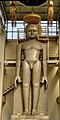


 Naugaza Digambar Jain temple, 923 CE

_(cropped).jpg)
.jpg)

.jpg)


Temples

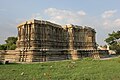
Along with Rishabhanatha, Neminatha, Parshvanatha and Mahavira, Shantinatha is one of the five Tirthankaras who attract the most devotional worship among the Jains.[56] Various Jain temple complexes across India feature him, and these are important pilgrimage sites in Jainism. Hastinapur, for example, is a hilly part of Uttar Pradesh, which is believed to have been a place of Shantinath, along with Aranatha and Kunthunath.[57][58] Important Shantinatha temple complexes include Shantinatha Temple in Khajuraho (UNESCO World Heritage Site), Semliya Śvetāmbara Tirth, Bhopawar Śvetāmbara Tirth, Shantinatha temple, Halebidu, Prachin Bada Mandir, Hastinapur, Shantinath Temple in Deogarh, Shantinatha Basadi, Jinanathapura, Shantinath Jain Teerth, Aharji Jain Teerth, Shantinath Jain temple, Kothara, Odegal basadi, Pavagiri Tirth, Kanch Mandir of Indore, Ladnu Jain temple, Beenaji and Shantinath Jain Temple in Leicester, United Kingdom.[59]



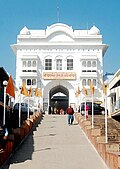 'Singh Dwaar' of Prachin Bada Mandir, Hastinapur
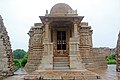 Shringar Chori, Chittor Fort


_CHITTORGARH_FORT.jpg)
Remove ads
See also

Wikimedia Commons has media related to Shantinatha.
Notes
- Heinrich Zimmer: "The cycle of time continually revolves, according to the Jainas. The present "descending" (avasarpini) period was preceded and will be followed by an "ascending" (utsarpini). Sarpini suggests the creeping movement of a "serpent" (sarpin); ava- means "down" and ut- means up."[3] A Tirthankara (ford-maker, saviour or spiritual teacher) signifies the founding of a tirtha, a passage across the sea of birth-and-death cycles.[4][5]
- 1 sagars is several million years
- 1 Purva is 8,400,0002 years
- A special symbol that marks the chest of a Tirthankara. The yoga pose is very common in Buddhism, Hinduism, and Jainism. Each tradition has had a distinctive auspicious chest mark that allows devotees to identify a meditating statue as a symbolic icon for their theology. There are several srivasta found in ancient and medieval Jain artworks, and these are not found on Buddhist or Hindu art works.
Remove ads
References
Wikiwand - on
Seamless Wikipedia browsing. On steroids.
Remove ads