Top Qs
Timeline
Chat
Perspective
Uniform integrability
Mathematical concept From Wikipedia, the free encyclopedia
Remove ads
In mathematics, uniform integrability is an important concept in real analysis, functional analysis and measure theory, and plays a vital role in the theory of martingales.
Measure-theoretic definition
Summarize
Perspective
Uniform integrability is an extension to the notion of a family of functions being dominated in which is central in dominated convergence. Several textbooks on real analysis and measure theory use the following definition:[1]

Definition A: Let be a positive measure space. A set is called uniformly integrable if , and to each there corresponds a such that
whenever and


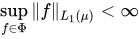


Definition A is rather restrictive for infinite measure spaces. A more general definition[2] of uniform integrability that works well in general measure spaces was introduced by G. A. Hunt.
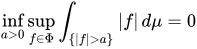
Definition H: Let be a positive measure space. A set is called uniformly integrable if and only if
where .
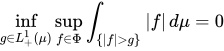

Since Hunt's definition is equivalent to Definition A when the underlying measure space is finite (see Theorem 2 below), Definition H is widely adopted in Mathematics.
The following result[3] provides another equivalent notion to Hunt's. This equivalency is sometimes given as definition for uniform integrability.
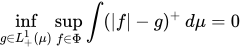
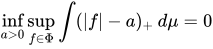
Theorem 1: If is a (positive) finite measure space, then a set is uniformly integrable if and only if
If in addition , then uniform integrability is equivalent to either of the following conditions
1. .
2.

When the underlying space is -finite, Hunt's definition is equivalent to the following:

Theorem 2: Let be a -finite measure space, and be such that almost everywhere. A set is uniformly integrable if and only if , and for any , there exits such that
whenever .


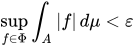

A consequence of Theorems 1 and 2 is that equivalence of Definitions A and H for finite measures follows. Indeed, the statement in Definition A is obtained by taking in Theorem 2.

Remove ads
Tightness and uniform integrability
Summarize
Perspective
Another concept associated with uniform integrability is that of tightness. In this article tightness is taken in a more general setting.
Definition: Suppose measurable space is a measure space. Let be a collection of sets of finite measure. A family is tight with respect to if
A tight family with respect to is just said to be tight.


When the measure space is a metric space equipped with the Borel algebra, is a regular measure, and is the collection of all compact subsets of , the notion of -tightness discussed above coincides with the well known concept of tightness used in the analysis of regular measures in metric spaces


For -finite measure spaces, it can be shown that if a family is uniformly integrable, then is tight. This is capture by the following result which is often used as definition of uniform integrabiliy in the Analysis literature:

Theorem 3: Suppose is a finite measure space. A family is uniformly integrable if and only if
- .
- is tight.
When , condition 3 is redundant (see Theorem 1 above).

Condition 2 in Theorem 3 is sometimes replaced by what is called equi-integrability in many books in Analysis [4][5][6][7]: A family of complex or real valued measurable functions is equi-integrable (or uniformly absolutely continuous with respect to a measure ) if for any there is such that


Remove ads
Relevant theorems
Summarize
Perspective
The following theorem describes a very useful criterion for uniform integrability which is very useful in Probability theory.
de la Vallée-Poussin theorem[8][9]
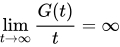
Suppose is a finite measure space. The family is uniformly integrable if and only if there exists a function such that and The function can be chosen to be monotone increasing and convex.




Uniform integrability gives a characterization of weak compactness in .
Dunford–Pettis theorem[10][11]
Suppose is a -finite measure. A family has compact closure in the weak topology if and only if is uniformly integrable.


Remove ads
Probability definition
Summarize
Perspective
In probability theory, Definition A or the statement of Theorem 1 are often presented as definitions of uniform integrability using the notation expectation of random variables.,[12][13][14] that is,
1. A class of random variables is called uniformly integrable if:
- There exists a finite such that, for every in , and
- For every there exists such that, for every measurable such that and every in , .


or alternatively
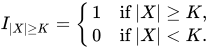
2. A class of random variables is called uniformly integrable (UI) if for every there exists such that , where is the indicator function .



Remove ads
Related corollaries
Summarize
Perspective
The following results apply to the probabilistic definition.[15]
- Definition 1 could be rewritten by taking the limits as
- A non-UI sequence. Let , and define Clearly , and indeed for all n. However, and comparing with definition 1, it is seen that the sequence is not uniformly integrable.

![{\displaystyle \Omega =[0,1]\subset \mathbb {R} }](http://wikimedia.org/api/rest_v1/media/math/render/svg/051774c56085fd1251cfab50a7cc824da5fe8b2a)
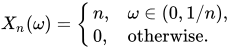

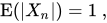



- By using Definition 2 in the above example, it can be seen that the first clause is satisfied as norm of all s are 1 i.e., bounded. But the second clause does not hold as given any positive, there is an interval with measure less than and for all .
- If is a UI random variable, by splitting and bounding each of the two, it can be seen that a uniformly integrable random variable is always bounded in .
- If any sequence of random variables is dominated by an integrable, non-negative : that is, for all ω and n, then the class of random variables is uniformly integrable.
- A class of random variables bounded in () is uniformly integrable.


![{\displaystyle E[|X_{m}|:(0,1/n)]=1}](http://wikimedia.org/api/rest_v1/media/math/render/svg/0863c3e7ff78cebe7724523cf2fedb876816a467)




Remove ads
Uniform integrability and stochastic ordering
A family of random variables is uniformly integrable if and only if[16] there exists a random variable such that and for all , where denotes the increasing convex stochastic order defined by if for all nondecreasing convex real functions .


Remove ads
Relation to convergence of random variables
A sequence converges to in the norm if and only if it converges in measure to and it is uniformly integrable. In probability terms, a sequence of random variables converging in probability also converge in the mean if and only if they are uniformly integrable.[17] This is a generalization of Lebesgue's dominated convergence theorem, see Vitali convergence theorem.
Remove ads
Citations
References
Wikiwand - on
Seamless Wikipedia browsing. On steroids.
Remove ads