Bevatron
Particle accelerator at Lawrence Berkeley National LaboratoryThe Bevatron was a particle accelerator – specifically, a weak-focusing proton synchrotron – located at Lawrence Berkeley National Laboratory, U.S., which began operations in 1954. The antiproton was discovered there in 1955, resulting in the 1959 Nobel Prize in physics for Emilio Segrè and Owen Chamberlain. It accelerated protons into a fixed target, and was named for its ability to impart energies of billions of eV.
Read article


Top Questions
AI generatedMore questions
Nearby Places
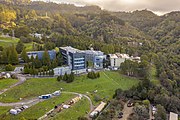
Lawrence Berkeley National Laboratory
Laboratory near Berkeley, California, US

Lawrence Hall of Science
Public science center in Berkeley, California
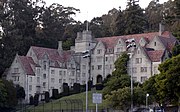
Bowles Hall
Building and residential college at the University of California, Berkeley
KALX
Radio station at the University of California, Berkeley
National Center for Electron Microscopy
Electron microscope laboratory facility

Advanced Light Source
Synchrotron radiation facility

The Big "C"
Shyh Wang Hall
Building in University of California