Miranda (moon)
smallest of the large moons of Uranus From Wikipedia, the free encyclopedia
Remove ads
Miranda is one of Uranus' moons. It is the smallest, and the one which has the least rotation time. Gerard Kuiper discovered it in 1948, February 16th and named it after Miranda, Prospero's daughter in William Shakespeare's play The Tempest. Sometimes it is also called Uranus V.
It's one of Uranus' strangest moons. Its complex surface may indicate partial melting of its interior, with icy material drifting to the surface.
The probe Voyager 2 made some photos in 1986. These are the only images that exist, so far. Geologically, it is the most active body in the Uranus system. The grooves and troughs reach depths of a few kilometers (or miles) and expose materials of different albedos (reflectivity). The features suggest a long, complex geologic evolution of this satellite.
Remove ads
Gallery
 A picture of Miranda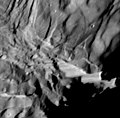
 An array of fractures, grooves and craters. This clear-filter, narrow-angle view shows areas of older, heavily cratered terrain with a wide variety of forms.


Wikimedia Commons has media related to Miranda (moon).

Remove ads
Wikiwand - on
Seamless Wikipedia browsing. On steroids.
Remove ads