Top Qs
Timeline
Chat
Perspective
Array factor
From Wikipedia, the free encyclopedia
Remove ads
In the study of antennas, the array factor is a mathematical function that describes the signal of an antenna array as a combination of the signals of its individual antennas. More precisely, the array factor is multiplied by the radiation pattern of an individual antenna to produce the pattern of the entire array. This difference in the patterns is due to the constructive and destructive interference properties of radio waves.
 | This article may be too technical for most readers to understand. (January 2019) |
The array factor depends on
- the positions of the individual antennas in the array,
- the complex weights (amplitudes and phases) being used to combine (or excite) the signals of the antennas, and
- the direction of signal arrival (or transmission).
When the antenna weights are chosen appropriately, then the array factor has large magnitude for signals in the desired direction(s) and small in the direction(s) that the array operator wants to ignore. This is how the beam of a phased array is steered.
Remove ads
Calculation
Summarize
Perspective
In order to simplify the mathematics, a number of assumptions are typically made:
- All antennas are identical in every respect.
- The antennas are uniformly spaced.
- The signal phase shift between radiators is constant.
The array factor is the complex-valued far-field radiation pattern obtained for an array of isotropic radiators located at coordinates , as determined by:[1]


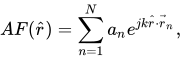
where are the complex-valued excitation coefficients, and is the direction unit vector. The array factor is defined in the transmitting mode,[2] with the time convention . A corresponding expression can be derived for the receiving mode, where a negative sign appears in the exponential factors, as derived in reference.[3]


Remove ads
References
See also
Wikiwand - on
Seamless Wikipedia browsing. On steroids.
Remove ads