Top Qs
Timeline
Chat
Perspective
Conversation theory
From Wikipedia, the free encyclopedia
Remove ads
Conversation theory is a pedagogical, dialectical, and cybernetic framework that examines conversation, cognition and learning in the context of two conversational participants. During a conversation, each participant attempts to converge towards a common understanding with each other as to the significance of some topic of discussion.[Note 1] The theory provides a formal dialectical framework that examines how conversational participants may modulate conceptualisation processes between themselves throughout a conversational interaction.[1][2]
A conversational interaction is characterised as a shared learning process: Each participant takes turns within the interaction—switching at intervals between the role of a student or the role of a teacher—to achieve a state of mutual understanding between themselves.[3] In this sense, the theory concerns itself with how two a priori asynchronous cognitive systems—either mechanical or organic in nature—are able to converse and conceptualise about a topic, in such a way that each system achieves the a posteriori synchronization of each cognitive system's perspective and attitude towards said topic.[2] This resultant synchronization allows each conversational participant to satisfy some shared task or goal.[3][4]
Conversation theory provides an experimental framework that heavily utilizes both human-computer interaction frameworks and computer-theoretic models, in order to create a testable framework explaining how conversational interactions lead to the emergence of shared knowledge between participants.[5][6] The theory was developed by Gordon Pask, who worked with Bernard Scott,[7] Dionysius Kallikourdis, Robin McKinnon-Wood,[8] and others during its initial development and implementation.[Note 2] With Ranulph Glanville and Paul Pangaro also contributing to the application and implementation of the framework in subsequent periods.[9][10]
Remove ads
Overview
Summarize
Perspective
Conversation theory is a formal theory—with practical applications—describing how conversation modulates conceptualisation processes between conversational participants.[11] Both experimentation and learning exercises are enacted in the practical application of the theory, in order to verify if a consensus has been established between conversational participants in relation to some aim or goal.[1][12] The theory prioritizes analysing learning and teaching approaches related to education, rather than other concerns about conversation.[13] It has historically attempted to examine the learning and intellectual development of conversational participants by means of human-machine interactions, thereby sufficiently providing a psychological framework with educational technological applications.[14][15] The theory was developed by Gordon Pask, whose motivation for developing conversation theory was to study and evaluate the nature of cybernetic inquiry via a cybernetic framework.[16][Note 3]
Conversation
A conversation—in the context of conversation theory—involves a learning exchange between conversational participants. Because of this, participants engaging in a discussion about a subject matter make their knowledge claims explicit through the means of such conversational interactions.[Note 4] Since meanings are agreed during the course of a conversation, and since purported agreements can be illusory—whereby we think we have the same understanding of a given topic but in fact do not—an empirical approach to the study of conversation would require stable reference points during such conversational exchanges between peers so as to permit reproducible results.[17]
Using computer theoretical models of cognition, conversation theory can document these intervals of understanding that arise in the conversations between two participating individuals, such that the development of individual and collective understandings can be analysed rigorously.[18] In this way, Pask has been argued to have been an early pioneer in AI-based educational approaches: Having proposed that advances in computational media may enable conversational forms of interactions to take place between man and machine.[19]
Strict Conversation
The types of languages that conversation theory demarcates in its approach include (i) language regarding the experiment itself and (ii) langauge used by the experimental participents during the course of the experiment. Within conversation theory, dialouge then displays different modalities depending on the role a language has in relation to an experiment.[20] The types of languages considered in conversation theory are as follows: Natural languages used for general discussions outside the experiment; object languages which are the subject of inquiry during an experiment, and finally a metalanguage which is used to talk about the design, management, and results on an experiment.[4]
For the purpouses of experimentation and observation, any conversational transactions withina given interaction under observation take the form of a strict conversation: That is, a conversation where (i) there is an agreement to limit the engagement to a finite number of topics, and (ii) some experimenter documents each iteration of a participents ongoing undertstanding of a given topic under consideration as time goes on.[21] Such strict conversations are monitorered though a cooperative externalisation technique (CET) which involves a participents aggreeing to externalise their—normally private— cognative events within the context of a strictly observable experimental setting.[22]
Each expemiment operates under the principle of there existing a CET herustic: This heurustic refers to the assumption by both the experimenter and each participent that (i) a participent is able to learn another participent's understanding of a given topic through constructing an explination of that topic which is satisfiable to the other person, and that (ii) such and understanding persists for the remainder of a given conversational interaction.[23]
Object Language


The object language differs from most formal languages, by virtue of being "a command and question language[,] not an assertoric language like [a] predicate calculus".[24] It priorities the sematic and pragmatic aspects of language rather than the syntactical features of propositions and their corresponding truth or falsity values.[24] It is often formally illustrated and embodied in the form of a conversational skeleton within conversation theory, which forms the basic unit of a conversational interactions between a collection of conversational participants . This unit is contextualized as a extended learning system whose internal states are changed and modulated through the course of the conversation.[25]


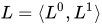
Since conversation theory specifically focuses on learning and development within human subjects, the object language is separated into two distinct modes of conversing; a likeness of which, resembles the distinction between procedural knowledge and declarative knowledge in epistemology. Firstly, there is conversation which happens at the level of of an object language which is concerned with "how to “do” a topic: how to recognize it, construct it, maintain it and so on".[26] Meanwhile, the level of an object language is "concerned with explaining or justifying what a topic means in terms of other topics".[26] This is expressed by the ordered-pair .

The conversational architecture which embodies a object language consists of the following components: Firstly, there are topic relations which may be discussed; secondly, there are speech-acts or descriptions that may be used to converse about said topics; thirdly, a series of procedural repertoires which act to modulate conversational and activity-based input and outputs, and finally a modelling facility whereby conversational participants may collaboratively build working models of a topic with each other. These components—when put together in the form of a conversational skeleton—provide the most basic unit of conversation within conversation theory.
Command and Question Language
The object language is also a language of commands and questions within conversation theory. In essence, this framing merely highlights another modality of the object language: One that frames the object language in terms of the type of speech acts that may be used when enacting different levels of itself. In a conversation between and , if the later participant acknowledges the former participant's statements of intent as corresponding to a command or question if they view that behaviour as legal within the confines of the conversational interaction.[27]


On level of the command and question language, the use of both commands and questions are active: Commands at this level are intended to direct the recipient to act in ways that may generate solutions to a problem, while the use of questions is intended to generate explanations from the recipient regarding what they are doing in a given activity.[28] On level of the language meanwhile, the use of both commands and questions are reflective: The intent of commands is to get the recipient to construct a model that describes what they have done, while the use of questions is intended to get the recipient to provide a step-by-step explanation as to how it was solved and to check if any errors of incompatible relations occurred in the construction of the model.[28]
Operations within this language take the form of commands, questions, explinations, and executions in the form of actions. An example of the type of Command and Question operations that occur within the framework of a strict conversation are given below:[29]
More information  ,
,  ...
...
 ,
,  ...
...


Whereby transactions are treated as either being base such that they relate to one topic, or qualified such that one topic is predicated on another.
Concepts
The term concept in conversation theory is contextualised differently to other uses of the term concept.[30] It has been argued that in conversation theory a concept is not a mental representation nor an abstract idea nor is it strictly speaking an ability—as commonly articulated within the subfield of conceptual ontology.[30] While it has properties which intersect with all these ontologies, a concept is treated in conversation theory in terms of a non-localised process which attempt to maintain the coherence of some set of relations with themselves in the face of incompatibilities.[30]
A concept is not the product of such a process—such as a symbol or mental coordinate—but an ongoing process of feedback which produces, maintains and modulates some set of topics. It is also not a class, nor description of a class, nor a stored description: Instead, a concept is specifically used to reconstruct, reproduce or stabilize relations.[31] In this sense, they may be sufficiently conceived as mental organisations or working models that hold a hypothesis and seek to test said hypothesis in order to confirm or deny its validity.[32][Note 5]
Formal Structure
Strictly speaking, a concept in conversation theory—as described by Pask—is conceived of as the production, reproduction, and maintenance of a given topic relation via other topic relations belonging some conversational domain .[33] This implies that all topic relations—within some area of a conversational domain—must mutually entail each other through a cyclic process of reciprocation.[34][Note 6]


Now if we let denote some arbitrary head topic relation that may be discussed, then it is considered identical to a procedural working model of said relation that produces it.


In which a working model of said relation is treated as identical to its concept:

And where a concept is defined as an operation that is substitutable for the below ordered-pair:

Whose contents are defined as:

Such that a program is defined as a calculus or set of rules that operates on some input, and an interpretation is conceived of as a compiler that attempts to compile said input into an executable form.[35][36] A concept—as thus defined—is considered by Pask to be a -procedure or process, which is embodied by its underlying processor called an -processor.[36] When said form has been compiled by said processor, then the concept may be executed to produce a topic relation, which may be sufficently written as:


Which represents one such representation of the basic logical form of a concept within conversation theory.[30] In later work, Pask envisaged conceptulisation as a parallel rather than a serial process: That within a conversational system, conversations may or may not be taking place at any given time.[Note 7] Because of this, he dematcates the application operator and the execution operator to indicate when the activation of a concept is nessesarily activated or when it is sufficently activated within a conversational sysem.


Protologic
The protologic or protolangauge (simplified often as Lp), is a sister theory of conversation theory which contains a system of rules of inference governing conceptual formulation and modulation. The rules and principles governing conceptualisation within the protologic are often illustrated as entailment structures, which are representational snapshots that may help visualize an organized and publicly available collection of resultant knowledge within conversation theory.[37] The entailment structure a graph composed of a series of nodes and arrows representing a series of topic relations and the derivations of such topic relations.
Entailment Derivation

Collective Derivation

Disjunct Derivation

Analogy Derivation

Cognitive Reflector
From conversation theory, Pask developed what he called a "Cognitive Reflector". This is a virtual machine for selecting and executing concepts or topics from an entailment mesh shared by at least a pair of participants. It features an external modelling facility on which agreement between, say, a teacher and pupil may be shown by reproducing public descriptions of behaviour.[3] We see this in essay and report writing or the "practicals" of science teaching.
Lp was Pask's protolanguage which produced operators like Ap which concurrently executes the concept, Con, of a Topic, T, to produce a Description, D. Thus:

where => stands for produces.
A succinct account of these operators is presented in Pask[38] Amongst many insights he points out that three indexes are required for concurrent execution, two for parallel and one to designate a serial process. He subsumes this complexity by designating participants A, B, etc.[38] In Commentary toward the end of Pask, he states:
- The form not the content of the theories (conversation theory and interactions of actors theory) return to and is congruent with the forms of physical theories; such as wave particle duality (the set theoretic unfoldment part of conversation theory is a radiation and its reception is the interpretation by the recipient of the descriptions so exchanged, and vice versa). The particle aspect is the recompilation by the listener of what a speaker is saying. Theories of many universes, one at least for each participant A and one to participant B- are bridged by analogy. As before this is the truth value of any interaction; the metaphor for which is culture itself.[38]
Learning strategies
In order to facilitate learning, Pask argued that subject matter should be represented in the form of structures which show what is to be learned. These structures exist in a variety of different levels depending upon the extent of the relationships displayed. The critical method of learning according to Conversation Theory is "teachback" in which one person teaches another what they have learned.[20]
Pask identified two different types of learning strategies:[20]
- Serialists – Progress through a structure in a sequential fashion
- Holists – Look for higher order relations
The ideal is the versatile learner who is neither vacuous holist "globe trotter" nor serialist who knows little of the context of his work.
In learning, the stage where one converges or evolves, many Cyberneticians describe the act of understanding as a closed-loop. Instead of simply “taking in” new information, one goes back to look at their understandings and pulls together information that was “triggered” and forms a new connection. This connection becomes tighter and one's understanding of a certain concept is solidified or “stable” (Pangaro, 2003). Furthermore, Gordon Pask emphasized that[39] conflict is the basis for the notion of “calling for'' additional information (Pangaro, 1992).
According to Entwistle, experiments which lead to the investigation of phenomenon later denoted by the term learning strategy came about through the implementation of a variety of learning tasks.[40] Initially, this was done through utilising either CASTE, INTUITION, or the Clobbits pseudo-taxonomy.[41][42][43] However, given issues resulting from either the time-consuming nature or operating experiments or inexactness of experimental conditions, new tests were created in the form of the Spy Ring History test and the Smuggler's test. The former test involved a participant having to learn the history of a fictitious spy ring (in other words, the history of a fictitious espionage network); the participant, having to learn about the history of five spies in three countries over the period of five years. The comprehension learning component of the test involved learning the similarities and differences between a set of networks; whereas the operation learning aspect of the test involved learning the role each spy played and what sequence of actions that spy played over a given year.[41]
While Entwistle noted difficulties regarding the length of such tests for groups of students who were engaged in the Spy Ring History test, the results of the test did seem to correspond with the type of learning strategies discussed.[44] However, it has been noted that while Pask and associates work on learning styles has been influential in both the development of conceptual tools and methodology, the Spy Ring History test and Smuggler's test may have been biased towards STEM students than humanities in its implementation, with Entwistle arguing that the "rote learning of formulae and definitions, together with a positive reaction to solving puzzles and problems of a logical nature, are characteristics more commonly found in science than arts student".[45][46]
Remove ads
Applications
Summarize
Perspective
One potential application of conversation theory that has been studied and developed is as an alternative approach to common types of search engine Information retrieval algorithms.[47][48] Unlike PageRank-like algorithms, which determine the priority of a search result based on how many hyperlinks on the web link to them, conversation theory has been used to apply a discursive approach to web search requests.[47][48]
ThoughtShuffler is an attempt to build a search engine utilizing design principles from conversation theory:[49] In this approach, terms that are input into a search request yield search results relating to other terms that derive or help provide context to the meaning of the first in a way that mimics derivations of topics in an entailment structure.[47] For example, given the input of a search term, a neighbourhood of corresponding terms that comprise the meaning of the first term may be suggested for the user to explore. In doing this, the search engine interface highlights snippets of webpages corresponding to a neighbourhood terms that help provide meaning to the first.[47]
The aim of this design, is to provide just enough information for a user to become curious about a topic in order to induce the intention to explore other subtopics related to the main term input into the search engine.[50]
Remove ads
See also
Footnotes
- For Gordon Pask's main works of conversation theory, see Pask (1975a), Pask (1975b), and Pask (1976) respectively.
- Pask (1976) also notes other contributors including: Brian Lewis, Robin Bailey, David Ensor, Tony Newton, Valary Robinson, Robert Newton, Elizibeth Pask, V. Midora and N. Green.
- In order to achieve this, Pask incorporated a variety of psychological, pedagogical and philosophical influences, such as Lev Vygotsky, R. D. Laing and George H. Mead and others.For further information see Laurillard (2002, p. 87), Tilak & Glassman (2022) and Scott (2021).
- According to Dubberly & Pangaro (2009), conversation is distinguished from the mere exchange of information as seen in information theory, by the fact that utterances are interpreted within the context of a given perspective of such a learning system. It is postulated that if one conversational participant is to be aware of another participant's conception of a topic, then both participants must be able to converse with each other about that topic in such a way that it can be demonstrated that there is a common understanding as to the significance said topic.
- Manning (2023a, pp. 49–50) notes this notion of a concept has been noted as formally resembling a TOTE cycle discussed by Miller, Galanter and Pribram. Following from this point, Tilak (2023) further argues that Pask believed Miller's model had been "carelessly applied to analogize the mind and computer programs without considering [the] possibility of recursive circularity between problem-solvers of varied competence iteratively supplementing each other's understandings" (p. 31).
- This implies that when , that:
Whereby the respective indexical subscripts are used to represent some order of number upon a finite index of numbers.
- See for example, the unfinished interaction of actors theory manuscript of Pask & De Zeeuw (1992).


Remove ads
References
Further reading
External links
Wikiwand - on
Seamless Wikipedia browsing. On steroids.
Remove ads