Top Qs
Timeline
Chat
Perspective
Abdul Hamid II
Sultan of the Ottoman Empire from 1876 to 1909 From Wikipedia, the free encyclopedia

Remove ads
} Abdülhamid II or Abdul Hamid II (Ottoman Turkish:
 | You can help expand this article with text translated from the corresponding article in Turkish. (November 2023) Click [show] for important translation instructions.
|


عبد الحميد ثانی,
romanized: Abd ul-Hamid-i s̱ānī
; Turkish:
II. Abdülhamid
; 21 September 1842 – 10 February 1918) was the 34th sultan of the Ottoman Empire, from 1876 to 1909, and the last sultan to exert effective control over the fracturing state.[3] He oversaw a period of decline with rebellions (particularly in the Balkans), and presided over an unsuccessful war with the Russian Empire (1877–78), the loss of Egypt, Cyprus, Bulgaria, Serbia, Montenegro, Tunisia, and Thessaly from Ottoman control (1877–1882), followed by a successful war against Greece in 1897, though Ottoman gains were tempered by subsequent Western European intervention. Elevated to power in the wake of Young Ottomancoups, he promulgated the Ottoman Empire's first constitution,[4] a sign of the progressive thinking that marked his early rule. But his enthronement came in the context of the Great Eastern Crisis, which began with the Empire's default on its loans, uprisings by Christian Balkan minorities, and a war with the Russian Empire. At the end of the crisis, Ottoman rule in the Balkans and its international prestige were severely diminished, and the Empire lost its economic sovereignty as its finances came under the control of the Great Powers through the Ottoman Public Debt Administration. In 1878, Abdul Hamid consolidated his rule by suspending both the constitution and the parliament,[4]purging the Young Ottomans, and curtailing the power of the Sublime Porte. He ruled as an autocrat for three decades. Ideologically an Islamist, the sultan asserted his title of Caliph to Muslims around the world. His paranoia about being overthrown, like his uncle and half-brother, led to the creation of secret police organizations, such as the Yıldız Intelligence Agency and the Umur-u Hafiye, and a censorship regime. The Ottoman Empire's modernization and centralization continued during his reign, including reform of the bureaucracy, extension of the Rumelia Railway and the Anatolia Railway, and construction of the Baghdad Railway and the Hejaz Railway with German assistance. Systems for population registration, sedentarizationof tribal groups, and control over the press were part of a unique imperialist system in fringe provinces known as borrowed colonialism.[5] The farthest-reaching reforms were in education through the establishment of many professional schools and a network of primary, secondary, and military schools throughout the Empire.[4] Ironically, the same education institutions that the Sultan sponsored proved to be his downfall. Large sections of the Ottoman intelligentsia were discontent with his repressive policies, which coalesced into the Young Turks movement.[6] Ethnic minorities started organizing their own national liberation movements, resulting in insurgencies in Macedonia and Eastern Anatolia. Armenians especially suffered from massacres and pogroms at the hands of the Hamidiye regiments. Of the many assassination attempts during Abdul Hamid's reign, one of the most famous is the Armenian Revolutionary Federation's Yıldız assassination attempt of 1905.[7] In 1908, the Committee of Union and Progress forced him to recall parliament and reinstate the constitution in the Young Turk Revolution. Abdul Hamid II attempted to reassert his absolutism a year later, resulting in his deposition by pro-constitutionalist forces in the 31 March incident, though the role he played in these events is disputed. Abdul Hamid has been long vilified as a reactionary "Red Sultan" for his tyrannical leadership and condoning of atrocities. It was initial consensus that his personal rule created an era of stagnation which held the Ottoman Empire back from the otherwise dynamic Belle Époque. Recent assessments have highlighted his promotion of education and public works projects, his reign a culmination and advancement of the Tanzimat reforms. Since the AKP's rise to power, scholars have attributed a resurgence in his personality cult an attempt to check Mustafa Kemal Atatürk's established image as the founder of modern Turkey.[8][9][10][11]
Remove ads
Early life

Hamid Efendi was born on 21 September 1842 either in Çırağan Palace, Ortaköy, or at Topkapı Palace, both in Constantinople. He was the son of Sultan Abdulmejid I[1] and Tirimüjgan Kadın (Circassia, 20 August 1819 – Constantinople, Feriye Palace, 2 November 1853),[12][13] originally named Virjinia.[14] Following his mother's death, he became the adoptive son of his father's legal wife, Perestu Kadın. Perestu was also the adoptive mother of Abdul Hamid's half-sister Cemile Sultan, whose mother Düzdidil Kadın had died in 1845, leaving her motherless at the age of two. The two were brought up in the same household, where they spent their childhood together.[15]
Unlike many other Ottoman sultans, Abdul Hamid II visited distant countries. In the summer of 1867, nine years before he ascended the throne, he accompanied his uncle Sultan Abdul Aziz on a visit to Paris (30 June – 10 July 1867), London (12–23 July 1867), Vienna (28–30 July 1867), and capitals or cities of a number of other European countries.[16]
Remove ads
First Constitutional Era, 1876–1878
Abdul Hamid worked with the Young Ottomans to realize some form of constitutional arrangement.[18] This new form could help bring about a liberal transition with an Islamic provenance. The Young Ottomans believed that the modern parliamentary system was a restatement of the practice of consultation, or shura, that had existed in early Islam.[19]
In December 1876, due to the 1875 insurrection in Bosnia and Herzegovina, the ongoing war with Serbia and Montenegro, and the feeling aroused throughout Europe by the cruelty used in stamping out the 1876 Bulgarian rebellion, Abdul Hamid promulgated a constitution and a parliament.[1] Midhat Pasha headed the commission to establish a new constitution, and the cabinet passed the constitution on 6 December 1876, allowing for a bicameral legislature with senatorial appointments made by the sultan. The first ever election in the Ottoman Empire was held in 1877. Crucially, the constitution gave Abdul Hamid the right to exile anyone he deemed a threat to the state.[20]
The delegates to the Constantinople Conference[21][22] were surprised by the promulgation of a constitution, but European powers at the conference rejected the constitution as a too-radical change; they preferred the 1856 constitution (Islâhat Hatt-ı Hümâyûnu) or the 1839 Gülhane edict (Hatt-ı Şerif), and questioned whether a parliament was necessary to act as an official voice of the people.
In any event, like many other would-be reforms of the Ottoman Empire, it proved nearly impossible. Russia continued to mobilize for war, and early in 1877 the Ottoman Empire went to war with the Russian Empire.
Remove ads
Disintegration

Abdul Hamid's distrust of the reformist admirals of the Ottoman Navy (whom he suspected of plotting against him and trying to restore the constitution) and his subsequent decision to lock the Ottoman fleet (the world's third-largest fleet during the reign of his predecessor Abdul Aziz) inside the Golden Horn indirectly caused the loss of Ottoman overseas territories and islands in North Africa, the Mediterranean Sea, and the Aegean Sea during and after his reign.[23]
Financial difficulties forced him to consent to foreign control over the Ottoman national debt. In a decree issued in December 1881, a large portion of the empire's revenues were handed over to the Public Debt Administration for the benefit of (mostly foreign) bondholders (see Ottoman Decree of 1296).
The 1885 union of Bulgaria with Eastern Rumelia was another blow to the Empire. The creation of an independent and powerful Bulgaria was viewed as a serious threat to the Empire. For many years Abdul Hamid had to deal with Bulgaria in a way that did not antagonize the Russians or the Germans. There were also key problems regarding the Albanian question resulting from the Albanian League of Prizren and with the Greek and Montenegrin frontiers, where the European powers were determined that the Berlin Congress's decisions be carried out.
Crete was granted "extended privileges", but these did not satisfy the population, which sought unification with Greece. In early 1897 a Greek expedition sailed to Crete to overthrow Ottoman rule on the island. This act was followed by the Greco-Turkish War, in which the Ottoman Empire defeated Greece, but as a result of the Treaty of Constantinople, Crete was taken over en depot by the United Kingdom, France, and Russia. Prince George of Greece was appointed ruler and Crete was effectively lost to the Ottoman Empire.[1] The ʿAmmiyya, a revolt in 1889–90 among Druze and other Syrians against excesses of the local sheikhs, similarly led to capitulation to the rebels' demands, as well as concessions to Belgian and French companies to provide a railroad between Beirut and Damascus.
Remove ads
After deposition

Abdul Hamid was conveyed into captivity at Salonica (now Thessaloniki),[36] mostly at the Villa Allatini in the city's southern outskirts. In 1912, when Salonica fell to Greece, he was returned to captivity in Constantinople. He spent his last days studying, practicing carpentry, and writing his memoirs in custody at Beylerbeyi Palace in the Bosphorus, in the company of his wives and children. He died there in 1918.
In 1930, his nine widows and thirteen children were granted $50 million from his estate after a lawsuit that lasted five years. His estate was worth $1.5 billion.[57]
Abdul Hamid was the last sultan of the Ottoman Empire to hold absolute power. He presided over 33 years of decline, during which other European countries regarded the empire as the "sick man of Europe".[58]
Remove ads
Paranoia

It was rumored that Abdul Hamid always carried a pistol on his person at all times. In addition to locking the Ottoman Navy in the Golden Horn, he also did not allow the army to train with live ammunition.[63]
Consorts
Abdul Hamid had at least 23 consorts:[67][68][69][70][71][72][73]
- Nazikeda Kadın (1848 – 11 April 1895). BaşKadin (First Consort). She was an Abkhazian princess, born Mediha Hanim, lady-in-waiting to Cemile Sultan. She died prematurely after years of deep depression, due to the death of her only daughter.
- Safinaz Nurefsun Kadın (1850–1915). Her real name was Ayşe and she was the younger sister of the last consort of Abdülmecid I, Yıldız Hanım. When Yıldız Hanım married Abdülmecid, Ayşe was sent into the service of Şehzade Abdülaziz, where she was renamed Safinaz. According to Harun Açba, Abdülaziz was fascinated by her beauty and wanted to marry her, but she refused because she was in love with Şehzade Abdul Hamid. The feeling was mutual and the young prince asked for the help of his stepmother Rahime Perestu Kadin. She told Abdülaziz that Safinaz was ill and that she needed a change of air; later, Abdülaziz was informed of her death. Abdul Hamid then secretly married Safinaz, who was renamed Nurefsun, in October 1868. However, she could not get used to life in the harem and wanted to be Abdul Hamid's only consort. She then asked for a divorce, which was granted to her in 1879. She had no children.
- Bedrifelek Kadın (1851–1930). Circassian Princess who took refuge in Istanbul when Russia invaded the Caucasus. She ruled Abdul Hamid's harem when Rahime Perestu Sultan died. She left Abdul Hamid when he was deposed, perhaps disappointed that their son had not been chosen as successor. She had two sons and a daughter.
- Bidar Kadın (5 May 1855 – 13 January 1918). Kabartian princess, she was considered the most beautiful and charming of Abdul Hamid's consorts. She had a son and a daughter.
- Dilpesend Kadın (16 January 1865 – 17 June 1901). Georgian. She was educated by Tiryal Hanim, the last consort of Mahmud II, who was Abdul Hamid's grandfather. She had two daughters.
- Mezidemestan Kadın (3 March 1869 – 21 January 1909). She was born Kadriye Kamile Merve Hanim, she was the aunt of Emine Nazikeda Kadın, future consort of Mehmed VI. She was loved by everyone, including his other consorts and her stepchildren. She was the most influential of his consorts, but she never abused her power. She had a son, who was Abdul Hamid's favorite.
- Emsalinur Kadın (1866–1952). She entered the Palace with her sister Tesrid Hanım, who became a consort of Şehzade Ibrahim Tevfik. She was very beautiful. She did not follow Abdul Hamid into exile and died in poverty. She had a daughter.
- Destizer Müşfika Kadın (1872 – 18 July 1961). She was Abkhazian, born Ayşe Hanim. She grew up with her sister under the tutelage of Pertevniyal Sultan, the mother of Sultan Abdülaziz, uncle of Abdul Hamid. She followed Abdul Hamid into exile and was with him until his death, so much so that it is said that the sultan died in her arms. She had a daughter.
- Sazkar Hanım (8 May 1873 – 1945). She was a noble Abkhazian, born Fatma Zekiye Hanım. She was among the consorts who followed Abdul Hamid into exile, and later left Turkey with her one daughter.
- Peyveste Hanım (1873 – 1943). Abkhazian princess, born Hatice Rabia Hanim and aunt of Leyla Açba. She served Nazikeda Kadın, with her sisters, and then became the treasurer of the harem. She was highly respected. She followed her husband into exile and then her one son.
- Pesend Hanım (13 February 1876 – 5 November 1924). Born princess Fatma Kadriye Achba, she was one of Abdul Hamid's favorite consorts, and was known for her kindness, charity, and tolerance. She was one of the consorts who stayed with Abdul Hamid until his death; and, on his death, she cut her hair and threw it into the sea as a sign of mourning. She had a daughter.
- Behice Hanım (10 October 1882 – 22 October 1969). She was Sazkar Hanım's cousin and her real name was Behiye Hanim. She was arrogant and proud, initially she had to marry Şehzade Mehmed Burhaneddin, son of Abdul Hamid, but in the end the sultan decided to marry her himself, against Behice's will. She had two twin sons.
- Saliha Naciye Kadın (1887–1923). She was born Zeliha Ankuap and was also called Atike Naciye Kadın. Known for her kindness and modesty, she was Abdul Hamid's favorite among the consorts who stayed with him until his death. She had a son and a daughter.
- Dürdane Hanım (1869 - January 1957).
- Calibös Hanım (1890 - 1955).
- Simperver Nazlıyar Hanım.
- Bergüzar Hanım.
- Levandit Hanım.
- Ebru Hanım.
- Sermelek Hanım.
- Gevherriz Hanım.
- Mihrimend Zelide Hanım (? - 1946).
- Nevcedid Hanım.
Remove ads
In popular culture
- Abdul the Damned (1935) portrays a time near the end of the sultan's life.
- Barry Unsworth's historical novel The Rage of the Vulture (1982) portrays the paranoia of Abdul Hamid's at the twilight of his sultanate (May 1908 onwards)
- In Don Rosa's comic book story "The Treasury of Croesus", Scrooge McDuck pulls out a permit which Abdul Hamid II signed in 1905, allowing McDuck carte blanche to excavate the ancient ruins of Ephesus.
- Payitaht Abdulhamid, named 'The Last Emperor' in English, is a Turkish popular historical television drama series depicting the last 13 years of the reign of Abdul Hamid II.[75]
- In Orhan Pamuk's satirical novel Nights of Plague (2021), Abdul Hamid dispatches the Ottoman Empire's chief inspector of public health, along with a Muslim epidemiologist and his wife, the sultan's niece, to the fictitious island of Mingheria to combat the bubonic plague.
- Civilization V: Brave New World features Abdul Hamid II as the leader of the Ottoman Empire during the Scramble for Africa scenario.
Remove ads
Awards and honors
- Ottoman orders
 Grand Master of the Order of the Crescent
 Grand Master of the Order of Glory
 Grand Master of the Order of the Medjidie
 Grand Master of the Order of Osmanieh

_-_ribbon_bar.png)


- Foreign orders and decorations
 Knight Grand Cross of the Order of Saint Stephen, in Diamonds, 1881 (Austria-Hungary)[76]
 Knight of the Order of the Elephant, 13 December 1884 (Kingdom of Denmark)[77]
 Knight of the Order of the Seraphim, in Diamonds, 24 July 1879 (Kingdom of Sweden)[78]
 Knight Grand Cross of the Order of Kamehameha I, July 1881 (Kingdom of Hawaii)[79]
 Knight Grand Cross of the Order of Saint Olav, 11 February 1885 (Kingdom of Norway)[80]
 Knight Grand Cross of the Order of the Tower and Sword (Kingdom of Portugal)
 Knight of the Order of the Golden Fleece, 19 December 1880 (Kingdom of Spain)[81]
 Knight Grand Cross of the Order of the White Falcon, 1891 (Grand Duchy of Saxe-Weimar-Eisenach)[82]
 Knight Grand Cross with Collar of the Order of Saint Alexander, 1897 (Principality of Bulgaria)[83]
 Knight Grand Cross with Collar of the Order of Carol I, 1907 (Kingdom of Romania)[84]
 Knight of the Order of the Annunciation, 29 November 1881 (Kingdom of Italy)[85]
 Knight of the Order of the Black Eagle, in Diamonds, 3 February 1882 (German Empire)[86]
 Knight of the Order of the Royal House of Chakri, 18 December 1892 (Kingdom of Siam)[87]
 Knight Grand Cordon of the Order of the Chrysanthemum, 26 June 1888 (Empire of Japan)[88]
 Knight of the Order of Saint Hubert, 1908 (Kingdom of Bavaria)[89]


_ribbon.svg)


Remove ads
Gallery
Threatened by several assassination attempts, Abdul Hamid II did not travel often (though still more than many previous rulers). Photographs provided visual evidence of what took place in his realm. He commissioned thousands of photographs of his empire, including from the Constantinople studio of Jean Pascal Sébah. The sultan presented large gift albums of photographs to various governments and heads of state, including the U.S.[90] and Great Britain.[91] The American collection is housed in the Library of Congress and has been digitized.[92]

 Abdul Hamid II, 1908 (L'Illustration)
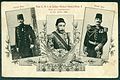 Enver Bey, Sultan Abdul Hamid II and Niyazi Bey
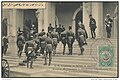 Abdul Hamid II arrives in Thessaloniki
 Istanbul Military Museum Abdulhamid II desk


See also
Citations
- Hoiberg, Dale H., ed. (2010). "Abdulhamid II". Encyclopedia Britannica. Vol. I: A-ak Bayes (15th ed.). Chicago, IL: Encyclopedia Britannica Inc. pp. 22. ISBN 978-1-59339-837-8.
- Some sources state that his birth date was on 22 September.
- Overy, Richard pp. 252, 253 (2010)
- "Abdulhamid II | biography – Ottoman sultan". Archived from the original on 26 January 2021. Retrieved 29 September 2015.
- Deringil, Selim (April 2003). "'They Live in a State of Nomadism and Savagery': The Late Ottoman Empire and the Post-Colonial Debate". Comparative Studies in Society and History. 45 (2): 311–342. doi:10.1017/S001041750300015X. JSTOR 3879318. Archived from the original on 31 December 2023. Retrieved 17 January 2024.
- "Sultan beaten, capital falls, 6,000 are slain". The New York Times. 25 April 1909. Archived from the original on 16 August 2019. Retrieved 16 August 2019.
- Vahan Hamamdjian (2004). Vahan's Triumph: Autobiography of an Adolescent Survivor of the Armenian Genocide. iUniverse. p. 11. ISBN 978-0-595-29381-0.
- Sharkey, Heather J. (2017). "The Pivotal Era of Abdulhamid II, 1876–1909". A History of Muslims, Christians, and Jews in the Modern Middle East. Cambridge University Press. pp. 179–242. doi:10.1017/9781139028455.006. ISBN 978-1-139-02845-5. Archived from the original on 10 June 2018. Retrieved 24 October 2020.
- Schmidt, Jan (2018). "Introduction". The Orientalist Karl Süssheim Meets the Young Turk Officer İsma'il Hakki Bey: Two Unexplored Sources from the Last Decade in the Reign of the Ottoman Sultan Abdulhamid II. Brill. p. 2. ISBN 978-90-04-36617-6. Archived from the original on 9 May 2021. Retrieved 24 October 2020.
- Ihrig, Stefan (2014). "Prologue: Leaving 'Enverland'". Atatürk in the Nazi Imagination. Harvard University Press. pp. 1–9. doi:10.2307/j.ctt9qdt54. ISBN 978-0-674-36837-8. JSTOR j.ctt9qdt54.
- Devrim, Cemil (February 1964). "The Oldest Turkish Newspaper – Yeni Asir". Gazette (Leiden, Netherlands). 10 (1): 11–15. doi:10.1177/001654926401000103. S2CID 144092475. Archived from the original on 29 October 2020. Retrieved 24 October 2020.
- Razmik Panossian (2013). The Armenians: From Kings and Priests to Merchants and Commissars. Columbia University Press. p. 165. ISBN 978-0-231-13926-7.
- Zürcher, Erik (1993). Turkey: A Modern History (2nd ed.). I. B. Tauris. pp. 80–81. ISBN 1-86064-222-5.
- İnanç, Yusuf Selmen (29 March 2024). "Abdulhamid II: An autocrat, reformer and the last stand of the Ottoman Empire". Middle East Eye.
- Yetkin, Murat (29 July 2020). "Abdülhamid: yazdım diye MİT sitesinden çıkarabilirler ama". Yetkin Report.
- Eldem, Edhem (Fall 2018). "Sultan Abdülhamid II: Founding Father of the Turkish State?". Journal of the Ottoman and Turkish Studies Association. 5 (2): 25–46. doi:10.2979/jottturstuass.5.2.05.
- "Turkish Royalty". Ancestry. Archived from the original on 6 April 2012. Retrieved 29 November 2012.
- "Osmanlı İmparatorluğu Türk Sultanları". Osmanlı Araştırmaları Vakfı. Archived from the original on 11 July 2012. Retrieved 29 November 2012.
- Freely, John – Inside the Seraglio, published 1999, Chapter 15: On the Shores of the Bosphorus
- Brookes, Douglas Scott (2010). The Concubine, the Princess, and the Teacher: Voices from the Ottoman Harem. University of Texas Press. p. 134. ISBN 978-0-292-78335-5.
- "Sultan Abdülaziz – Avrupa Seyahati". blog.milliyet.com.tr. Archived from the original on 11 November 2014. Retrieved 15 November 2014.
- Davison, Roderique H. Reform in the Ottoman Empire. Princeton University Press, 1963
- Hourani, Albert. Arabic Thought in the Liberal Age, 1798–1939. Cambridge University Press, 1962, p. 68
- Freely, John (1998). Istanbul: The Imperial City. London; New York: Penguin Books. p. 282. ISBN 978-0-14-024461-8.
- The Encyclopædia Britannica, Vol.7, Edited by Hugh Chisholm, (1911), 3; Constantinople, the capital of the Turkish Empire
- Britannica, Istanbul Archived 18 December 2007 at the Wayback Machine:When the Republic of Turkey was founded in 1923, the capital was moved to Ankara, and Constantinople was officially renamed Istanbul in 1930.
- "Turkish Naval History: The Period of the Navy Ministry". Dzkk.tsk.mil.tr. Archived from the original on 7 December 2006.
- Cleveland, William L. (2008)"History of the Modern Middle East" (4th ed.) p. 121.
- Erdem, Y. (1996). Slavery in the Ottoman Empire and Its Demise 1800–1909. Storbritannien: Palgrave Macmillan UK. 144
- Cleveland, William; Burton, Martin (2013). A History of the Modern Middle East. Boulder, CO: Westview Press. pp. 123–124. ISBN 978-0-8133-4833-9.
- "Curios Information about Armenia". Armenica.org. Archived from the original on 3 March 2016. Retrieved 23 September 2006.
- Klein, Janet (2011). The Margins of Empire: Kurdish Militias in the Ottoman Tribal Zone. Stanford: Stanford University Press, pp. 21–34.
- McDowall, David (2004). A Modern History of the Kurds (3rd rev. and updated ed.) London: I.B. Tauris, pp. 60–62.
- Nalbandian, Louise (1963). The Armenian Revolutionary Movement: The Development of Armenian Political Parties through the Nineteenth Century. Berkeley: University of California Press.
- "Constitutional Rights Foundation". Cfr-usa.org. Archived from the original on 9 October 2006. Retrieved 22 September 2006.
- Rodogno, Davide. Against Massacre: Humanitarian Interventions in the Ottoman Empire, 1815–1914. Princeton University Press, 2012, pp. 185–211; Gary J. Bass, Freedom's Battle: The Origins of Humanitarian Intervention. New York: Alfred A. Knopf, 2008; Balakian, The Burning Tigris
- "Sitara, Interior Door Curtain of the Ka'ba, Sultan Abdülhamid II (r. 1876–1909)". www.metmuseum.org. Archived from the original on 16 October 2022. Retrieved 28 December 2018.
- Takkush, Mohammed Suhail, "The Ottoman's History" pp. 489, 490
- One or more of the preceding sentences incorporates text from a publication now in the public domain: Chisholm, Hugh, ed. (1911). "Abd-ul-Hamid II". Encyclopædia Britannica. Vol. 1 (11th ed.). Cambridge University Press. p. 36.
- "עניין היהודים", (יומני הרצל). הוצאת מוסד ביאליק. p. 332.
את הדברים אמר הסולטאן לשליחו של הרצל (נוולינסקי) ב-19 ביוני 1896. מקור - "עניין היהודים", (יומני הרצל) - הוצאת מוסד ביאליק, כרך א' עמוד 332. הרצל עצמו נפגש עם הסולטאן רק ב-17 במאי 1901, ללא הישגים נוספים.
- Lewis.B, "The Emergence of Modern Turkey" Oxford, 1962, p. 337
- Kemal H. Karpat (2001). The Politicization of Islam: Reconstructing Identity, State, Faith, and Community in the Late Ottoman State. Oxford University Press. pp. 235–. ISBN 978-0-19-513618-0.
- Moshe Yegar (2002). Between Integration and Secession: The Muslim Communities of the Southern Philippines, Southern Thailand, and Western Burma/Myanmar. Lexington Books. pp. 397–. ISBN 978-0-7391-0356-2.
- Idris Bal (2004). Turkish Foreign Policy in Post Cold War Era. Universal-Publishers. pp. 405–. ISBN 978-1-58112-423-1.
- Idris Bal (2004). Turkish Foreign Policy in Post Cold War Era. Universal-Publishers. pp. 406–. ISBN 978-1-58112-423-1.
- Akyol, Mustafa (26 December 2006). "Mustafa Akyol: Remembering Abdul Hamid II, a pro-American caliph". Weekly Standard. History News Network. Archived from the original on 27 September 2022. Retrieved 28 July 2016.
- ERASMUS (26 July 2016). "Why European Islam's current problems might reflect a 100-year-old mistake". The Economist. Archived from the original on 4 September 2017. Retrieved 13 July 2017.
- Mustafa Akyol (2011). Islam without Extremes: A Muslim Case for Liberty. W. W. Norton. pp. 159–. ISBN 978-0-393-07086-6.
- J. Robert Moskin (2013). American Statecraft: The Story of the U.S. Foreign Service. St. Martin's Press. pp. 204–. ISBN 978-1-250-03745-9.
- George Hubbard Blakeslee; Granville Stanley Hall; Harry Elmer Barnes (1915). The Journal of International Relations. Clark University. pp. 358–.
- The Journal of Race Development. Clark University. 1915. pp. 358–.
- Political Science Quarterly. Academy of Political Science. 1904. pp. 22–.
Straus Sulu Ottoman.
- Kho, Madge. "The Bates Treaty". Philippine Update. Archived from the original on 9 December 2000. Retrieved 26 June 2015.
- R. Snelling (5 October 1906). "The Sultan's Successor". The Egyptian Gazette. Archived from the original on 17 October 2022. Retrieved 1 May 2020.
- Kemal H. Karpat (2001). The politicisation of Islam: reconstructing identity, state, faith, and community in the late Ottoman state. US: Oxford University Press. p. 237. ISBN 0-19-513618-7. Retrieved 28 June 2010.The Spectator, Volume 87. F.C. Westley. 1902. p. 243. Retrieved 1 April 2013.
Harris, Lillian Craig (1993). China Considers the Middle East (Illustrated ed.). I. B. Tauris. p. 56. ISBN 1-85043-598-7. Retrieved 1 April 2013.
"The official Russian announcement that..." The Straits Times. 10 July 1901. p. 2. Archived from the original on 3 August 2016. Retrieved 1 April 2013.
The Moslem World. Vol. 1–3. Hartford Seminary Foundation. 1966. p. 190. Retrieved 1 April 2013. - Robert A. Bickers (2007). The Boxers, China, and the World. Rowman & Littlefield. pp. 150–. ISBN 978-0-7425-5395-8.
- Lévy-Aksu, Noémi (8 November 2016). "An Ottoman variation on the state of siege: The invention of the idare-i örfiyye during the first constitutional period". New Perspectives on Turkey. 55: 5–28. doi:10.1017/npt.2016.19 – via Cambridge University Press.
- McMeekin 2016, p. 34.
- Creelman, James (22 August 1909). "The Slaughter of Christians in Asia Minor". The New York Times. Archived from the original on 28 July 2012. Retrieved 27 December 2007.
- "World's Largest Fortune to be Split Among Harem Inmates of the Last and Ill-Fated Turkish Sultan". The Cincinnati Enquirer. 20 April 1930. Archived from the original on 24 February 2018. Retrieved 23 February 2018.
- Renée Worringer (2004). "Sickman of Europe or Japan of the Near East?: Constructing Ottoman Modernity in the Hamidian and Young Turk Eras". International Journal of Middle East Studies. 36 (2): 209. doi:10.1017/S0020743804362033. S2CID 156657393.
- "The Ottoman caliphate: Worldly, pluralist, hedonistic – and Muslim, too". The Economist. 19 December 2015. Archived from the original on 8 August 2017. Retrieved 26 December 2015.
- Turner, Barry. Suez.1956 pp. 32–33
- Küskü, Fırat (1 January 2021). "II. Abdülhamid'in Madalya Siyaseti: Liyakat Madalyası Örneği / Abdul Hamid II's Medal Policy: The Medal of Merit Example". Türk Kültürü İncelemeleri Dergisi. 04 (46): 109. Archived from the original on 28 March 2022. Retrieved 29 January 2022.
- "Straddling two worlds". The Economist. London. 19 December 2015. Archived from the original on 26 December 2015. Retrieved 9 September 2024.
- McMeekin 2016, p. 31.
- "Sheikh Mohammed Zafir". Madani86.blogspot.com. 19 July 2008. Archived from the original on 26 February 2014. Retrieved 19 November 2013.
- Ottoman Diplomacy: Abdülhamid II and the Great Powers 1878–1888
- F. A. K. Yasamee. Ottoman Diplomacy: Abdülhamid II and the Great Powers 1878–1888 p. 20
- Farah, C.E. (2008). Abdülhamid II and the Muslim world. Foundation for Research on Islamic history, Art and History. p. 58. ISBN 978-975-7874-31-7. Archived from the original on 16 April 2022. Retrieved 13 September 2020.
- Mushirul Hasan (2010). Between Modernity and Nationalism: Halide Edip's Encounter with Gandhi's India. Oxford University Press. p. 32. ISBN 978-0-19-806332-2. Archived from the original on 16 April 2022. Retrieved 13 September 2020.
- Brookes, D.S., 2010. The concubine, the princess, and the teacher: Voices from the Ottoman Harem. University of Texas Press.
- Harun Açba (2007). Kadın efendiler: 1839–1924. Profil. ISBN 978-9-759-96109-1.
- Gündoğdu, Raşit (19 November 2020). The Portrait of A Political Genius Sultan Abdulhamid II. Rumuz Publishing. Archived from the original on 8 April 2023. Retrieved 18 July 2022.
- Adra, Jamil (2005). Genealogy of the Imperial Ottoman Family 2005, pg. 23
- Necdet Sakaoğlu, "Bu Mülkün Kadın Sultanları: Vâlide Sultanlar, Hâtunlar, Hasekiler, Kadınefendiler, Sultanefendiler"; pp.667-686
- Harun Açba (2007). Kadın efendiler: 1839–1924. Profil. ISBN 978-9-759-96109-1.
- Asghar, Ain Hafizah (15 July 2010). "Payitaht Abdulhamid Turkish Historical Drama Series". 3ISK Space (in Arabic). Jannah Aamal Shammas.[permanent dead link]
- "Ritter-Orden", Hof- und Staatshandbuch der Österreichisch-Ungarischen Monarchie, 1900, p. 58, archived from the original on 13 July 2020, retrieved 22 May 2020
- Pedersen, Jørgen (2009). Riddere af Elefantordenen, 1559–2009 (in Danish). Syddansk Universitetsforlag. p. 300. ISBN 978-87-7674-434-2. Archived from the original on 14 January 2023. Retrieved 11 July 2019.
- Sveriges Statskalender (in Swedish), 1905, p. 440, archived from the original on 24 February 2021, retrieved 6 January 2018 – via runeberg.org
- Kalakaua to his sister, 12 July 1881, quoted in Greer, Richard A. (editor, 1967) "The Royal Tourist – Kalakaua's Letters Home from Tokio to London Archived 19 October 2019 at the Wayback Machine", Hawaiian Journal of History, vol. 5, p. 96
- Norges Statskalender (in Norwegian), 1890, pp. 595–596, archived from the original on 11 July 2019, retrieved 6 January 2018 – via runeberg.org
- "Guía Oficial de España". Guía Oficial de España: 147. 1887. Archived from the original on 22 December 2019. Retrieved 21 March 2019.
- Staatshandbuch für das Großherzogtum Sachsen / Sachsen-Weimar-Eisenach Archived 6 September 2020 at the Wayback Machine (1900), "Großherzogliche Hausorden" p. 16
- The Grand Master of the Bulgarian Orders Archived 10 July 2020 at the Wayback Machine - official website of H.M. Simeon II
- "Ordinul Carol I" [Order of Carol I]. Familia Regală a României (in Romanian). Bucharest. Archived from the original on 6 May 2021. Retrieved 17 October 2019.
- Italia : Ministero dell'interno (1898). Calendario generale del Regno d'Italia. Unione tipografico-editrice. p. 54.
- "Schwarzer Adler-orden". Königlich Preussische Ordensliste (in German). Vol. 1. Berlin: General-Ordenskommission. 1886. p. 9. Archived from the original on 18 August 2021. Retrieved 22 January 2024.
- Royal Thai Government Gazette (18 December 1892). "พระราชทานเครื่องราชอิสริยาภรณ์" (PDF) (in Thai). Archived from the original (PDF) on 4 March 2016. Retrieved 8 May 2019.
- 刑部芳則 (2017). 明治時代の勲章外交儀礼 (PDF) (in Japanese). 明治聖徳記念学会紀要. p. 144. Archived (PDF) from the original on 9 October 2022. Retrieved 17 August 2020.
- Hof- und - Staatshandbuch des Königreichs Bayern (1910), "Königliche Orden". p. 8
- William Allen, "The Abdul Hamid II Collection", History of Photography eight (1984): 119–145.
- M. I. Waley and British Library, "Sultan Abdulhamid II Early Turkish Photographs in 51 Albums from the British Library on Microfiche"; Zug, Switzerland: IDC, 1987
- "Ottoman Empire photographs". Library of Congress. Archived from the original on 6 March 2010. Retrieved 24 February 2005.

Remove ads
Further reading
- Akarli, Engin D. (2001). "The Tangled Ends of an Empire and Its Sultan". In Leila Tarazi Fawaz; C.A. Bayly (eds.). Modernity and Culture: From the Mediterranean to the Indian Ocean. New York: Columbia University Press. pp. 261–284. ISBN 978-0-231-11426-4.
- Zürcher, Erik (1993). Turkey: A Modern History (2nd ed.). New York, NY: I. B. Tauris. ISBN 1-86064-222-5.
- Georgeon, François (2003). Abdülhamid II. Le sultan calife. Paris: Fayard.
- Haslip, Joan (1973). The Sultan: The life of Abdul Hamid (2nd ed.). Cassell. ISBN 978-0-297-76519-6.
- Küçük, Cevdet (1988). Abdülhamid II – An article published in the first volume of Turkish Encyclopedia of Islam (in Turkish). Vol. 1 (Ab-i Hayat /el-Ahkamu's – Ser'iyye). Istanbul: TDV İslâm Ansiklopedisi. pp. 216–224. ISBN 978-97-53-89428-9.
- Pears, Edwin Sir (1917). The Life of Abdul Hamid (1 ed.). London: Constable and Company Ltd. Retrieved 17 March 2019 – via Internet Archive.
- Shaw, Stanford J.; Shaw, Ezel K. (1977). History of the Ottoman Empire and Modern Turkey. Vol. 2: Reform, Revolution, and Republic: The Rise of Modern Turkey, 1808–1975. Cambridge: Cambridge University Press. ISBN 978-0-521-29166-8.
- Yasamee, F.A.K. (1996). Ottoman Diplomacy: Abdülhamid II and the Great Powers, 1878–1888. Istanbul: ISIS. ISBN 978-975-428-088-3.
External links
 Media related to Abdül Hamid II at Wikimedia Commons
- II. Abdul Hamid Forum in English Archived 2 February 2010 at the Wayback Machine II. Abdul Hamid Forum in English
- II. Abdülhamit Dönemi Olayları – ittihat Ve Terakki Ödev Sitesi
- US Library of Congress Abdul Hamid II Photo Collection – about 1,800 photographs mounted in albums, ca. 1880–1893
- . Collier's New Encyclopedia. 1921.
- Newspaper clippings about Abdul Hamid II in the 20th Century Press Archives of the ZBW
- Portraits of Abdul Hamid II at the National Portrait Gallery, London

Wikiwand - on
Seamless Wikipedia browsing. On steroids.
Remove ads