Top Qs
Timeline
Chat
Perspective
Anantanatha
14th Tirthankara in Jainism From Wikipedia, the free encyclopedia

Remove ads
Anantanatha was the fourteenth Tirthankara of the present age (Avasarpini) of Jainism. According to Jain beliefs, he became a siddha, a liberated soul which has destroyed all of its karma.
Remove ads
Biography
Summarize
Perspective
Anantanatha was the fourteenth Tirthankara of the present age (Avasarpini) of Jainism.[2] According to Jain beliefs, he became a siddha, a liberated soul which has destroyed all of its karma.[citation needed]His name, meaning “Infinite Lord,” symbolizes the boundlessness of spiritual liberation in Jain philosophy.[3] The Jainpedia account describes the five major kalyanakas, which are conception, birth, renunciation, enlightenment, and liberation. These mark the sacred milestones of his life as preserved in both Svetambara and Digambara traditions.[3]
Anantanatha was born to King Sinhasena and Queen Suyasha at Ayodhya in the Ikshvaku dynasty.[2] His birth date was the 13th day of the Vaishakha Krishna month of the Indian calendar.[citation needed] From a young age, Anantanatha exhibited signs of spiritual inclination, including detachment from worldly pleasures and an early interest in meditation and reflection, as described in Jain narratives.[3] After living a princely life, he renounced worldly attachments and undertook rigorous ascetic practices, eventually attaining kevala jñāna, or omniscience, through meditation and discipline.[3] His height is mentioned as 50 dhanusha.[4] He is said to have lived for 3,000,000 years.[4]
Anantanatha is said to have been born 9 sagara after his predecessor, Vimalanatha.[4] His successor, Dharmanatha, is said to have been born 4 sagara after him.[4]
Remove ads
Literature
- Ananthnatha Purana was written by Janna in 1230 CE.[citation needed]
Famous Temple
Anantnath Swami Temple in Kalpetta, Kerala
 Anantnath Swami Temple in Kalpetta, Kerala
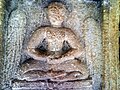 Image at Anantnath Swami Temple
 Ananthnath Temple, Madhuban


Anantanātha is venerated at several important Jain temples across India. He appears frequently in temple complexes where all 24 Tīrthankaras are represented in sequence.[3]
See also

Wikimedia Commons has media related to Anantanatha.
References
Wikiwand - on
Seamless Wikipedia browsing. On steroids.
Remove ads