Top Qs
Timeline
Chat
Perspective
Askey scheme
Classification of orthogonal polynomials From Wikipedia, the free encyclopedia
Remove ads
In mathematics, the Askey scheme is a way of organizing orthogonal polynomials of hypergeometric or basic hypergeometric type into a hierarchy. For the classical orthogonal polynomials discussed in Andrews & Askey (1985),[1] the Askey scheme was first drawn by Labelle (1985)[2] and by Askey and Wilson (1985),[3] and has since been extended by Koekoek & Swarttouw (1998)[4] and Koekoek, Lesky & Swarttouw (2010)[5] to cover basic orthogonal polynomials.
Remove ads
Askey scheme for hypergeometric orthogonal polynomials
Summarize
Perspective
Koekoek, Lesky & Swarttouw (2010)[6] give the following version of the Askey scheme:
- Wilson | Racah
- Continuous dual Hahn | Continuous Hahn | Hahn | dual Hahn
- Meixner–Pollaczek | Jacobi | Pseudo Jacobi | Meixner | Krawtchouk
- Laguerre | Bessel | Charlier
- Hermite




Here indicates a hypergeometric series representation with parameters


Remove ads
Askey scheme for basic hypergeometric orthogonal polynomials
Koekoek, Lesky & Swarttouw (2010)[7] give the following scheme for basic hypergeometric orthogonal polynomials:
- 43
- Askey–Wilson | q-Racah
- 32
- Continuous dual q-Hahn | Continuous q-Hahn | Big q-Jacobi | q-Hahn | dual q-Hahn
- 21
- Al-Salam–Chihara | q-Meixner–Pollaczek | Continuous q-Jacobi | Big q-Laguerre | Little q-Jacobi | q-Meixner | Quantum q-Krawtchouk | q-Krawtchouk | Affine q-Krawtchouk | Dual q-Krawtchouk
- 20/11
- Continuous big q-Hermite | Continuous q-Laguerre | Little q-Laguerre | q-Laguerre | q-Bessel | q-Charlier | Al-Salam–Carlitz I | Al-Salam–Carlitz II
- 10
- Continuous q-Hermite | Stieltjes–Wigert | Discrete q-Hermite I | Discrete q-Hermite II

Remove ads
Completeness
Summarize
Perspective
While there are several approaches to constructing still more general families of orthogonal polynomials, it is usually not possible to extend the Askey scheme by reusing hypergeometric functions of the same form. For instance, one might naively hope to find new examples given by

above which corresponds to the Wilson polynomials. This was ruled out in Cheikh, Lamiri & Ouni (2009)[8] under the assumption that the are degree 1 polynomials such that


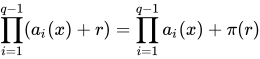
for some polynomial .

Remove ads
References
Further reading
Wikiwand - on
Seamless Wikipedia browsing. On steroids.
Remove ads