Top Qs
Timeline
Chat
Perspective
Cheyenne Depot Museum
Railroad museum in Cheyenne, Wyoming, US From Wikipedia, the free encyclopedia

Remove ads
The Cheyenne Depot Museum is a railroad museum in Cheyenne, Wyoming, United States. It is located inside the 1880s Union Pacific Railroad depot. A National Historic Landmark, the station was the railroad's largest west of Council Bluffs, Iowa, and a major western example of Richardsonian Romanesque architecture.
.jpg)

The museum, founded in 1993, interprets Cheyenne's early history and that of the construction of the Union Pacific Railroad. It houses multiple exhibits and occasionally offers tours of other railroad facilities.
Remove ads
History
The Depot was built directly down the street from and facing the Wyoming State Capitol building, signaling its significance to the city and state.
The building was lengthened and renovated in 1922 and redecorated in 1929. Further renovations were made from 2001 to 2006, including a $6.5 million improvement by the city of Cheyenne and a plaza built in front of the Depot. This plaza hosts a variety of music and events throughout the year.
Amtrak's San Francisco Zephyr ceased serving this station directly in 1979 in favor of a new station in Borie, nine miles to the west. This eliminated a time-consuming backup move in and out of the Cheyenne station.[5] Passengers were bused between Borie and Cheyenne. Passenger rail service ended altogether in Wyoming when Amtrak canceled its Pioneer in 1997.
As of 2022, a new train service is proposed to connect Cheyenne and Pueblo, Colorado.
The Old West Museum and Cheyenne Frontier Days made an agreement that established the Cheyenne Depot Museum, Inc., as a 501(c)3 non-profit organization. The organization leased the depot from the city of Cheyenne for 25 years.
Remove ads
Architecture
Summarize
Perspective
Exterior
The original design of the depot was a Richardsonian Romanesque style, designed by Van Brunt & Howe.[6] There are many notable architectural elements used in the depot's design including rounded arches, a tall clock tower, dual-colored sandstone, and pitched roofs. Large rounded arches make up the north and south facades of the depot, as well as a clock tower standing six stories tall on the north side of the building.[6] The clock tower features 4 conical spires on each corner with a pyramidal roof capped by a cast-iron weather vane. Towards the top of the tower facing North, South, East, and West, are 4 clock faces spanning 6 feet 4 inches in diameter.[7] The clock however, was not installed until 1890, 3 years after the building was completed.[7] The Union Pacific quarry in Bellevue, CO produced a red-orange and a softer sand-colored stone to be used on the depot.[6] The red-orange stone was used to outline arches, windows, roof lines, floor lines, and doors. In some cases, the red-orange stones were used to create false windows. The dark, slate, pitched roof features 4 congruent dormer windows facing the depot square.
Interior
When the dining room and kitchen were added, interior finishes included wood paneling, coffered ceilings, and tile floors.[6] Gilbert Stanley Underwood redecorated the Depot Interior in 1929. Some of these new decorations included new paint and plaster.[5]
Remove ads
Construction
John F. Coots was hired by the Union Pacific Railroad in 1886 to complete the depot. In the middle of July 1886, the Cheyenne community celebrated the placement of the cornerstone. The stone blocks were transported from the Union Pacific quarry to the Cheyenne depot by train. As the project continued, the administration hired more laborers to accommodate a May 1887 completion. The Cheyenne depot underwent a renovation in 1922, adding a 114 ft addition to the east side of the building. This addition was a near mirror of the west part of the depot and was built by H.W. Baum.[6] The quarry used in 1886 for the original building was reopened and used to acquire matching stone for the new addition. The addition accompanied a dining room as well as a kitchen. In 1929, the depot underwent another major renewal, steel replaced structural wood members, and the interior was reimagined in the Art Deco style.[8]
Gallery
 2011 photo of the depot
 The nearby roundhouse where the Union Pacific Railroad stores its historic steam locomotives and E9 diesel locomotives.
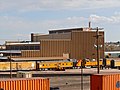 UP's nearby machine shop, where it services its steam locomotives.


See also


References
External links
Wikiwand - on
Seamless Wikipedia browsing. On steroids.
Remove ads