Top Qs
Timeline
Chat
Perspective
Goormaghtigh conjecture
From Wikipedia, the free encyclopedia
Remove ads
In mathematics, the Goormaghtigh conjecture is a conjecture in number theory named for the Belgian mathematician René Goormaghtigh about the solutions of the exponential Diophantine equation
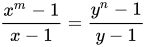
with distinct integers larger than one and exponents larger than two. One convention is and in turn .


The conjecture states that the only such solutions are
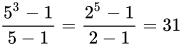
and
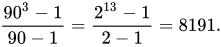
Remove ads
Representation
Summarize
Perspective
The fraction of either side of the conjecture exactly represents a geometric series. Indeed, and so, for example, . As such, the exponential Diophantine equation equates two univariate polynomials, with terms and highest order on the left hand side, and on the right.


Alternatively, by cross-multiplication of the fraction's denominators, the equation is equivalently expressed as

or similar forms.
In terms of repunits
Equating two expressions of the form , the Goormaghtigh conjecture may also be expressed as saying that there are only two numbers that are repunits with at least three digits in two different bases. The number 31 may be represented as 111 in base 5 or as 11111 in base 2, while 8191 is 111 in base 90 or 1111111111111 in base 2.

Remove ads
Partial results
Yuan (2005) showed that for and odd , the equation has no solution other than the two solutions given above.


The conjecture has been subject to extensive computer supported solution search, especially in small cases (restricting to in the thousands, or alternatively restricting to with around a dozen digits) or when the fraction is prime (hundreds of digits). This is aided by various necessary congruence relations. For fixed and , loose upper bounds for can be computed from . Taking logs relates the exponents as .


Nesterenko & Shorey (1998) showed that if the exponents are composed from positive integers as in and with , then is bounded by an effectively computable constant depending only on and .


Davenport, Lewis & Schinzel (1961) showed that, for each pair of fixed exponents and , the equation has only finitely many solutions. The proof of this, however, depends on Siegel's finiteness theorem, which is ineffective.
Balasubramanian and Shorey proved in 1980 that there are only finitely many possible solutions to the equations with prime divisors of and lying in a given finite set and that they may be effectively computed.

He & Togbé (2008) showed that, for each fixed and , this equation has at most one solution. For fixed x (or y), equation has at most 15 solutions, and at most two unless y is either odd prime power times a power of two, or in the finite set {15, 21, 30, 33, 35, 39, 45, 51, 65, 85, 143, 154, 713}, in which case there are at most three solutions. Furthermore, there is at most one solution if the odd part of y is squareful unless y has at most two distinct odd prime factors or y is in a finite set {315, 495, 525, 585, 630, 693, 735, 765, 855, 945, 1035, 1050, 1170, 1260, 1386, 1530, 1890, 1925, 1950, 1953, 2115, 2175, 2223, 2325, 2535, 2565, 2898, 2907, 3105, 3150, 3325, 3465, 3663, 3675, 4235, 5525, 5661, 6273, 8109, 17575, 39151}. If y is a power of two, there is at most one solution except for y = 2, in which case there are two known solutions. In fact, and .


Again, beware that the alternative convention, , is also used in the literature.

Remove ads
See also
References
- Goormaghtigh, Rene. L’Intermédiaire des Mathématiciens 24 (1917), 88
- Bugeaud, Y.; Shorey, T.N. (2002). "On the diophantine equation " (PDF). Pacific Journal of Mathematics. 207 (1): 61–75. doi:10.2140/pjm.2002.207.61.
- Balasubramanian, R.; Shorey, T.N. (1980). "On the equation ". Mathematica Scandinavica. 46: 177–182. doi:10.7146/math.scand.a-11861. MR 0591599. Zbl 0434.10013.
- Davenport, H.; Lewis, D. J.; Schinzel, A. (1961). "Equations of the form ". Quad. J. Math. Oxford. 2: 304–312. doi:10.1093/qmath/12.1.304. MR 0137703.
- Guy, Richard K. (2004). Unsolved Problems in Number Theory (3rd ed.). Springer-Verlag. p. 242. ISBN 0-387-20860-7. Zbl 1058.11001.
- He, Bo; Togbé, Alan (2008). "On the number of solutions of Goormaghtigh equation for given and ". Indag. Math. New Series. 19: 65–72. doi:10.1016/S0019-3577(08)80015-8. MR 2466394.
- Nesterenko, Yu. V.; Shorey, T. N. (1998). "On an equation of Goormaghtigh" (PDF). Acta Arithmetica. LXXXIII (4): 381–389. doi:10.4064/aa-83-4-381-389. MR 1610565. Zbl 0896.11010.
- Shorey, T.N.; Tijdeman, R. (1986). Exponential Diophantine equations. Cambridge Tracts in Mathematics. Vol. 87. Cambridge University Press. pp. 203–204. ISBN 0-521-26826-5. Zbl 0606.10011.
- Yuan, Pingzhi (2005). "On the diophantine equation ". J. Number Theory. 112: 20–25. doi:10.1016/j.jnt.2004.12.002. MR 2131139.


Remove ads
Wikiwand - on
Seamless Wikipedia browsing. On steroids.
Remove ads