Top Qs
Timeline
Chat
Perspective
HMS London (1840)
Ship of the line of the Royal Navy From Wikipedia, the free encyclopedia

Remove ads
HMS London was a two-decker, 90-gun second-rate ship of the line of the Royal Navy, launched on 28 September 1840 at Chatham Dockyard.[1] In 1854 she took part in the bombardment of the Konstantin Battery at Sevastopol during the Crimean War of 1854–1855, where she sustained damage.

Remove ads
Design and description
Summarize
Perspective
The ships were 205 feet 6 inches (62.6 m) at the gun deck and 170 feet 1 inch (51.8 m) at the keel. The Rodney class had a beam of 54 feet 5 inches (16.6 m), a depth of hold of 23 feet (7.0 m) and measured 2,625 69⁄94 tons burthen. Their crew numbered 720 in peacetime and 820 in wartime.[2] The ships had the usual three-masted full-ship rig with a sail area of 28,102 square feet (2,610.8 m2).[3]
Captain Charles Napier called Rodney, "a fine warship, but it is not a very superior sailer".[4] That is not supported by experience as the ship proved to be a steady gun platform with a slow roll and was able to make 11.4 knots (21.1 km/h; 13.1 mph) sailing large early during her first deployment to the Mediterranean. Minor modifications in the early 1840s that including raking her masts backwards subsequently reduced her performance.[5] During comparative speed trials in 1845 against other ships of the line, including Canopus, Vanguard, and Albion, Rodney proved to be the fastest in a head sea, but performed less well under other conditions.[6]
The muzzle-loading, smoothbore armament of the Rodney class consisted of thirty-two 32-pounder (63 cwt) guns[Note 1] and two 8-inch (203 mm) (50 cwt) shell guns on the lower gun deck and thirty-two 32-pounder (55 cwt) and two 8-inch (50 cwt) shell guns on the upper gun deck. Between their forecastle and quarterdeck, they carried twenty-four 32-pounder (42 cwt) guns. The ships were later rearmed with twenty-six 32-pounders (56 cwt) and six 8-inch shell guns on the lower gundeck and thirty 32-pounders (56 cwt) and six 8-inch shell guns on the upper deck. The number of guns on the forecastle and quarterdeck increased to twenty-six 32-pounders (42 cwt) guns.[7] These guns made the Rodney-class ships the most powerful warships in the world when designed because they were the first to carry a full array of long guns that were accurate at long range. Without short-range carronades they outgunned French and American ships of the same size at long range.[5]
Based on the experiences gained during the Crimean War, Baldwin Wake Walker, Surveyor of the Navy, favored converting first- and second-rate ships as they could accommodate the engines and their required coal better than smaller ships. Nile's mediocre performance confirmed that the ships needed to be lengthened and their sterns rebuilt to get the best performance[8] and London was ordered to be converted accordingly on 11 December 1856. Work began on 14 January 1857 and she was lengthened to 213 feet 3 inches (65.0 m) which modestly increased her tons burthen to 2,687.[9] The ship received a 500 nhp engine built by Ravenhill, Selkeld & Co. that gave London a speed of 11.5 knots (21.3 km/h; 13.2 mph) during her sea trials on 15 December 1858 from 1,804 ihp (1,345 kW), although her masts and stores were not yet fitted.[10] London's conversion was so successful that she served as a model for the subsequent conversions of the five first-rate ships of the broadened Caledonia class and HMS Queen.[11]
By 1873, she was a hulk, serving as a depot ship in Zanzibar Bay, off the east coast of Africa, but in March 1878 she was recommissioned to assist in the suppression of the slave trade in the area, serving as a central repair depot, hospital and storage ship for many smaller steam screw boats. At this time there were Africans from West Africa (Kroomen or Krumen) and East Africa (Seedies or Sidis) serving on board. There were also Zanzibari and Arab interpreters and cooks from Portuguese Goa (India). In 1880 Lieutenant Charles Stewart Smith, an officer on another ship, led patrols which captured seven dhows and 185 enslaved people.[12] In 1883, three years later, Lieutenant Smith was seconded to the post of Vice-Consul, Zanzibar to Sir John Kirk, the British Consul-General.[13]
Captained by Charles J Brownrigg, London herself and her crew made several patrols aimed at hindering the slave trade and, on 3 December 1881, caught up with a slave dhow captained by Hindi bin Hattam. This dhow had around 100 enslaved people on board and was transporting them between Pemba and Zanzibar. Captain Brownrigg led a boarding party to release the enslaved people but bin Hattam's men then attacked the sailors, killing Brownrigg and some of his party before sailing away. Sir Lloyd William Mathews led a force to Wete on Pemba and, after a short battle, took a mortally wounded bin Hattem (Hindi-bin-Khartoum[14]) prisoner before returning to Zanzibar.
 19 January 1875 the bombardment of Mombasa by HMS Nassau and Rifleman and boats of HMS London, Illustrated London News
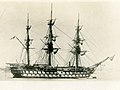 HMS London in Zanzibar circa 1876.
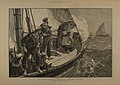 Pinnace attached to HMS London chasing a dhow in 1881
 A pinnace probably attached to the London for chasing slave ships.
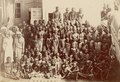 Newly released slaves on board H.M.S. London, circa 1880.


In late 1881, while the vessel was at Zanzibar, it suffered damage of a nature such that repairs were urgently required. The type of wood desired to make the repairs was teak, which "could not readily be procured in the open market." The Sultan was, however, known to have a store of the desired timber and so he was requested to assist with supplying it. This he did and the repairs done. However, the Sultan refused to accept any payment for the supplies. In the eyes of the commander of HMS London, it put the British Royal Navy "in an awkward position" because it would be very difficult to make similar requests in the future.[15]
The final entry in the ship's log is dated 22 January 1883. Captain Luxmoore writes "Paid ship off" "Sent ship's company to transport Windsor Castle in passage to England". In 1884 she was sold and broken up.[1]
Remove ads
Notes
- "Cwt" is the abbreviation for hundredweight, 63 cwt referring to the weight of the gun.
Citations
References
External links
Wikiwand - on
Seamless Wikipedia browsing. On steroids.
Remove ads