Top Qs
Timeline
Chat
Perspective
Metallic starling
Species of bird From Wikipedia, the free encyclopedia

Remove ads
The metallic starling (Aplonis metallica), also known as the shining starling, is a bird in the starling family native to the Moluccas, New Guinea, Queensland and the Solomon Islands.

Remove ads
Taxonomy
Summarize
Perspective
The metallic starling was formally described and illustrated as Lamprotornis metallicus in 1824 by the Dutch zoologist Coenraad Jacob Temminck.[2] He mistakenly specified the locality as Timor and Celebres but this has been corrected to the island of Ambon in the Maluku Islands of Indonesia.[3] The metallic starling is now one of 24 starlings placed in the genus Aplonis that was introduced in 1836 by the English ornithologist John Gould.[4]
Five subspecies are recognised:[4]
- A. m. metallica (Temminck, CJ, 1824) – Moluccas, Sula Islands, New Guinea including Aru Islands, and northeastern Australia (Cape York Peninsula southward to Sarina, northern Queensland)
- A. m. nitida (Gray, GR, 1858) – Admiralty Islands (Rambutyo, Tong, and outer Islands), Bismarck Archipelago, and Solomon Islands
- A. m. purpureiceps (Salvadori, AT, 1878) – Admiralty Islands (Manus Island and Los Negros Islands)
- A. m. inornata (Salvadori, AT, 1881) – Numfor and Biak (Cenderawasih Bay, off northwestern New Guinea)
- A. m. circumscripta (Meyer, AB, 1884) – Tanimbar Islands (Larat and Kirimoen) and Damar Island
The subspecies A. m. circumscripta has sometimes been considered as a separate species, the violet-hooded starling.[5]
Remove ads
Description

The adult has brilliant red eyes, a long forked tail and green-glossed black plumage. Immatures are pale below with dark streaks.
Behaviour
They are very social and flocks of them build messy suspended globular nests in tall rain forest trees where they breed, possibly only during the wet season (north-west monsoon, October–March) (observed at Kokopo, East New Britain Province, 2016). They are not fearful of humans and their activity on the ground below, being well separated from them by altitude, but a loud noise will see them fly out in a tight formation, circle, then return to their nests. Their movement is very fast. During the early part of the 20th century, a flock (or flocks) were seen to migrate during August[6] to Dunk Island in far north Queensland, where they mate, preparing messy globular nests for their young which hang from tall trees.[7] There they remain until April,[6] whereupon they make their return journey to New Guinea.[8] They are also seen in other areas of Queensland including Kuranda in the Atherton Tablelands, and Mossman Gorge.[8]
Gallery
 Phoenix Zoo, Arizona
 Juveniles, Cairns Esplanade, North Queensland
 Female with nest - Cairns, Queensland
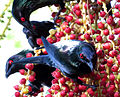 Feeding on Ptychosperma elegans fruit in Cairns, Queensland
 Metallic Starlings around high nests in the Daintree Rainforest in Queensland.
 Male at San Diego Zoo, California, USA
 Cairns


References
External links
Wikiwand - on
Seamless Wikipedia browsing. On steroids.
Remove ads