Top Qs
Timeline
Chat
Perspective
Quantum register
System comprising multiple qubits From Wikipedia, the free encyclopedia
Remove ads
In quantum computing, a quantum register is a system comprising multiple qubits.[1] It is the quantum analogue of the classical processor register. Quantum computers perform calculations by manipulating qubits within a quantum register.[2]
Definition
Summarize
Perspective
It is usually assumed that the register consists of qubits. It is also generally assumed that registers are not density matrices, but that they are pure, although the definition of "register" can be extended to density matrices.
An size quantum register is a quantum system comprising pure qubits.

The Hilbert space, , in which the data is stored in a quantum register is given by where is the tensor product.[3]



The number of dimensions of the Hilbert spaces depends on what kind of quantum systems the register is composed of. Qubits are 2-dimensional complex spaces (), while qutrits are 3-dimensional complex spaces (), etc. For a register composed of N number of d-dimensional (or d-level) quantum systems we have the Hilbert space


The registers quantum state vector of this -dimensional Hilbert space can in the bra-ket notation be written as a linear combination of some set of orthogonal basis vectors labeled to as Such linear combinations are in quantum mechanics called superpositions and the values are probability amplitudes. Because of the Born rule and the 2nd axiom of probability theory, so the possible state space of the register is the surface of the unit sphere in


Examples:
- The quantum state vector of a 5-qubit register is a unit vector in
- A register of four qutrits similarly is a unit vector in


Remove ads
Quantum vs. classical register
There are both structural and functional differences between quantum and classical registers. Structurally, an size classical register is an array of flip flops, whereas an size quantum register is a collection of qubits. Functionally, an size classical register stores a single value of the possibilities spanned by bits, whereas a quantum register is able to simultaneously store all possibilities spanned by quantum pure qubits.

For example, consider a two-bit register. A classical register is able to store only one of the possible values represented by 2 bits - accordingly.

If we consider two pure qubits in superpositions and , using the quantum register definition it follows that it is capable of storing all the possible values (by having non-zero probability amplitude for all outcomes) spanned by two qubits simultaneously.
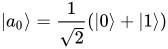
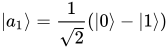

Remove ads
See also
References
Further reading
Wikiwand - on
Seamless Wikipedia browsing. On steroids.
Remove ads