Top Qs
Timeline
Chat
Perspective
Shaping codes
Improved efficiency encoding From Wikipedia, the free encyclopedia
Remove ads
In digital communications shaping codes are a method of encoding that changes the distribution of signals to improve efficiency.
 | This article has multiple issues. Please help improve it or discuss these issues on the talk page. (Learn how and when to remove these messages)
|


Remove ads
Description
Summarize
Perspective
Typical digital communication systems uses M-quadrature amplitude modulation (QAM) to communicate through an analog channel (specifically a communication channel with Gaussian noise). For Higher bit rates (M) the minimum signal-to-noise ratio (SNR) required by a QAM system with Error Correcting Codes is about 1.53 dB higher than minimum SNR required by a Gaussian source(>30% more transmitter power) as given in the Shannon–Hartley theorem
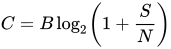
where
- C is the channel capacity in bits per second;
- B is the bandwidth of the channel in hertz;
- S is the total signal power over the bandwidth and
- N is the total noise power over the bandwidth.
- S/N is the signal-to-noise ratio of the communication signal to the Gaussian noise interference expressed as a straight power ratio (not as decibels).
This 1.53 dB difference is called the shaping gap. Typically, a digital system will encode bits with uniform probability to maximize the entropy. Shaping codes act as a buffer between digital sources and the modulator. They will receive uniformly distributed data and convert it to a Gaussian-like distribution before presenting it to the modulator. Shaping codes are helpful in reducing transmit power and thus reducing the cost of the power amplifier and the interference caused to other users in the vicinity.
Remove ads
Application
Some of the methods used for shaping are described in the trellis shaping paper by Dr. G. D. Forney Jr.[1]
Shell mapping[2] is used in V.34 modems to get a shaping gain of .8 dB. All the shaping schemes in the literature try to reduce the transmitted signal power. In the future, this may find application in wireless networks if the interference from other nodes becomes the major issue.
References
Wikiwand - on
Seamless Wikipedia browsing. On steroids.
Remove ads