Top Qs
Timeline
Chat
Perspective
Simplicial approximation theorem
Continuous mappings can be approximated by ones that are piecewise simple From Wikipedia, the free encyclopedia
Remove ads
In mathematics, the simplicial approximation theorem is a foundational result for algebraic topology, guaranteeing that continuous mappings can be (by a slight deformation) approximated by ones that are piecewise of the simplest kind. It applies to mappings between spaces that are built up from simplices—that is, finite simplicial complexes. The general continuous mapping between such spaces can be represented approximately by the type of mapping that is (affine-) linear on each simplex into another simplex, at the cost (i) of sufficient barycentric subdivision of the simplices of the domain, and (ii) replacement of the actual mapping by a homotopic one.
This theorem was first proved by L.E.J. Brouwer, by use of the Lebesgue covering theorem (a result based on compactness).[citation needed] It served to put the homology theory of the time—the first decade of the twentieth century—on a rigorous basis, since it showed that the topological effect (on homology groups) of continuous mappings could in a given case be expressed in a finitary way. This must be seen against the background of a realisation at the time that continuity was in general compatible with the pathological, in some other areas. This initiated, one could say, the era of combinatorial topology.
There is a further simplicial approximation theorem for homotopies, stating that a homotopy between continuous mappings can likewise be approximated by a combinatorial version.
Remove ads
Statement
Summarize
Perspective
The basic form of the theorem is the following:
Theorem—[1] Let be two simplicial complexes. If is a continuous map, then there are a subdivision of and a simplicial mapping whose geometric realization is homotopic to .

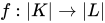


Also, if is a based map between pointed spaces, then and the homotopy can be taken to be based as well.


In short, the theorem says any continuous map between simplicial complexes is the geometric realization of a simplicial mapping up to homotopy and subdivision.
Here is a more precise formulation. A simplicial mapping is called a simplicial approximation of if for every point in , belongs to the minimal closed simplex of containing .[2]


If is a simplicial approximation to a map , then the geometric realization of is necessarily homotopic to ; in fact, the homotpy is given by .[3]


The simplicial approximation theorem states that given a map , there exists a natural number such that for all , there exists a simplicial approximation


to where denotes the barycentric subdivision of , and denotes the result of applying barycentric subdivision times. In fact, the proof of the theorem shows there is a real number depending on and (not just ) such that if each simplex in has diameter less than , then there exists a simplicial approximation to .


Moreover, if is a positive continuous map, then there are subdivisions of and a simplicial map such that is -homotopic to ; that is, there is a homotopy from to such that for all .[citation needed] So, we may consider the simplicial approximation theorem as a piecewise linear analog of Whitney approximation theorem.


![{\displaystyle H:|K|\times [0,1]\to |L|}](http://wikimedia.org/api/rest_v1/media/math/render/svg/50412176c71d70203e17e50b940ce4ed7281fb34)

![{\displaystyle \mathrm {diam} (H(x\times [0,1]))<\epsilon (f(x))}](http://wikimedia.org/api/rest_v1/media/math/render/svg/f724099d4ee412848a2fa603c34fd27ca5fa4298)

Remove ads
Applications
Summarize
Perspective
Here are some typical applications.

Indeed, given a map , it is homotopic to a simplicial map . Now, for dimension reason, cannot map onto an n-simplex; i.e., is not surjective and thus the image lies in a contractible subset and is homotpic to a constant map. (Strictly speaking, here the based version of the simplicial approximation theorem is used.)


Here is another more substantial but typical application.
- (Lefschetz fixed point theorem) For a compact manifold or a finite CW complex , if the trace of a map (see below) is nonzero, then admits a fixed point.


Here, for a field , the trace of the map is the number (an element in )


which is a finite number since X has finite dimension.
Sketch of proof:[4] We assume does not have a fixed point and shall show the trace of it is zero.
Step 1: reduces to the case when X is the geometric realization of a simplicial complex; i.e., .

Indeed, X here is known to be an ENR, a Euclidean neighborhood retract. Thus, there is a retract from a simplicial complex and has exactly the same set of fixed points as does; so we can replace by .


Step 2:

This is a linear algebra calculation.
Step 3: subdivide to so that a simplicial approximation to exists and note it doesn’t intersect a simplex in the sense below. (We shall write for both and the geometric realization of it .)


Since doesn’t have a fixed point and is compact, we have . Replacing by a refinement without loss of generality, we shall assume the diameter of each simplex in is ; note this is not about simplicial approximation.


Let be a subdivision so that the simplicial approximation exists. Then, by the definition of a simplicial approximation, for each in , belong to the same closed simplex; thus, by the early assumption,


It follows:

Thus, for each (closed) simplex in ,


Final step.
Assuming is algebraically closed without loss of generality, the diagonal of the Jordan canonical form of consists of all zeros. In particular, the trace of it is zero. Then by Step 2 applied to , we are done since by the homotopy invariance of homology.


Remove ads
Proof[5]
Summarize
Perspective
The idea of the proof is quite intuitive; if there are sufficiently many and sufficiently randomly located vertices, then on each simplex, a continuous map can be approximated by a piecewise-linear map; thus globally so.
Precisely, let denote the open star of ; i.e., the union of all relatively-open simplexes containing in the closure. Note is the complement of the union of all simplexes disjoint from ; in particular, is an open subset and thus , vertices, form an open cover of . Let be the Lebesgue number of this open cover; i.e., a positive real number such that if is a subset of diameter , then is contained in some open set in the cover.


Now, let be some refinement of with the property that the diameter of each simplex in is less then (see below for how to find such a refinement). Then the diameter of is less than , since for each in . Thus, for each vertex , we have or


for some vertex . Let denote some such . Then is a map between the sets of the vertices. We note that extends by linearity to ; i.e., it maps simplexes to simplexes for each set of the vertices of a simplex in , the convex hull is a (closed) simplex in for each set of the vertices of a simplex in , there is a relatively-open simplex in whose closure contains all ’s as vertices, possibly with repetition.


Now, the last condition in the above holds since given a set of the vertices of a simplex in , we have:

And then we get the (necessary continuous) map . Next, for each in , belongs to a unique relatively-open simplex in . Let be a convex combination with nonzero coefficients for some vertices in Then . Let . For each , we have and so


Thus, belongs to some whose closure contains and by uniqueness, . Then we have


Hence, belongs to the same simplex . So, if we let , then is a homotopy .


Here, we shall give some rigorous argument on how to find a refinement in which the diameter of each simplex is arbitrarily small (of course, this is intuitively entirely obvious.) The argument is by estimating the diameter of a simplex in a barycentric subdivision as follows.
Lemma—Let be a -simplex. Then each simplex in the barycentric subdivision of has diameter . Moreover, the estimate is sharp.


Since is less than , we can make the maximal diameter of a simplex arbitrary small by iterating barycentric subdivisions.


Proof:[6] By construction, each simplex in the barycentric subdivision has the vertices of the form for a chain of faces


where means is a proper face of , and, thinking consisting of vertices, the barycenter of is


Now, given faces , with , we have:


Then the expression after is in


where the bracket means convex hull. Thus, since ,


This implies the diameter of is bounded by the claimed bound.

Finally, to see the estimate cannot be improved, first note: for the vertices of ,

Thus, for example, if is the 2-simplex with vertices , then the ratio approaches as goes to zero. A similar argument works in higher dimension.


Remove ads
References
Wikiwand - on
Seamless Wikipedia browsing. On steroids.
Remove ads