Top Qs
Timeline
Chat
Perspective
U.S. Army Field Manual 30-31B
Document claiming to be a classified appendix to a U.S. Army Field Manual From Wikipedia, the free encyclopedia

Remove ads
The US Army Field Manual 30-31B, dubbed the Westmoreland Field Manual,[1] purportedly outlined a strategy called the "strategy of tension," wherein violent attacks are orchestrated and blamed on left-wing groups to justify government action. However, most scholars believe it to be a Cold War-era hoax conducted by Soviet intelligence services.[2][3][4][5][6]
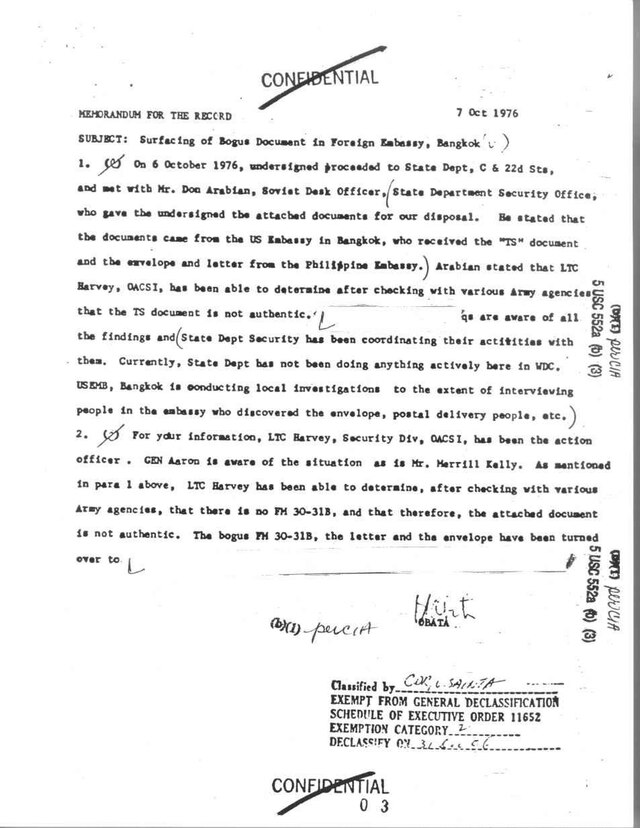
The document first surfaced in the 1970s in Turkey and later circulated in various countries. During a 1980 hearing, CIA officials denied its authenticity, declaring it a forgery. Scholars and the US State Department also state that it is a Soviet forgery. Its usage in implicating the CIA in certain events further fueled debate, but arguments to its authenticity were strengthened by evidence uncovered during Operation Gladio in the 1990s.
Remove ads
History
Summarize
Perspective
The first mention of the document was in the Turkish newspaper Barış (sometimes anglicized to Barish), in 1975.[7][8] It was labelled as supplement B (hence "30-31B"), although the publicly released version of FM30-31 only has one appendix, Supplement A.[9][10][11][7][6]
A facsimile copy of FM30-31B then appeared a year later in Bangkok, Thailand,[7] and in various capitals of north African states.[8] In 1978, it appeared in various European magazines, including the Spanish Triunfo and El Pais.[7][8] The Italian press picked up the Triunfo publication, and a copy was published in the October 1978 issue of L'Europeo.[7]
A wide range of field manuals, including 30–31, can be accessed through websites that catalog U.S. field manuals. However, 30-31B is not among the field manuals published by the military.[12]
The "Westmoreland Field Manual" (so named because it bears the alleged signature of General William Westmoreland)[1] was mentioned in at least two parliamentary commissions reports of European countries, one about the Italian Propaganda Due masonic lodge,[13] and one about the Belgian stay-behind network. The latter says that "the commission has not any certainty about the authenticity of the document".[14]
Remove ads
Authenticity
Summarize
Perspective
At a 1980 hearing of the House of Representatives Permanent Select Committee on Intelligence, Subcommittee of Oversight, CIA officials testified that the document was a singularly effective forgery by the KGB and an example of Soviet covert action.[15]
Scholars Peer Henrik Hansen and Thomas Rid, both specializing in Cold War intelligence,[16][17] and the U.S. State Department claim the document is a forgery by Soviet intelligence services.[10][11][7][6] The document first appeared in Turkey in the 1970s, before being circulated to other countries. It was also used at the end of the 1970s during Operation GLADIO, to implicate the Central Intelligence Agency in the Red Brigades' kidnapping and assassination of former Italian prime minister Aldo Moro.[18][19]
The discovery in the early 1990s of Operation Gladio (NATO stay-behind networks) in Europe led to renewed debate as to whether or not the manual was fraudulent. In Allan Francovich's BBC documentary about Gladio, Licio Gelli, the leader of the Italian anti-Communist P2 freemason lodge, stated "The CIA gave it to me." In the documentary, former CIA Deputy director Ray S. Cline said "I suspect that it is an authentic document", but former CIA Director William Colby said "I have never heard of it.".[20][21]
The Swiss author Daniele Ganser made use of the Field Manual for his book on Gladio. And, in response to the U.S. official denials, pointed out:
"FM 30-31B is dated 18 March 1970, Headquarters of the US Army, Washington DC, and signed by General Westmoreland. William Westmoreland commanded American military operations in the Vietnam War from 1964 to 1968 and thereafter was US Army Chief of Staff from 1968 to 1972. He died in the summer of 2005 and is no longer available to testify whether Annex B is a Soviet forgery as the State Department claims, or whether it is a genuine US document which he signed. Documentary film-maker Allan Francovich asked Ray Cline, CIA Deputy Director from 1962 to 1966, whether FM 30-31B was an authentic document or a Soviet forgery, and the latter responded on the BBC: ‘Well, I suspect it is an authentic document. I don’t doubt it. I never saw it but it’s the kind of special forces military operations that are described. On the other hand you gotta recall, that the defence department and the President don’t initiate any of those orders, until there is an appropriate occasion’."[22]
Covert Action Information Bulletin concluded that "It is hard to imagine that the document is not genuine. The format, style and classification stampings appear consistent with other military supplements, and the document is filled with authentic military phraseology...If it is a forgery, why did a high Embassy official describe its publication as 'inopportune'?"[23]
Remove ads
See also
References
External links
Wikiwand - on
Seamless Wikipedia browsing. On steroids.
Remove ads