Top Qs
Timeline
Chat
Perspective
Weak value
Quantity in quantum mechanics From Wikipedia, the free encyclopedia
Remove ads
In quantum mechanics (and computation), a weak value is a quantity related to a shift of a measuring device's pointer when usually there is pre- and postselection. It should not be confused with a weak measurement, which is often defined in conjunction. The weak value was first defined by Yakir Aharonov, David Albert, and Lev Vaidman in 1988, published in Physical Review Letters[1] and is related to the two-state vector formalism. The first experimental realization came from researchers at Rice University in 1991.[2] The physical interpretation and significance of weak values remains a subject of ongoing discussion in the quantum foundations and metrology literature.
Remove ads
Definition
The weak value of the observable is defined as:[3]: 308 where is the initial or preselection state and is the final or postselection state. The nth order weak value, is defined using the nth power of the operator in this expression.


Weak values arise in small perturbations of quantum measurements. Representing a small perturbation with the operator , the probability of detecting a system in a final state given the initial state is For small perturbations, is small and the exponential can be expanded in a Taylor series The first term is the unperturbed probability of detection, , and the first order correction involves the first order weak value:[3]: 309 In general the weak value quantity is a complex number. In the weak interaction regime, the ratio is close to one and is significantly larger than higher order terms.[3]: 309


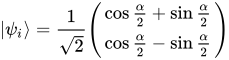
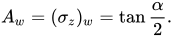
For example, two Stern-Gerlach analyzers can be arranged along the y axis, with the field of the first one along the z axis set at low magnetic field and second on along the x axis with sufficient field to separate the spin 1/2 particle beams. Going into the second analyzer is the initial state and the final state will be The perturbing action of the first analyzer is described with Pauli z-axis operator as giving the weak value[4]


Remove ads
Real part
The real part of the weak value provides a quantitative way to discuss non-classical aspects of quantum systems.[3] When the real part of a weak value is falls outside the range of the eigenvalues of the operator, it is called an "anomalous weak value". In addition to being important in discussions of quantum paradoxes, anomalous weak values are the basis of quantum sensor applications.[5]
Derivation
The derivation below follows the presentation given References.[4][5]
More information A quantum system is measured by coupling it to an ancillary quantum system that acts as the measuring device. The joint Hilbert space is  ...
...
 ...
...

![{\displaystyle [q,p]=i}](http://wikimedia.org/api/rest_v1/media/math/render/svg/4c2f7848a3c987ec601489d96784bc893db7ff76)
![{\displaystyle U=\exp[-i\gamma A\otimes p].}](http://wikimedia.org/api/rest_v1/media/math/render/svg/e7d6b2bfbfc755731e4d30e85f9d85fd1cdb266b)
![{\displaystyle |\Phi \rangle ={\frac {1}{(2\pi \sigma ^{2})^{1/4}}}\int dq'\exp[-q'^{2}/4\sigma ^{2}]|q'\rangle .}](http://wikimedia.org/api/rest_v1/media/math/render/svg/afff971be670dd5291392d614746ed6a944690bc)
![{\displaystyle \Phi (q)=\langle q|\Phi \rangle ={\frac {1}{(2\pi \sigma ^{2})^{1/4}}}\exp[-q^{2}/4\sigma ^{2}],}](http://wikimedia.org/api/rest_v1/media/math/render/svg/bd646b25cade6f829b062487351f0e6234b7b6d8)


Remove ads
Applications
Summarize
Perspective
Weak values have been proposed as potentially useful for quantum metrology and for clarifying aspects of quantum foundations. The sections below briefly outline these applications.
Quantum metrology
At the end of the original weak value paper[1] the authors suggested weak values could be used in quantum metrology:
Another striking aspect of this experiment becomes evident when we consider it as a device for measuring a small gradient of the magnetic field ... yields a tremendous amplification.
Aharonov, Albert, Vaidman[1]
In modern language, when the weak value lies outside the eigenvalue range of the observable , the effect is known as weak value amplification. In this regime, the shift of the measuring device's pointer can appear much larger than expected, for example a component of spin may seem 100 times greater than its largest eigenvalue. This amplification effect has been viewed as potentially beneficial for metrological applications where small physical signals need to be detected with high sensitivity.[citation needed]

This weak value amplification subsequently demonstrated experimentally.[10][11][3][12][13].
Quantum Tomography
Weak values have also been explored in the context of quantum state tomography. Direct state tomography[14][15] uses weak measurements and post-selection, motivated by weak-value protocols, to reconstruct the quantum state. It also provides an operational interpretation of wavefunction amplitudes. Weak-measurement tomography [16] aims to improve upon standard tomography by exploiting the minimal disturbance from weak measurements, allowing the same system to be reused for additional measurements.
Quantum foundations
Weak values are used as indicators of nonclassicality, as tools for explaining quantum paradoxes, and as links between different interpretations of quantum mechanics.[citation needed]
Anomalous weak values, those lying outside the eigenvalue range of an observable, are considered indicators of nonclassicality. They serve as proofs of quantum contextuality, showing that measurement outcomes cannot be reproduced by any noncontextual hidden-variable model.[17].
Weak values have been used to create and explain some of the paradoxes in the foundations of quantum theory, for example, the Quantum Cheshire cat.[18] They have also been used in experimental studies of Hardy's paradox, where joint weak measurements of entangled pairs of photons reproduced the paradoxical predictions.[19][20][21]
Weak values have been proposed as a way to define a particle's velocity at a given position, referred to as the 'naively observable velocity.'[22] Experiments in 2010 reported photon trajectories in a double-slit interferometer that qualitatively matched earlier predictions[23] for photons in the de Broglie-Bohm interpretation.[24][25] Subsequent analyses have argued that weak velocity measurements do not provide new evidence for or against de Broglie-Bohm theory and cannot directly reveal the form of particle trajectories, even under deterministic assumptions[26][27]
Remove ads
Criticisms
Summarize
Perspective
Criticisms of weak values include philosophical and practical criticisms. Some noted researchers such as Asher Peres, Tony Leggett, David Mermin[citation needed], and Charles H. Bennett [28][29] are critical of weak values.
After Aharonov, Albert, and Vaidman published their paper, two critical comments and a reply were subsequently published.
Asher Peres in his comment [30], argued that even if a weak measurement yields a precisely determined average value, this does not imply the observable itself actually took that value. He stated that a detailed analysis of the measurement data would reveal two peaks at (), corresponding to the true eigenvalues, with their widths reflecting the initial measurement uncertainty. According to Peres, such results are fully consistent with standard quantum mechanics, and the apparently "anomalous" weak values arise from overlap and interference effects rather than any violation of quantum principles.

Tony Leggett's[31] comment raised two main objections. First, he argued that Aharonov, Albert, and Vaidman's result is largely irrelevant to standard quantum measurement theory because it relies on a nonstandard definition of measurement, treating a specific weak interaction Hamiltonian as fundamental rather than as one component of a broader process. Second, he maintained that the weak value is not a true value of the observable—it is neither an individual outcome nor an ensemble average, but instead reflects how the system affects the measuring device under weak coupling and postselection, and is valid only to lowest order in the interaction strength.
The reply by Aharonov and Vaidman[32] to the comments by Peres and Leggett addressed several of the technical points raised in the critiques, although later discussions in the literature have expressed differing views on how fully these issues were resolved.
Metrological Significance
There has been extensive debate in the primary literature regarding the role of weak values in quantum metrology[33], including critiques and rebuttals. According to a review article[34], analyses based on Fisher information and parameter estimation indicate that postselected weak-value amplification does not generally improve precision in metrological tasks. Although the technique can increase signal size, postselection reduces data efficiency because most trials are discarded. The review concludes that weak-value methods do not provide a fundamental quantum advantage in metrology, and that large amplification factors alone do not enhance estimation performance.
Remove ads
References
Further reading
Wikiwand - on
Seamless Wikipedia browsing. On steroids.
Remove ads