Australian brushturkey
species of bird From Wikipedia, the free encyclopedia

Remove ads
The Australian brushturkey, sometimes called the bush turkey or scrub turkey, is a big bird that builds mounds to lay its eggs. Its scientific name is Alectura lathami. It lives along the east coast of Australia, from the far north of Queensland down to the south coast of New South Wales. People have also brought it to Kangaroo Island in South Australia. It’s the largest living bird in its family, the Megapodiidae, and one of three types that live in Australia. Even though it's called a "turkey," this bird isn't closely related to American turkeys or the Australian bustard (which is also sometimes called a bush turkey in central Australia). Its closest relatives are the wattled brushturkey, Waigeo brushturkey, and malleefowl.
_female_Atherton.jpg)

Remove ads
Description
The Australian brushturkey is a big bird with black feathers and a red head. It usually measures between 60–75 cm (23.5–29.5 in) long and has a wingspan of about 85 cm (33 in). There is a smaller type called A. l. purpureicollis that lives in the northern Cape York Peninsula, but the more common kind is bigger. The brushturkey has a wide, fan-shaped tail that looks flat from the side. The larger subspecies has a yellow wattle (the hanging skin under the neck), and the smaller subspecies has a purple one.[2] When it’s breeding season, the males’ wattles get much bigger and often swing as they move. Their heads and wattles also become brighter in color during this time. Older birds have more white feathers under their bodies. The brushturkey is not very good at flying and can’t go very far. It usually only flies to escape from danger, or to rest in trees at night, or when it’s very hot during the day.
 Egg
Egg Chick
Chick Adult male
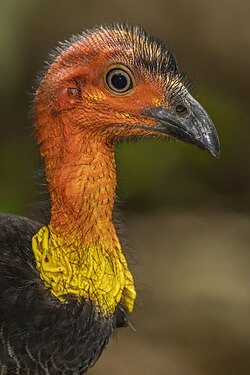 Adult female


.jpg)
_female_head_Atherton.jpg)
Remove ads
Habitat
The Australian brushturkey lives in rainforests, wet sclerophyll forests, dry scrub, and open areas. It can be found in both mountains and flat areas.[1] In the north, brushturkeys are mostly seen in the mountains, but they may move to lower areas during winter. In the south, they are common in both high and low spots. Today, brushturkeys often live in cities. People see them in backyards in Brisbane and Sydney. The Australian brushturkey’s range stretches from the top of Cape York down to the area near Wollongong.[3]
Remove ads
Nesting
.jpg)
Australian brushturkeys make big nests on the ground out of leaves, dirt, and other things that rot. These nests can be 1 to 1.5 metres (3.3 to 4.9 ft) high and as wide as 4 m (13 ft).[4] One main male builds the mound and many local females visit it to mate and lay eggs.[5] The eggs are very big, (90 × 45 mm). The male spends a lot of time gathering material and keeps away other males who want his spot. They often fail in protecting the nest, and another male will take over. The mound keeps the eggs warm as they grow. The male checks the heat by sticking his beak into the nest and can keep the temperature at 33–35 °C (91–95 °F) by adding or taking away material. If the temperature is 34 °C, there will be equal numbers of male and female chicks. A cooler mound will results in more males, and more females if it is warmer. Whether the parents use this to manage the sex of their offspring is unknown.[6]
When the chicks hatch, they are already covered in feathers and can fly within a few hours as soon as their feathers dry.
The same mound is often used for nesting every year. Each breeding season, more material is added to the old nests. Usually, a bird lays between 16 and 24 big white eggs from September to March. Sometimes, a single mound will have as many as 50 eggs because several females use it. The eggs are put in a circle, about 60–80 cm (23.5–31.5 in) deep and 20–30 cm (8–12 in) apart, with the bigger end pointing up. When the chicks hatch, they dig their way out of the mound and take care of themselves from the start.
References
Other websites
Wikiwand - on
Seamless Wikipedia browsing. On steroids.
Remove ads