Austria
country in Central Europe From Wikipedia, the free encyclopedia

Remove ads


Austria (/ˈɒstriə/ ( listen), /ˈɔːs-/;[10] German: Österreich [ˈøːstɐʁaɪç] (listen)), officially the Republic of Austria (German: Republik Österreich [ʁepuˈbliːk ˈʔøːstɐʁaɪç] (listen)), is a country in Central Europe. Around Austria are the countries of Germany, Czech Republic, Slovakia, Hungary, Slovenia, Italy, Switzerland, and Liechtenstein.
The people in Austria speak German, a few also speak Hungarian, Slovenian and Croatian. The capital of Austria is Vienna (Wien).
Remove ads
History
Austria is more than 1000 years old. Its history can be followed to the 9th century. At that time, the first people moved to the land now known as Austria. The name Ostarrichi is first written in an official document from 996. Since then, that word developed into the Modern German word Österreich, which literally means "Eastern Empire."
Ancient times
There has been human settlement in the area that is now Austria for a long time. The first settlers go back to the Paleolithic Age, the time of the Neanderthals. They left works of art such as the Venus of Willendorf. In the Neolithic Age people, lived there to dig for mineral resources, especially copper. Ötzi, a mummy found in a glacier between Austria and Italy, is from that time.
During the Bronze Age, people built larger settlements and fortresses, especially where there were mineral resources. Salt mining began near Hallstatt. At that time, Celts began to form the first states.
The Romans

The Romans came 15 BC to Austria and made the Celtic Regnum Noricum to a Roman province. What is now Austria, was part of three provinces, Raetia, Noricum and Pannonia. The border in the north was the Danube.
Holy Roman Empire
From the Early Middle Ages, the area of modern-day Austria was part of the Holy Roman Empire. The capital of the Holy Roman Empire was the Austrian city of Vienna. The Austrian Habsburg family became the rulers of the empire, and the son of the Holy Roman Emperor held the title of Archduke of Austria.
In 1806, France defeated the Holy Roman Empire and replaced it with the Confederation of the Rhine. Former Holy Roman Emperor Francis II became the Emperor of the new Austrian Empire, which later became Austria-Hungary.
Modern history
In 1869, the first postcards were sent from Austria.[11] Within three months, almost 3 million cards had been sold.[11]
In 1914, Franz Ferdinand was assassinated in Sarajevo. Austria-Hungary declared war on Serbia and this led to World War I. In 1918, both Austria and Hungary became republics and split into separate countries that were much smaller tha before.
In 1938, Austria became part of Nazi Germany. However, Austrias became independent again in May 1945.
Remove ads
Geography

Austria is a mountainous country since it is partially in the Alps. Grossglockner is the tallest mountain in Austria. The high mountainous Alps in the west of Austria flatten somewhat into low lands and plains in the east of the country where the Danube flows.
Climate
Austria has a continental climate.
The highest temperature ever recorded in Austria was 40.5 °C (104.9 °F), on 8 August 2013 in Bad Deutsch-Altenburg.[12] The lowest temperature ever recorded in Austria was −52.6 °C (−62.7 °F), on 19 February 1932 at Grünloch doline.[13]
Remove ads
Politics
.svg)

Austria is a democratic republic. The President of Austria is the head of state and the Chancellor of Austria is the head of government.
It is a neutral state, that means it does not take part in wars with other countries. It has been in the United Nations since 1955 and in the European Union since 1995.
Austria is also a federal state and divided into nine states (German: Bundesländer):
- Burgenland (Burgenland)
- Carinthia (Kärnten)
- Lower Austria (Niederösterreich)
- Upper Austria (Oberösterreich)
- Salzburg(erland) (Salzburg)
- Styria (Steiermark)
- Tyrol (Tirol)
- Vorarlberg (Vorarlberg)
- Vienna (Wien)
A new cabinet (Austria) was formed (February 2025). It is formed by political parties ÖVP, SPÖ, and Neos.
The chancellor is Christian Stocker since 2025. Austria has been a member-state of the United Nations since 1955, the European Union since 1995 and OPEC since 2019.
More information: States of Austria.
Culture
Music and arts
Many famous composers were Austrians or born in Austria. There are Wolfgang Amadeus Mozart, Joseph Haydn, Franz Schubert, Anton Bruckner, Johann Strauss, Sr., Johann Strauss, Jr. and Gustav Mahler. In modern times there were Arnold Schoenberg, Anton Webern and Alban Berg, who belonged to the Second Viennese School.
Austria has many artists, there are Gustav Klimt, Oskar Kokoschka, Egon Schiele or Friedensreich Hundertwasser, Inge Morath or Otto Wagner and scienc.
Food
Famous Austrian dishes are Wiener Schnitzel, Apfelstrudel, Schweinsbraten, Kaiserschmarren, Knödel, Sachertorte and Tafelspitz. But you can also find a lot of local dishes like Kärntner Reindling (a kind of cake), Kärntner Nudeln (also called "Kärntner Kasnudeln", you may write it "...nudln" too), Tiroler Knödl (may be written "...knödel"; ), Tiroler Schlipfkrapfen (another kind of "Kärntner Nudeln"), Salzburger Nockerl (also may be written ..."Nockerln"), Steirisches Wurzelfleisch (..."Wurzlfleisch") or Sterz ("Steirischer Sterz").
UNESCO World Heritage Sites
- Historic Centre of Salzburg — 1996
- Schönbrunn Palace — 1996
- Hallstatt–Dachstein Salzkammergut Cultural Landscape — 1997
- Semmering Railway — 1998
- Historic Centre of Graz and Schloss Eggenberg — 1999 (extended in 2010)
- Wachau Cultural Landscape — 2000
- Historic Centre of Vienna — 2001
- Lake Neusiedl — 2001
Gallery
 Schönbrunn palace
 Graz
Graz Wachau


 Hallstatt
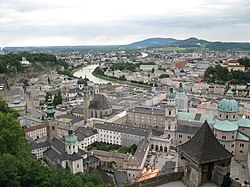 Salzburg
 Semmering railway
 Schloss Eggenberg
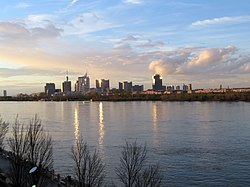 Vienna
 Neusiedler See


Remove ads
Related pages
References
Other websites
Wikiwand - on
Seamless Wikipedia browsing. On steroids.
Remove ads