Edvard Munch
Norwegian painter. (1863–1944) From Wikipedia, the free encyclopedia

Remove ads
Edvard Munch (12 December 1863 – 23 January 1944) was a Norwegian painter and print-maker. He was born in Adalsbruk. He was an expressionist who painted 1789 known paintings. He is well known for his treatment of emotion such as fear. His way of seeing things had a large influence on the expressionism of the 20th century. People saw this treatment as being intense.
.jpg)
During his life, he had success as a painter: He became famous outside Norway, and his paintings got high prices. The National Gallery (Norway) used much money to buy paintings by Munch.[1] He painted a large murals in the aula (main room) of Norway's (then) only university.
Remove ads
Early life and education
He had four brothers and sisters. He had followed his mother and sister by being the best artists in their family. While Edvard was still young, his mother and one of his sisters died. But it was when he was thirteen that he really came to like art. The first paintings he did were simple objects like medicine bottles and other objects. Later on, he drew oil paintings.
He went to technical college in 1879 where he learnt how to draw paintings with perspective. However, in 1880, the following year he left the school to become a painter.
He went to the Royal School of Art and Design. This is where he learnt sculpturing and naturalistic painting. This is where he drew his first important portrait of himself and his father.
Remove ads
Health and death
Munch was ill very often. Many scientists think that he suffered from bipolar disorder (manic depression). He died at his house in Oslo.
Paintings
The Scream (1893; originally called Despair). This is Munch's best-known painting, and is one of the best known images in the world. It is one of the pieces in a series titled The Frieze of Life. In the series Munch explored the themes of life, love, fear, death and melancholy.
The Frieze of Life themes come back throughout Munch's work. These themes can be seen in paintings such as The Sick Child (1886, portrait of his deceased sister Sophie), (1893–1894), Ashes (1894), and The Bridge. The last-named shows limp figures. Those figures have faces with no features, or they have no faces at all. Threatening shapes of heavy trees and houses are above the figures. Munch portrayed women either as frail, innocent sufferers or as lurid, life-devouring vampires. Munch analysts say this reflects his sexual anxieties.
.jpg)
- 1885-86: The Sick Child
- 1892: Evening on Karl Johan
- 1893: The Scream
- 1894: Ashes
- 1894–1895: Madonna
- 1895: Puberty
- 1895: Self-Portrait with Burning Cigarette
- 1895: Death in the Sickroom
- 1899–1900: The Dance of Life
- 1899–1900: The Dead Mother
- 1903: Village in Moonlight
- 1940–1942: Self Portrait: Between Clock and Bed
- Some famous paintings
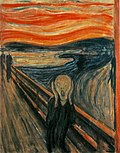 The Scream. 1893. Oil, tempera, and pastel on cardboard. Nasjonalgalleriet, Oslo
 The Dance of Life. 1899–1900. Oil on canvas, 491⁄2 × 75 in. Nasjonalgalleriet, Oslo
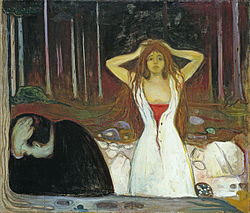 Ashes. 1894. Oil on canvas. 120.5 × 141 cm. Nasjonalgalleriet, Oslo
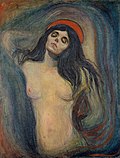 Madonna. 1894. Oil on canvas. 90 × 68 cm. Munch Museum, Oslo

.jpg)

Other paintings
 The Seine at Saint-Cloud. 1890. 46 × 38 cm. Munch Museum, Oslo
 At the Roulette Table in Monte Carlo. 1892. 74,5 × 116 cm. Munch Museum, Oslo
 Death in the Sickroom. 1893. 134 × 160 cm. Munch Museum, Oslo
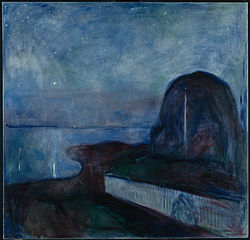 Starry Night. 1893. 135.6 × 140 cm. J. Paul Getty Museum.
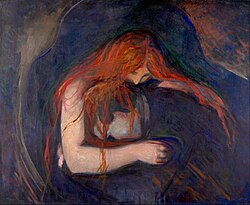 Vampire. 1895. 91 × 109 cm. Munch Museum, Oslo
 Anxiety. 1894. 94 × 74 cm. Munch Museum, Oslo
 Death in the Sickroom. c. 1895. Oil on canvas. 59 × 66 in. Nasjonalgalleriet, Oslo
 Lady From the Sea (detail). 1896. Oil on canvas. 391⁄2 × 126 in.
 Evening. Melancholy I. 1896. 41.1 × 55.7 cm. Munch Museum, Oslo
 Separation. 1896. 96 × 127 cm. Munch Museum, Oslo
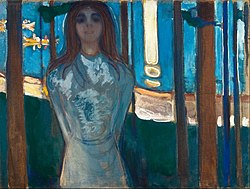 The Voice / Summer Night. 1896. 90 × 119 cm. Munch Museum, Oslo
 The Kiss. 1897. 99 × 81 cm. Munch Museum, Oslo
 Inheritance. 1897–99. 141 × 120 cm. Munch Museum, Oslo
 Metabolism. 1898–99. 172 × 142 cm. Munch Museum, Oslo
 Red and White. 1899–1900. 93 × 129 cm. Munch Museum, Oslo
 Train Smoke. 1900. 84 × 109 cm. Munch Museum, Oslo
 Consul Christen Sandberg. 1901. 215 × 147 cm. Munch Museum, Oslo
 Kiss IV. 1902. 47 × 47 cm. Munch Museum, Oslo
 Four Girls in Åsgårdstrand. 1903. 87 × 111 cm. Munch Museum, Oslo
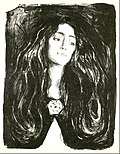 The Brooch. Eva Mudocci. 1903. 76 × 53.2 cm. Munch Museum, Oslo
 Shore with Red House. 1904. 69 × 109 cm. Munch Museum, Oslo
 Portrait of Friedrich Nietzsche (1906). Thielska Galleriet, Stockholm
 Death of Marat I (1907)
 Jealousy. 1907. 75 × 98 cm. Munch Museum, Oslo
 The Sun. 1910–11. 450 × 772 cm. Munch Museum, Oslo
 Galloping Horse. 1910–12. 148 × 120 cm. Munch Museum, Oslo
 The Yellow Log. 1912. 129.5 × 159.5 cm. Munch Museum, Oslo
 On the Sofa. 1913. 80 × 150 cm. Munch Museum, Oslo
 Weeping Nude. 1913–14. 110 × 135 cm. Munch Museum, Oslo
 Golgotha.1900.
 Workers on their Way Home. 1913–14. 227 × 201 cm. Munch Museum, Oslo


_-_Google_Art_Project.jpg)


.jpg)

Nudes
 Puberty. 1894-95.
 The Hands. 1893.
 Seated Nude. 1902.
 Weeping woman. 1907-1909.
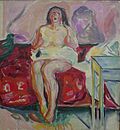 Morning Yawn. 1913.
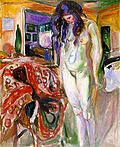 Naked model by the wicker chair. 1919.
_by_Edvard_Munch.jpg)
.jpg)


Self-portraits
 Self-Portrait. 1882. 26 × 19 cm. Munch Museum, Oslo
 Self-Portrait. 1895. 458 × 314 mm. Munch Museum, Oslo
 Self-Portrait in Hell. 1903. 82 × 66 cm. Munch Museum, Oslo
 Self-Portrait with Brushes. 1904. 197 × 91 cm. Munch Museum, Oslo
 Self-Portrait with a Bottle of Wine. 1906. 110 × 120 cm. Munch Museum, Oslo
.jpg)
_G0192-59_-_Google_Art_Project.jpg)


Photographs
 Self-Portrait at 53 Am Strom in Warnemünde. 1907. 89 × 89 mm. Munch Museum, Oslo
 Edvard Munch at the Beach in Warnemünde. 1907. 83 × 87 mm. Munch Museum, Oslo
 Self-Portrait “à la Marat”. 1908–09. 81 × 85 mm. Munch Museum, Oslo
 Self-Portrait Somewhere on the Continent I. 1906. 90 × 90 mm. Munch Museum, Oslo
 Self-Portrait Somewhere on the Continent II. 1906. 82 × 87 mm. Munch Museum, Oslo
 Portrait at 26 years
 Portrait of Edvard Munch 1902
 Portrait of Edvard Munch
 Portrait of Edvard Munch 1929
 Munch in 1912
 Rosa Meissner at the Hotel Rohn in Warnemünde. 1907. Photograph. 87 × 73 mm. Munch Museum, Oslo


.jpg)

.jpg)


Paintings by year
.jpg)


,_1886.jpg)


.jpg)

.jpg)
.jpg)
,_NG.M.01111.jpg)


.jpg)
.jpg)


,_1906-07.jpg)


.jpg)

.jpg)

.jpg)


.jpg)
.jpg)
.jpg)


_-_Tate_Modern.jpg)

Remove ads
References
Other websites
Wikiwand - on
Seamless Wikipedia browsing. On steroids.
Remove ads