Not to be confused with
Hexene.
Hexane is an organic compound with the chemical formula C
6H
14. It is an alkane with 6 carbon atoms. "Hexane" can mean any of the 5 structural isomers (meaning compounds with the same chemical formula but a different shape) it has. IUPAC naming says that "hexane" only means the isomer with no branches, with the other 4 having different names.
Quick facts Names, Identifiers ...
Hexane
 |
 |
 |
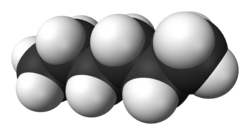 |
| Names |
| IUPAC name
|
| Other names
|
| Identifiers |
|
|
3D model (JSmol) |
|
| Beilstein Reference |
1730733 |
| ChEBI |
|
| ChEMBL |
|
| ChemSpider |
|
| DrugBank |
|
| ECHA InfoCard |
100.003.435 |
| EC Number |
|
| Gmelin Reference |
1985 |
| KEGG |
|
| MeSH |
n-hexane |
|
|
| RTECS number |
|
| UNII |
|
| UN number |
1208 |
|
|
|
|
| Properties |
|
C6H14 |
| Molar mass |
86.18 g·mol−1 |
| Appearance |
Colorless liquid |
| Odor |
Petrolic |
| Density |
0.6606 g mL−1[3] |
| Melting point |
−96 to −94 °C; −141 to −137 °F; 177 to 179 K |
| Boiling point |
68.5 to 69.1 °C; 155.2 to 156.3 °F; 341.6 to 342.2 K |
|
9.5 mg L−1 |
| log P |
3.764 |
| Vapor pressure |
17.60 kPa (at 20.0 °C) |
| kH |
7.6 nmol Pa−1 kg−1 |
| λmax |
200 nm |
|
−74.6·10−6 cm3/mol |
|
1.375 |
| Viscosity |
0.3 mPa·s |
| Thermochemistry |
Std enthalpy of
formation ΔfHo298 |
−199.4–−198.0 kJ mol−1 |
Std enthalpy of
combustion ΔcHo298 |
−4180–−4140 kJ mol−1 |
Standard molar
entropy So298 |
296.06 J K−1 mol−1 |
| Specific heat capacity, C |
265.2 J K−1 mol−1 |
| Hazards |
| Main hazards |
Reproductive toxicity – After aspiration, pulmonary oedema, pneumonitis, and death [4] |
| NFPA 704 |
|
| Explosive limits |
1.2–7.7% |
U.S. Permissible
exposure limit (PEL) |
TWA 500 ppm (1800 mg/m3)[5] |
| Related compounds |
| Related {{{label}}} |
{{{value}}} |
Except where otherwise noted, data are given for materials in their standard state (at 25 °C [77 °F], 100 kPa). |
| Y verify (what is YN ?) |
| Infobox references |
|
|
Close
Hexane is often part of modern gasoline. Pure hexane has no color and is quite unreactive.


