Tuberculosis
infectious disease caused by the bacterium Mycobacterium tuberculosis From Wikipedia, the free encyclopedia

Remove ads
Tuberculosis (TB) is an infectious disease caused by bacteria. In the past, people called it consumption or the white death.
TB is caused by several types of mycobacteria, usually Mycobacterium tuberculosis.[1] The disease usually attacks the lungs, but it can also affect other parts of the body.
Remove ads
How it spreads
The bacteria can travel through the air and spread from one person to the next. This happens when infected people cough, sneeze, or spit.[2]
Of every 100 people with TB, between five and ten people show symptoms.[3] In these people, the disease is called active. Tuberculosis kills more than half of the people who are infected if they do not get treatment. TB affects a lot of people globally, but many do not show any symptoms.[4]
,_OWID.svg)
Remove ads
Detection and treatment
Diagnosis of active TB relies on radiology. Doctors often look at an X-ray of the chest. In addition, they check body fluids. These fluids have microbes in them, which are grown in a cell culture. The cell cultures are then analysed to see if the person is infected with TB.
If the patient has TB, but does not show symptoms, the disease is 'latent'. Doctors use a skin test, called the Mantoux test, to detect latent TB. They often do blood tests too.
There is a vaccine against some forms of tuberculosis. It is called the Bacillus Calmette–Guérin vaccine.[verification needed]
TB used to be easily treated and cured with antibiotics. However, the bacterium is now highly resistant to most antibiotics. This resistance makes treatment difficult. Many different kinds of antibiotics need to be given over a long period of time. There is a form of tuberculosis that is resistant to all drugs.
Remove ads
Symptoms
Tuberculosis can have many symptoms.
The most common include:
- A cough that does not go away, especially if the person is coughing up blood (this is called hemoptysis)
- Chest pain
- Not having any appetite
- Weakness
- Weight loss
- Chills
- Very pale skin
- Listless eyes
- Fever
- Sweating a lot at night
- Difficulty breathing
- Feeling very tired
- People are also more likely to get tuberculosis if they live close to other people who have TB. For example, TB can spread easily in homeless shelters, prisons, and immigrant communities
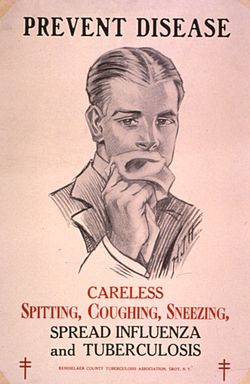
Public health campaigns in the 1920s tried to halt the spread of TB.

How common is TB?
Experts believe that one third of the world population is infected with M. tuberculosis.[4]
New infections occur at a rate of one per second.[4] In 2007, about 13.7 million chronic cases were active globally.[8] In 2010, about 8.8 million new cases developed and nearly 1.5 million people died from the disease, most of them in developing countries.[9] The number of tuberculosis cases has been decreasing since 2006, and new cases have decreased since 2002.[9]
Tuberculosis does not happen at the same rate around the world. About eighty percent of the population in many Asian and African countries test positive for TB, but only five to ten percent of people in the United States do.[1]
People usually get tuberculosis because of a weakened immune system. Many people with HIV and AIDS can also get tuberculosis because it causes the person to become immunocompromised.[10]
Remove ads
References
Other websites
Wikiwand - on
Seamless Wikipedia browsing. On steroids.
Remove ads