| Genus |
Authors |
Year |
Status |
Age |
Location |
Notes |
Images |
| Acamptonectes[2] |
Fischer et al. |
2012 |
Valid |
Early Cretaceous |
 Germany Germany
 United Kingdom United Kingdom
( England) England) |
Possessed an unusually rigid trunk, which would make the extent of its lateral locomotion very limited |
 |
| Actiosaurus |
Sauvage |
1883 |
Dubious |
Late Triassic |
 France France |
While originally described as a dinosaur and later reinterpreted as an ichthyosaur, it may actually represent a choristodere |
 |
| Acuetzpalin[3] |
Barrientos-Lara & Alvarado-Ortega |
2020 |
Valid |
Late Jurassic |
 Mexico Mexico |
Known from a partial limbless skeleton with a well-preserved skull |
|
| Aegirosaurus[4] |
Bardet & Fernández |
2000 |
Valid |
Late Jurassic to Early Cretaceous |
France
Germany |
Four of its caudal vertebrae made its tail to bend roughly 45° downwards |
 |
| Anhuisaurus[1] |
Chen |
1985 |
Jr. synonym |
N/A |
N/A |
Preoccupied by lizard genus Anhuisaurus (Hou, 1974). Junior synonym of Chaohusaurus |
|
| Argovisaurus[5] |
Miedema et al. |
2024 |
Valid |
Middle Jurassic |
 Switzerland Switzerland |
May have preserved traumatic injuries based on abnormalities in its skeleton |
 |
| Arthropterygius |
Maxwell |
2010 |
Valid |
Late Jurassic to Early Cretaceous? |
 Argentina Argentina
 Canada Canada
 Norway Norway
 Russia Russia |
Its rostrum was relatively short and robust |
 |
| Athabascasaurus |
Druckenmiller & Maxwell |
2010 |
Valid |
Early Cretaceous |
Canada |
The holotype was discovered at an oilsand mine |
 |
| Auroroborealia[6] |
Zverkov et al. |
2021 |
Valid |
Late Triassic |
Russia |
Suggested to be a small-bodied animal although its exact ontogenetic stage is uncertain due to fragmentary remains |
|
| Baisesaurus[7] |
Ren et al. |
2022 |
Valid |
Early Triassic |
 China China |
Very similar to Utatsusaurus |
 |
| Baptanodon |
Marsh |
1880 |
Valid |
Late Jurassic |
 United States United States |
Formerly erroneously thought to have been toothless |
 |
| Barracudasauroides |
Maisch |
2010 |
Valid |
Middle Triassic |
China |
Only known from a partial skeleton originally referred to Mixosaurus |
 |
| Barracudasaurus |
Jiang et al. |
2005 |
Dubious |
Middle Triassic |
China |
Its premaxillary teeth were rounded in cross-section |
|
| Besanosaurus[8] |
Dal Sasso & Pinna |
1996 |
Valid |
Middle Triassic |
 Italy Italy
Switzerland |
May have had strong jaw muscles as indicated by its skull bones |
 |
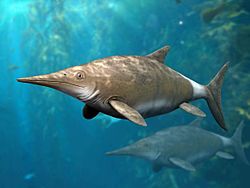
| Brachypterygius[9][10] |
von Huene |
1922 |
Valid |
Late Jurassic |
United Kingdom
( England) |
Closely related to Platypterygius and Caypullisaurus |
 |
| Californosaurus[9][11] |
Kuhn |
1934 |
Valid |
Middle Triassic to Late Triassic |
Germany
United States |
Originally named as a species of Shastasaurus |
 |
| Callawayia[12] |
Maische & Matzke |
2000 |
Valid |
Late Triassic |
Canada |
The morphology of its scapulae was more similar to those of Jurassic ichthyosaurs than to other Triassic taxa |
 |
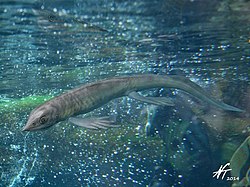
| Cartorhynchus[13] |
Motani et al. |
2014 |
Valid |
Early Triassic |
China |
Represents a sudden diversification of marine reptiles that occurred shortly after the Permian-Triassic extinction event |
 |
| Catutosaurus[14] |
Fernández et al. |
2021 |
Valid |
Late Jurassic |
Argentina |
Represented by at least three fragmentary specimens |
|
| Caypullisaurus[9][10] |
Fernández |
1997 |
Valid |
Late Jurassic to Early Cretaceous |
Argentina |
Each of its forelimbs contained ten digits |
 |
| Chacaicosaurus[11] |
Fernández |
1994 |
Valid |
Middle Jurassic |
Argentina |
Inconsistent in phylogenetic placement |
 |
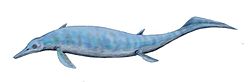
| Chaohusaurus[1][9] |
Young & Dong |
1972 |
Valid |
Early Triassic |
China |
One specimen preserves the remains of two embryos and a neonate |
 |
| Chensaurus[1][9] |
Mazin et al. |
1991 |
Jr. synonym |
N/A |
N/A |
Junior synonym of Chaohusaurus |
|
| Chonespondylus[9] |
Leidy |
1868 |
Jr. synonym |
N/A |
N/A |
Junior synonym of Cymbospondylus |
|
| Contectopalatus[15] |
Maische & Matzke |
1998 |
Jr. synonym? |
N/A |
N/A |
Possibly a junior synonym of Phalarodon |
|
| Cryopterygius[16] |
Druckenmiller et al. |
2012 |
Jr. synonym |
N/A |
N/A |
Junior synonym of Undorosaurus |
|
| Cymbospondylus[9][12] |
Leidy |
1868 |
Valid |
Early Triassic to Middle Triassic |
Switzerland
United States |
Lacked a dorsal fin and fluked tail, which would suggest it probably swam by wriggling its body from side to side like a modern sea snake |
 |
| Dearcmhara[17] |
Brusatte et al. |
2015 |
Valid |
Early Jurassic to Middle Jurassic |
United Kingdom
( Scotland) Scotland) |
The first ichthyosaur discovered in Scotland |
|
| Delphinosaurus[9] |
Eichwald |
1853 |
Dubious |
Early Cretaceous to Late Cretaceous |
Russia |
Originally mistakenly believed to be an amphibian |
|
| Eretmorhipis[18] |
Chen et al. |
2015 |
Valid |
Early Triassic |
China |
Exhibited a suite of unusual features, such as relatively small eyes, a platypus-like snout, and plates on its back similar to those of stegosaurs |
 |
| Eternauta[19] |
Campos et al. |
2025 |
Valid |
Late Jurassic |
Argentina |
May have relied on deep-diving while hunting its prey as suggested by its preserved scleral ring |
 |
| Eurhinosaurus[9][11] |
Abel |
1909 |
Valid |
Early Jurassic |
 Belgium Belgium
France
Germany
 Luxembourg Luxembourg
 Netherlands Netherlands
Switzerland
United Kingdom
( England) |
Its upper jaw was twice as long as the lower jaw, convergent with billfish |
 |
| Eurypterygius |
Jaekel |
1904 |
Jr. synonym |
N/A |
N/A |
Junior synonym of Ichthyosaurus |
|
| Excalibosaurus |
McGowan |
1986 |
Valid |
Early Jurassic |
United Kingdom
( England) |
May have been a rare component of its environment as only two skeletons are known |
 |
| Fernatator[20] |
Massare et al. |
2025 |
Valid |
Early Jurassic |
Canada |
The most complete ichthyosaur known from the Early Jurassic of North America |
|
| Gadusaurus[21] |
Pratas e Souza et al. |
2025 |
Valid |
Early Jurassic |
 Portugal Portugal |
Although the majority of the cranial sutures are completely fused, which is often seen in adult ichthyosaurs, the midline suture is not fused, which would indicate the holotype belonged to either a juvenile or subadult individual |
 |
| Gengasaurus |
Paparella et al. |
2017 |
Valid |
Late Jurassic |
Italy |
Before its formal description, it had been nicknamed the "Genga ichthyosaur" |
|
| Grendelius[9] |
McGowan |
1976 |
Valid |
Late Jurassic |
Russia
United Kingdom
( England) |
Once considered to be synonymous with Brachypterygius |
 |
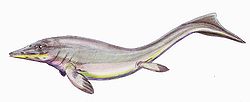
| Grippia[1][9] |
Wiman |
1930 |
Valid |
Early Triassic |
Canada
China
 Greenland Greenland
 Japan Japan
Norway |
Members of this genus may have swum by moving their tails laterally, similar to an eel |
 |
| Guanlingsaurus |
Yin et al. |
2000 |
Valid |
Late Triassic |
China |
Has been suggested to be an Asian species of Shastasaurus |
 |
| Guizhouichthyosaurus |
Cao & Luo |
2000 |
Valid |
Middle Triassic to Late Triassic |
China |
Two morphotypes of skulls and limbs are known, which could be an indication of sexual dimorphism |
 |
| Gulosaurus[22] |
Cuthbertson et al. |
2013 |
Valid |
Early Triassic |
Canada |
Originally thought to belong to either Grippia or Parvinatator |
|
| Hauffiopteryx |
Maisch |
2008 |
Valid |
Early Jurassic |
Germany
Luxembourg
Switzerland
United Kingdom
( England) |
Distinguished by its short, very thin snout |
 |
| Himalayasaurus |
Dong |
1972 |
Valid |
Late Triassic |
China |
Similarly to Thalattoarchon, its teeth possessed distinctive cutting edges |
 |
| Hudsonelpidia |
McGowan |
1995 |
Valid |
Late Triassic |
Canada |
The holotype specimen is almost complete |
 |
| Hupehsuchus[1] |
Young |
1972 |
Valid |
Early Triassic |
China |
Has been suggested to be a filter feeder, similar to baleen whales, although a 2025 review argues that it most likely fed like a pelican[23] |
 |
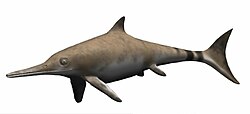
| Ichthyosaurus[9][11] |
De la Beche & Conybeare |
1821 |
Valid |
Early Jurassic |
Belgium
Germany
Portugal
United Kingdom
( England) |
The first ichthyosaur genus to be validly named and described |
 |
| Ichthyotitan[24] |
Lomax et al. |
2024 |
Valid |
Late Triassic |
United Kingdom
( England) |
The largest ichthyosaur and marine reptile currently known |
 |
| Isfjordosaurus |
Motani |
1999 |
Valid |
Early Triassic |
Norway |
Named as a species of Pessopteryx before being assigned to its own genus |
|
| Jabalisaurus[25] |
Barrientos-Lara & Alvarado-Ortega |
2021 |
Valid |
Late Jurassic |
Mexico |
Originally believed to be a specimen of Ophthalmosaurus |
|
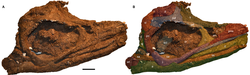
| Janusaurus[26] |
Roberts et al. |
2014 |
Valid |
Late Jurassic |
Norway |
Has been suggested to be synonymous with Arthropterygius although this was disputed by a subsequent study[27] |
 |
| Kazakhstanosaurus[28] |
Bolatovna & Makustovich |
2021 |
Valid |
Late Jurassic |
 Kazakhstan Kazakhstan
Russia |
Two species are known |
|
| Keilhauia[29] |
Delsett et al. |
2017 |
Valid |
Early Cretaceous |
Norway |
Can be distinguished from other ophthalmosaurids by the wide top end of the ilium and exceptionally short ischiopubis compared to the femur |
 |
| Kyhytysuka[30] |
Cortés et al. |
2021 |
Valid |
Early Cretaceous |
 Colombia Colombia |
Formerly thought to represent a species of Platypterygius, but it was assigned to its own genus due to morphological differences |
 |
| Leninia[31] |
Fischer et al. |
2013 |
Valid |
Early Cretaceous |
Russia |
One of the latest-surviving ophthalmosaurines |
|
| Lentamanusuchus[32] |
Qiao, Iijima & Liu |
2025 |
Valid |
Early Triassic |
China |
Possessed unusually wide autopodia compared to other hupehsuchians |
 |
| Leptocheirus |
Merriam |
1903 |
Jr. synonym |
N/A |
N/A |
Junior synonym of Toretocnemus |
|
| Leptonectes |
McGowan |
1996 |
Valid |
Late Triassic to Early Jurassic |
Belgium
Germany
 Spain Spain
United Kingdom
( England) |
One referred specimen reported from Switzerland has been found to actually belong to the related Hauffiopteryx |
 |
|
Leptopterygius |
Huene |
1929 |
Jr. synonym |
N/A |
N/A |
Junior synonym of Leptonectes |
|
| Macgowania |
Motani |
1999 |
Valid |
Late Triassic |
Canada |
Originally misidentified as a species of Ichthyosaurus |
 |
| Macropterygius |
von Huene |
1922 |
Dubious |
Late Jurassic |
United Kingdom
( England) |
Several specimens have been assigned to this genus, but only the type, a single vertebra, can confidently be referred to it |
|
| Magnipterygius[33] |
Maisch & Matzke |
2022 |
Valid |
Early Jurassic |
Germany |
Shares some features with Stenopterygius |
 |
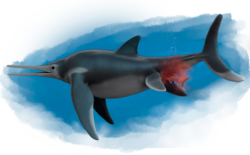
| Maiaspondylus[10] |
Maxwell & Caldwell |
2006 |
Valid |
Early Cretaceous to Late Cretaceous |
Canada
Russia
United Kingdom
( England) |
One particular specimen proves this genus, just like other ichthyosaurs, was viviparous |
 |
| Malawania[34] |
Fischer et al. |
2013 |
Valid |
Early Cretaceous |
 Iraq Iraq |
Relatively basal compared to other Cretaceous ichthyosaur taxa |
 |
| Merriamia[9] |
Boulenger |
1904 |
Jr. synonym |
N/A |
N/A |
Junior synonym of Toretocnemus |
|
| Metashastasaurus |
Nicholls & Manabe |
2001 |
Jr. synonym |
N/A |
N/A |
Junior synonym of Callawayia |
|
| Mikadocephalus[12][35] |
Maisch & Matzke |
1997 |
Jr. synonym |
N/A |
N/A |
Junior synonym of Besanosaurus |
|
| Mixosaurus[9][12] |
Baur |
1887 |
Valid |
Middle Triassic |
China
Italy
Switzerland |
Various species have been named, but most have been considered doubtful or assigned to new genera |
 |
| Mollesaurus |
Fernández |
1999 |
Valid |
Middle Jurassic |
Argentina |
The oldest known ophthalmosaurid |
|
| Muiscasaurus |
Maxwell et al. |
2015 |
Valid |
Early Cretaceous |
Colombia |
May have been a specialized predator that fed on small, soft prey |
|
| Myobradypterygius |
von Huene |
1927 |
Valid |
Early Cretaceous |
Argentina
 Chile? Chile? |
Once thought to be a species of Platypterygius |
|
| Myopterygius |
von Huene |
1922 |
Jr. synonym |
N/A |
N/A |
Junior synonym of Platypterygius |
|
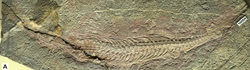
| Nanchangosaurus |
Wang |
1959 |
Valid |
Middle Triassic |
China |
Its back carried bony scutes, not unlike an alligator |
 |
| Nannopterygius |
von Huene |
1922 |
Valid |
Middle Jurassic to Early Cretaceous |
Kazakhstan
Norway
Russia
United Kingdom
( England) |
Similar to Ophthalmosaurus but with smaller flippers. Six species are recognized |
 |
| Omphalosaurus |
Merriam |
1906 |
Valid |
Early Triassic to Middle Triassic |
 Austria Austria
Norway
 Poland Poland
United States |
Its bones were relatively fast-growing as evidenced by the presence of woven-fibered bone tissue |
 |
| Ophthalmosaurus[10] |
Seeley |
1874 |
Valid |
Middle Jurassic to Late Jurassic |
United Kingdom
( England) |
Noted for its proportionally large eyes, which could measure between 22–23 centimetres (8.7–9.1 in) in diameter |
 |
| Otschevia |
Efimov |
1998 |
Jr. synonym |
N/A |
N/A |
Junior synonym of Grendelius |
|
| Pachygonosaurus |
von Huene |
1916 |
Dubious |
Middle Triassic |
Poland |
Only definitively known from two vertebrae |
 |
| Palvennia[16] |
Druckenmiller et al. |
2012 |
Valid |
Late Jurassic |
Norway |
One study considered it to be a junior synonym of Arthropterygius, but this was not supported by later resarch[27] |
|
| Panjiangsaurus |
Chen & Chang |
2003 |
Jr. synonym |
N/A |
N/A |
Junior synonym of Guizhouichthyosaurus[36][37] |
|
| Parahupehsuchus |
Chen et al. |
2014 |
Valid |
Early Triassic |
China |
Unlike other hupehsuchians, it possessed flat, wide ribs |
 |
| Paraophthalmosaurus |
Arkhangelsky |
1997 |
Jr. synonym |
N/A |
N/A |
Junior synonym of Nannopterygius |
|
| Parrassaurus[38] |
Barrientos-Lara & Alvarado-Ortega |
2021 |
Valid |
Late Jurassic |
Mexico |
Relatively large for an ophthalmosaurid |
 |
| Parvinatator |
Nicholls & Brinkman |
1995 |
Valid |
Early Triassic to Middle Triassic |
Canada |
The only known specimen has a badly damaged skull |
 |
| Pessopteryx |
Wiman |
1910 |
Valid |
Early Triassic |
Norway |
Originally known from four species, but only the type can confidently be assigned to the genus |
|
| Pessosaurus |
Wiman |
1910 |
Valid |
Middle Triassic |
Norway |
Two species have been described |
|
| Phalarodon |
Merriam |
1910 |
Valid |
Middle Triassic |
Canada
China
Germany
Norway
Switzerland?
United States |
Mostly known from specimens consisting of cranial remains |
 |
| Phantomosaurus[9] |
Maisch & Matzke |
2000 |
Valid |
Middle Triassic |
Germany |
Although it was closely related to Cymbospondylus, its braincase resembled more that of other diapsids than other ichthyosaurs |
 |
| Platypterygius |
von Huene |
1922 |
Valid |
Early Cretaceous to Late Cretaceous |
 Australia Australia
Colombia
Germany
United States |
Several species have been named, but most may not be diagnostic or belong to this genus |
 |
| Plutoniosaurus |
Efimov |
1997 |
Dubious? |
Early Cretaceous |
Russia |
May be identical to Simbirskiasaurus |
|
| Proteosaurus |
Home |
1819 |
Jr. synonym |
N/A |
N/A |
Junior synonym of Ichthyosaurus |
|
| Protoichthyosaurus |
Appleby |
1979 |
Valid |
Early Jurassic |
Switzerland?
United Kingdom
( England) |
Has been considered a junior synonym of Ichthyosaurus, but a 2017 study found that it could be distinguished from that genus based on the morphology of its forelimbs[39] |
 |
| Qianichthyosaurus |
Li |
1999 |
Valid |
Late Triassic |
China |
A relatively common component of its habitat, known from remains of both juvenile and pregnant individuals |
 |
| Quasianosteosaurus |
Maisch & Matzke |
2003 |
Valid |
Early Triassic |
Norway |
Had the largest skull of any Early Triassic ichthyosaur |
|
| Rachitrema |
Sauvage |
1883 |
Dubious |
Late Triassic |
France |
Initially believed to be a dinosaur |
 |
| Sangiorgiosaurus |
Brinkmann |
1998 |
Jr. synonym |
N/A |
N/A |
Junior synonym of Mixosaurus |
|
| Sclerocormus |
Jiang et al. |
2016 |
Valid |
Early Triassic |
China |
Unusually proportioned with a heavily built trunk, long tail, and small head |
 |
| Shastasaurus |
Merriam |
1895 |
Valid |
Late Triassic |
Canada?
China?
United States |
A referred species, which was one of the largest marine reptiles, estimated at 21 metres (69 ft) long, has been suggested by several analyses to belong to either this genus or Shonisaurus |
 |
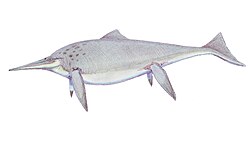
| Shonisaurus |
Camp |
1976 |
Valid |
Late Triassic |
United States |
One of the largest ichthyosaurs yet known. State fossil of Nevada |
 |
| Simbirskia |
Otschev & Efimov |
1985 |
Jr. synonym |
N/A |
N/A |
Junior synonym of Platypterygius |
|
| Simbirskiasaurus |
Otschev & Efimov |
1985 |
Valid |
Early Cretaceous |
Russia |
Closely related to Platypterygius |
|
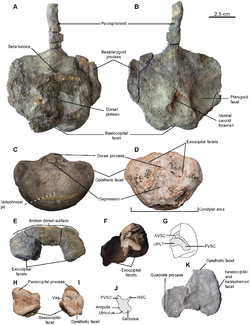
| Sisteronia[40] |
Fischer et al. |
2014 |
Valid |
Early Cretaceous |
France
United Kingdom
( England) |
Its discovery suggests a greater diversity of ichthyosaurs from Early Cretaceous Europe than previously thought |
 |
| Stenopterygius |
Jaekel |
1904 |
Valid |
Early Jurassic to Middle Jurassic |
France
Germany
Luxembourg
Switzerland
United Kingdom
( England) |
One well-known specimen proves that ichthyosaur infants were born tail-first, just like cetaceans, to prevent them from drowning before fully clearing the birth canal |
 |
| Suevoleviathan |
Maisch |
1998 |
Valid |
Early Jurassic |
Germany |
Had uniquely large forefins compared to other ichthyosaurs |
 |
| Sumpalla[41] |
Campos et al. |
2021 |
Valid |
Late Jurassic |
Argentina |
Originally thought to be a specimen of Aegirosaurus |
 |
| Svalbardosaurus |
Mazin |
1981 |
Dubious |
Early Triassic |
Norway |
Although initially described as an ichthyosaur, it was later suggested to be an amphibian |
|
| Sveltonectes |
Fischer et al. |
2011 |
Valid |
Early Cretaceous |
Russia |
Its teeth have an unusual morphology |
|
| Temnodontosaurus |
Lydekker |
1889 |
Valid |
Early Jurassic |
Belgium
Chile?
France
Germany
Italy
Luxembourg
Switzerland
United Kingdom
( England) |
Possibly had the largest eyes of any known animal, rivaling those of a colossal squid in size |
 |
| Thaisaurus |
Mazin et al. |
1991 |
Valid |
Early Triassic |
 Thailand Thailand |
The first and fifth metacarpals are identical in size |
 |
| Thalassodraco[42] |
Jacobs & Martill |
2020 |
Valid |
Late Jurassic |
United Kingdom
( England) |
May be closely related to Nannopterygius |
 |
| Thalattoarchon[43] |
Fröbisch et al. |
2013 |
Valid |
Middle Triassic |
United States |
The apex predator of its ecosystem, filling an ecological role similar to orcas |
 |
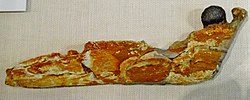
| Tholodus |
von Meyer |
1851 |
Valid |
Middle Triassic |
China?
Germany
Italy
|
Mainly known from teeth and fragments of jaws |
 |
| Toretocnemus |
Merriam |
1903 |
Valid |
Late Triassic |
Mexico
United States |
Had very large eye sockets and narrow jugals |
 |
| Typicusichthyosaurus |
Yin et al. |
2000 |
Jr. synonym? |
N/A |
N/A |
Probably a junior synonym of Guanlingsaurus, but this cannot be confirmed due to poor preservation[44][45] |
|
| Undorosaurus |
Efimov |
1999 |
Valid |
Late Jurassic |
Norway
Poland
Russia |
Can be distinguished from Ophthalmosaurus by characters of its ischiopubis and teeth |
 |
| Utatsusaurus[1][9] |
Shikama et al. |
1978 |
Valid |
Early Triassic |
Canada
Japan |
The earliest known ichthyopterygian |
 |
| Wahlisaurus |
Lomax |
2016 |
Valid |
Early Jurassic |
United Kingdom
( England) |
Its shoulder girdle is markedly different from that of Eurhinosaurus |
 |
| Wimanius |
Maisch & Matzke |
1998 |
Valid |
Middle Triassic |
Switzerland |
Has been recovered in a variety of phylogenetic positions within the Hueneosauria |
 |
| Xinminosaurus |
Jiang et al. |
2008 |
Valid |
Middle Triassic |
China |
Has been suggested to be synonymous with Tholodus |
|
| Xiphodracon[46] |
Lomax, Massare & Maxwell |
2025 |
Valid |
Early Jurassic |
United Kingdom
( England) |
Probably closely related to Hauffiopteryx |
 |
| Yasykovia |
Efimov |
1999 |
Jr. synonym |
N/A |
N/A |
Junior synonym of Nannopterygius |
|
|


.png)


.png)


.png)


.jpg)


)_Музей_палеонтологии._Ундоры._Ульяновская_обл._Ноябрь_2013_-_panoramio.jpg)


.jpg)
