Top Qs
Timeline
Chat
Perspective
Quantum yield
Number of times a given event occurs per photon absorbed by a quantum system From Wikipedia, the free encyclopedia

Remove ads
In particle physics, the quantum yield (denoted Φ) of a radiation-induced process is the number of times a specific event occurs per photon absorbed by the system.[1]

In photosensitive device engineering, the events of interest are charge carriers collected at either terminal. In that context, the same concept is called quantum efficiency (QE).[citation needed][dubious – discuss] QE is dimensionless, but it is closely related to the responsivity, which is expressed in amps per watt.
Since the energy of a photon is inversely proportional to its wavelength, quantum efficiency is often measured over a range of different wavelengths to characterize a device's efficiency at each photon energy level. For typical semiconductor photodetectors, QE drops to zero for photons whose energy is below the band gap. A photographic film typically has a QE of much less than 10%,[2] while CCDs can have a QE of well over 90% at some wavelengths.
Remove ads
Applications
Summarize
Perspective
Fluorescence spectroscopy
The fluorescence quantum yield is defined as the ratio of the number of photons emitted to the number of photons absorbed.[3]
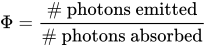
Fluorescence quantum yield is measured on a scale from 0 to 1.0, but is often represented as a percentage. A quantum yield of 1.0 (100%) describes a process where each photon absorbed results in a photon emitted. Substances with the largest quantum yields, such as rhodamines, display the brightest emissions; however, compounds with quantum yields of 0.10 are still considered quite fluorescent.
Quantum yield is defined by the fraction of excited state fluorophores that decay through fluorescence:
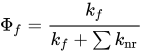
where
- Φf is the fluorescence quantum yield,
- kf is the rate constant for radiative relaxation (fluorescence),
- knr is the rate constant for all non-radiative relaxation processes.
Non-radiative processes are excited state decay mechanisms other than photon emission, which include: Förster resonance energy transfer, internal conversion, external conversion, and intersystem crossing. Thus, the fluorescence quantum yield is affected if the rate of any non-radiative pathway changes. The quantum yield can be close to unity if the non-radiative decay rate is much smaller than the rate of radiative decay, that is kf > knr.[3]
Fluorescence quantum yields are measured by comparison to a standard of known quantum yield.[3] The quinine salt quinine sulfate in a sulfuric acid solution was regarded as the most common fluorescence standard,[4] however, a recent study revealed that the fluorescence quantum yield of this solution is strongly affected by the temperature, and should no longer be used as the standard solution. The quinine in 0.1M perchloric acid (Φ = 0.60) shows no temperature dependence up to 45 °C, therefore it can be considered as a reliable standard solution.[5]
More information  ,
,  ...
...
 ,
,  ...
...Experimentally, relative fluorescence quantum yields can be determined by measuring fluorescence of a fluorophore of known quantum yield with the same experimental parameters (excitation wavelength, slit widths, photomultiplier voltage etc.) as the substance in question. The quantum yield is then calculated by:

where
- Φ is the quantum yield,
- Int is the area under the emission peak (on a wavelength scale),
- A is absorbance (also called "optical density") at the excitation wavelength,
- n is the refractive index of the solvent.
The subscript R denotes the respective values of the reference substance.[6][7] The determination of fluorescence quantum yields in scattering media requires additional considerations and corrections.[8]
FRET efficiency
Förster resonance energy transfer efficiency (E) is the quantum yield of the energy-transfer transition, i.e. the probability of the energy-transfer event occurring per donor excitation event:

where
Solvent and environmental effects
A fluorophore's environment can impact quantum yield, usually resulting from changes in the rates of non-radiative decay.[3] Many fluorophores used to label macromolecules are sensitive to solvent polarity. The class of 8-anilinonaphthalene-1-sulfonic acid (ANS) probe molecules are essentially non-fluorescent when in aqueous solution, but become highly fluorescent in nonpolar solvents or when bound to proteins and membranes. The quantum yield of ANS is ~0.002 in aqueous buffer, but near 0.4 when bound to serum albumin.
Photochemical reactions
The quantum yield of a photochemical reaction describes the number of molecules undergoing a photochemical event per absorbed photon:[1]

In a chemical photodegradation process, when a molecule dissociates after absorbing a light quantum, the quantum yield is the number of destroyed molecules divided by the number of photons absorbed by the system. Since not all photons are absorbed productively, the typical quantum yield will be less than 1.

Quantum yields greater than 1 are possible for photo-induced or radiation-induced chain reactions, in which a single photon may trigger a long chain of transformations. One example is the reaction of hydrogen with chlorine, in which as many as 106 molecules of hydrogen chloride can be formed per quantum of blue light absorbed.[11]
Quantum yields of photochemical reactions can be highly dependent on the structure, proximity and concentration of the reactive chromophores, the type of solvent environment as well as the wavelength of the incident light. Such effects can be studied with wavelength-tunable lasers and the resulting quantum yield data can help predict conversion and selectivity of photochemical reactions.[12]
In optical spectroscopy, the quantum yield is the probability that a given quantum state is formed from the system initially prepared in some other quantum state. For example, a singlet to triplet transition quantum yield is the fraction of molecules that, after being photoexcited into a singlet state, cross over to the triplet state.
Photosynthesis
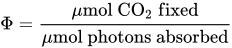
Quantum yield is used in modeling photosynthesis:[13]
Remove ads
QE of solar cells
Summarize
Perspective

 |
A solar cell's quantum efficiency value indicates the amount of current that the cell will produce when irradiated by photons of a particular wavelength. If the cell's quantum efficiency is integrated over the whole solar electromagnetic spectrum, one can evaluate the amount of current that the cell will produce when exposed to sunlight. The ratio between this energy-production value and the highest possible energy-production value for the cell (i.e., if the QE were 100% over the whole spectrum) gives the cell's overall energy conversion efficiency value. Note that in the event of multiple exciton generation (MEG), quantum efficiencies of greater than 100% may be achieved since the incident photons have more than twice the band gap energy and can create two or more electron-hole pairs per incident photon.
Types
Two types of quantum efficiency of a solar cell are often considered:
- External quantum efficiency (EQE) is the ratio of the number of charge carriers collected by the solar cell to the number of photons of a given energy shining on the solar cell from outside (incident photons).
- Internal quantum efficiency (IQE) is the ratio of the number of charge carriers collected by the solar cell to the number of photons of a given energy that shine on the solar cell from outside and are absorbed by the cell.
The IQE is always larger than the EQE in the visible spectrum. A low IQE indicates that the active layer of the solar cell is unable to make good use of the photons, most likely due to poor carrier collection efficiency. To measure the IQE, one first measures the EQE of the solar device, then measures its transmission and reflection, and combines these data to infer the IQE.


The external quantum efficiency therefore depends on both the absorption of light and the collection of charges. Once a photon has been absorbed and has generated an electron-hole pair, these charges must be separated and collected at the junction. A "good" material avoids charge recombination. Charge recombination causes a drop in the external quantum efficiency.
The ideal quantum efficiency graph has a square shape, where the QE value is fairly constant across the entire spectrum of wavelengths measured. However, the QE for most solar cells is reduced because of the effects of recombination, where charge carriers are not able to move into an external circuit. The same mechanisms that affect the collection probability also affect the QE. For example, modifying the front surface can affect carriers generated near the surface. Highly doped front surface layers can also cause 'free carrier absorption' which reduces QE in the longer wavelengths.[14] And because high-energy (blue) light is absorbed very close to the surface, considerable recombination at the front surface will affect the "blue" portion of the QE. Similarly, lower energy (green) light is absorbed in the bulk of a solar cell, and a low diffusion length will affect the collection probability from the solar cell bulk, reducing the QE in the green portion of the spectrum. Generally, solar cells on the market today do not produce much electricity from ultraviolet and infrared light (<400 nm and >1100 nm wavelengths, respectively); these wavelengths of light are either filtered out or are absorbed by the cell, thus heating the cell. That heat is wasted energy, and could damage the cell.
Remove ads
QE of image sensors
Quantum efficiency (QE) is the fraction of photon flux that contributes to the photocurrent in a photodetector or a pixel. Quantum efficiency is one of the most important parameters used to evaluate the quality of a detector and is often called the spectral response to reflect its wavelength dependence. It is defined as the number of signal electrons created per incident photon. In some cases it can exceed 100% (i.e. when more than one electron is created per incident photon).
EQE mapping
Conventional measurement of the EQE will give the efficiency of the overall device. However it is often useful to have a map of the EQE over large area of the device. This mapping provides an efficient way to visualize the homogeneity and/or the defects in the sample. It was realized by researchers from the Institute of Researcher and Development on Photovoltaic Energy (IRDEP) who calculated the EQE mapping from electroluminescence measurements taken with a hyperspectral imager.[15][16]
Spectral responsivity
Summarize
Perspective
Spectral responsivity is a similar measurement, but it has different units: amperes per watt (A/W); (i.e. how much current comes out of the device per unit of incident light power).[17] Responsivity is ordinarily specified for monochromatic light (i.e. light of a single wavelength).[citation needed] Both the quantum efficiency and the responsivity are functions of the photons' wavelength (indicated by the subscript λ).
To convert from responsivity (Rλ, in A/W) to QEλ[18] (on a scale 0 to 1): where λ is the wavelength in nm, h is the Planck constant, c is the speed of light in vacuum, and e is the elementary charge. Note that the unit W/A (watts per ampere) is equivalent to V (volts).

Determination
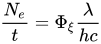
where = number of electrons produced, = number of photons absorbed.
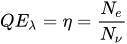


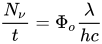
Assuming each photon absorbed in the depletion layer produces a viable electron-hole pair, and all other photons do not, where t is the measurement time (in seconds), = incident optical power in watts, = optical power absorbed in depletion layer, also in watts.


Remove ads
See also
References
Wikiwand - on
Seamless Wikipedia browsing. On steroids.
Remove ads