Top Qs
Timeline
Chat
Perspective
Solomonic column
Spiraling type of column From Wikipedia, the free encyclopedia

Remove ads
The Solomonic column, also called barley-sugar column, is a helical column, characterized by a spiraling twisting shaft like a corkscrew. It is not associated with a specific classical order, although most examples have Corinthian or Composite capitals. But it may be crowned with any design, for example, making a Roman Doric solomonic or Ionic solomonic column.[1]
_(cropped).jpg)
Perhaps originating in the Near East, it is a feature of Late Roman architecture, which was revived in Baroque architecture, especially in the Spanish and Portuguese-speaking worlds. Two sets of columns, both in the very prestigious setting of St. Peter's Basilica in Rome, were probably important in the wide diffusion of the style. The first were relatively small, and given by Constantine the Great in the 4th century. These were soon believed to have come from the Temple in Jerusalem, hence the style's naming after the biblical Solomon. The second set are those of Bernini's St. Peter's Baldacchino, finished in 1633.
Remove ads
Etymology and origin
Summarize
Perspective

.jpg)
Unlike the classical example of Trajan's Column of ancient Rome, which has a turned shaft decorated with a single continuous helical band of low-reliefs depicting Trajan's military might in battle, the twisted column is known to be an eastern motif taken into Byzantine architecture and decoration. Twist-fluted columns were a feature of some eastern architecture of Late Antiquity.
In the 4th century, Constantine the Great brought a set of columns to Rome and gave them to the original St. Peter's Basilica for reuse in the high altar and presbytery; The Donation of Constantine, a painting from Raphael's workshop, shows these columns in their original location. According to tradition, these columns came from the "Temple of Solomon", even though Solomon's temple was the First Temple, built in the 10th century BC and destroyed in 586 BC, not the Second Temple, destroyed in 70 AD. These columns, now considered to have been made in the 2nd century AD,[2] became known as "Solomonic". In actuality, the columns probably came from neither temple. Constantine is recorded as having brought them de Grecias i.e., from Greece, and they are archaeologically documented as having been cut from Greek marble.[2] A small number of Roman examples of similar columns are known. All that can firmly be said is that they are early and, because they have no Christian iconography in the carving and their early date (before the construction of elaborate churches), are presumably reused from some non-church building.[2] The columns have distinct sections that alternate from ridged to smooth with sculpted grape leaves.
Some of these columns remained on the altar until the old structure of St. Peter's was torn down in the 16th century. While removed from the altar, eight of these columns remain part of the structure of St. Peter's. Two columns were placed below the pendentives on each of the four piers beneath the dome. Another column can now be observed up close in the St. Peter's Treasury Museum. Other columns from this set of twelve have been lost over the course of time.
If these columns really were from one of the Temples in Jerusalem, the spiral pattern may have represented the oak tree which was the first Ark of the Covenant, mentioned in Joshua 24:26.[3] These columns have sections of twist-fluting alternating with wide bands of foliated reliefs.
From Byzantine examples, the Solomonic column passed to Western Romanesque architecture. In Romanesque architecture some columns also featured spiraling elements twisted round each other like hawser. Such variety adding life to an arcade is combined with Cosmatesque spiralling inlays in the cloister of St. John Lateran. These arcades were prominent in Rome and may have influenced the baroque Solomonic column.
Remove ads
Technological Influence's
Unintentionally, the mathematical design for the model of the water screw designed by Archimedes directly correlated with the design of the spiral fluted column. Vitruvius later explained and showed how the mathematical geometry of marking specific points on a cylindrical column could be repeated without fear of it coming out crooked or misshapen. Due to the shape of spiral flute columns, they needed more labor and a higher level of precision because of how long they are compared to the vertical flutes you can see in Roman and Greek Architecture. Typically, the large spiral fluted columns had about 1.5 more spiral flutes than the small columns.
Remove ads
Mechanical Screws & Spiral Columns
Spiral columns are mostly made of right-handed columns (meaning the spiral goes up and to the right). Still, there are examples of right-handed and left-handed columns (spiral goes up and to the left) seen together at the exact location. A couple of good examples of this are the Apamea colonnade and St. Peter's. These spiral-fluted columns are often seen in multiples, not just alone. Some think right-handed columns are more common because the designer was right-handed, and due to a minority of the population being left-handed, there are little left-handed columns known, but this is not confirmed.
Greek Development
Spiral columns also appeared in the Aegean Bronze Age, specifically the Minoans of Crete, and at Mycenae, located on the Greek mainland. No surviving columns were found or cited when any excavations had taken place. There are signs of spiral columns in vase paintings, frescoes, and other minor works. For example, a seal found in a tomb depicted a spiral column between two griffins (birdlike creatures) and a fresco in a shrine showed the use of a spiral column being used. From this evidence, it is thought that the Mycenae used the spiral column as a structural element.
Remove ads
Roman Use
Spiral fluted columns were more commonly known in Roman Architecture and appeared in theaters, fountains, gateways, and colonnades. One of the most well-known examples of this is the Apamea colonnade in Syria, which features rows of spiral-fluted columns alternating between Z- and S-style spirals, approximately 30 feet tall and 1 meter wide at the base. Many varied materials were used, but marble was the most common. Even though the marble had to be imported, it was worth it for them to use it due to its symbolic power and luxury. Spiral fluted columns were also shown on coins, sarcophaguses, and various other things. Romans used spiral columns on important buildings and structures.
Remove ads
Uses of the Mud-brick in Ancient Mesopotamia
Mud bricks were produced from a mixture of earth (typically some sort of clay), water, and straw. The bricks varied from red brown to grey, depending on the source taken from the earth. To increase the strength of the mud bricks, a large amount of straw is used, approximately sixty kilograms of straw per one hundred bricks. One downside of the vast amount of straw used was that once it was exposed and began to decay, the mud-bricks strength also decreased. The bricks were used to build spiral columns by manually cutting them to create angled faces and assembling them into spirals or even palm-trunk-like shapes (combing right-handed and left-handed spirals). A good example of this would be the Panel of Spiral Columns found at the Tell al Rimah, in the Great Temple located in Mesopotamia.
Remove ads
Trajan's Column
One of the first examples of the spiral column is Trajan's Column. This Column was 27 meters high and showed its right-handed spirals, showing many Roman decorations. Many interpret the right-handed columns as being read as you would read a book, from left to right. Other examples that followed this trend are the Columns created by Theodosius and by Theodosius's son, Arcadius. Unfortunately, both columns no longer exist. Later, Bernward's Column was made with left-handed spirals and depicted more Christian-based content rather than Roman. This Column lies in the Church of St. Michael's and celebrates the New Testament.
Remove ads
In Baroque architecture
Summarize
Perspective

The Solomonic column was revived as a feature of Baroque architecture. The twisted S-curve shaft gives energy and dynamism to the traditional column form which fits these qualities that are characteristically Baroque.
Easily the best-known Solomonic columns are the colossal bronze Composite columns by Bernini in his Baldacchino at St. Peter's Basilica. The construction of the baldachin, actually a ciborium, which was finished in 1633, required that the original ones of Constantine be moved.
During the succeeding century, Solomonic columns were commonly used in altars, furniture, and other parts of design. Sculpted vines were sometimes carved into the spiralling cavetto of the twisting columns, or made of metal, such as gilt bronze. In an ecclesiastical context such ornament may be read as symbolic of the wine used in the Eucharist.
.jpg)
In the 16th century Raphael depicted these columns in his tapestry cartoon The Healing of the Lame at the Beautiful Gate, and Anthony Blunt noticed them in Bagnocavallo's Circumcision at the Louvre and in some Roman altars, such as one in Santo Spirito in Sassia, but their full-scale use in actual architecture was rare: Giulio Romano employed a version as half-columns decoratively[4] superimposed against a wall in the Cortile della Cavallerizza of the Palazzo Ducale, Mantua (1538-39).[5]
.jpg)
Peter Paul Rubens employed Solomonic columns in tapestry designs, ca 1626 , where he provided a variant of an Ionic capital for the columns as Raphael had done, and rusticated and Solomonic columns appear in the architecture of his paintings with such consistency and in such variety that Anthony Blunt thought it would be pointless to give a complete list.[5]
The columns became popular in Catholic Europe including southern Germany. The Solomonic column spread to Spain at about the same time as Bernini was making his new columns, and from Spain to Spanish colonies in the Americas, where the salomónica was often used in churches as an indispensable element of the Churrigueresque style. The design was most infrequently used in Britain, the south porch of St Mary the Virgin, Oxford, being the only exterior example found by Robert Durman,[3] and was still rare in English interior design, an example noted by Durman is the funerary monument for Helena, Lady Gorges (died 1635) at Salisbury perhaps the sole use.
After 1660, such twist-turned columns became a familiar feature in the legs of French, Dutch and English furniture, and on the glazed doors that protected the dials of late 17th- and early 18th-century bracket and longcase clocks. English collectors and dealers sometimes call these twist-turned members "barley sugar twists" after the type of sweet traditionally sold in this shape.
Remove ads
Modern Imitations
More modern examples of Trajan Columns include the Church of St Charles Borromeo, Napoleon's Column, and the History Column. The Church of St Charles, commissioned by Emperor Charles VI in 1714, is in Vienna and shows both a right-handed and left-handed column in the front to achieve complete symmetry of the building. Napoleon's Column, found in Paris, featured a right-handed spiral and was made from bronze cannons captured at the Battle of Austerlitz. Lastly, the most recent example is the History Column, based in the United Kingdom and was revealed in 2005. The History Column has a left-handed spiral, but the story depicted ends at the bottom rather than at the top, like usual.
Gallery

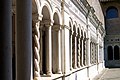 Solomonic columns and other fanciful variants in the cloister of St John Lateran, Rome, early 13th century
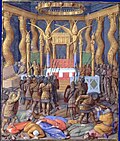 Pompey in the Temple of Jerusalem by Jean Fouquet, 1470–1475
 Raphael's workshop's Donation of Constantine shows St. Peter's Solomonic columns in their original location in front of the altar in the old basilica
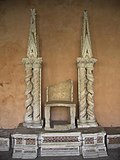 Papal throne from the cloister of St. John Lateran
 Renaissance design of a candlestick in form of an Ionic Solomonic column, circa 1530-1546
 Renaissance door to the staircase of the Hôtel d'Assézat, Toulouse (France), 1555-1556.
 Print by François Boucher, in which appears a pair of Solomonic columns with Ionic capitals


Remove ads
See also
References
External links
Wikiwand - on
Seamless Wikipedia browsing. On steroids.
Remove ads