Top Qs
Timeline
Chat
Perspective
PAOK FC
Greek association football club From Wikipedia, the free encyclopedia

Remove ads
PAOK FC (Greek: ΠΑΕ ΠΑΟΚ, ['pa.ok]),[3] short for "Pan-Thessalonian Athletic Club of Constantinopolitans" (Greek: Πανθεσσαλονίκειος Αθλητικός Όμιλος Κωνσταντινουπολιτών, romanized: Panthessaloníkios Athlitikós Ómilos Konstadinoupolitón), and commonly known as PAOK Thessaloniki, PAOK Salonika or simply PAOK, is a Greek professional football club based in Thessaloniki, Macedonia, Greece. PAOK are one of the top domestic clubs, the most successful and widely supported in Northern Greece.


Established on 20 April 1926 by Greek refugees who fled to Thessaloniki from Constantinople in the wake of the Greco-Turkish War (1919–1922), they play their home games at Toumba Stadium, a 29,000 seating capacity football ground. Their name, along with the club's emblem, the Byzantine-style double-headed eagle with retracted wings, honours the memory of the people and places (mostly from the city of Constantinople) that once belonged to the Eastern Roman Empire.[4][5] PAOK currently plays in the top-flight Super League, which they have won four times (in 1976, 1985, 2019 and 2024). They are eight-time winners of the Greek Cup (in 1972, 1974, 2001, 2003, 2017, 2018, 2019 and 2021). The club is one of the three which have never been relegated from the top national division and the only team in Greece that have won the Double (in 2019) going unbeaten (26–4–0 record) in a national round-robin league tournament (league format since 1959).[6]
The team has appeared several times in the UEFA Europa League, but has yet to reach the group stage of the UEFA Champions League. PAOK have reached the quarter-finals of a European competition three times; once in the 1973–74 European Cup Winners' Cup and twice in the UEFA Conference League, in the 2021–22 and 2023–24 seasons. PAOK is the only Greek team that has more wins than losses in their European record (99 wins, 68 draws and 87 defeats, as of August 2025) and the 0–7 away UEFA Cup win over Locomotive Tbilisi on 16 September 1999 is the largest ever achieved by a Greek football club in all European competitions.
Remove ads
History
Summarize
Perspective
Foundation and early years (1926–1939)

PAOK FC is the oldest department of the major multi-sport club AC P.A.O.K., which is closely linked with Hermes Sports Club, that was formed in 1875 by the Greek community of Pera, a district of Istanbul (Constantinople).[4] The football club was founded in April 1926 after a dispute with Enosis Konstantinoupoliton Thessalonikis (E.K. Th.), a social and political organisation, by Constantinopolitans who fled to Thessaloniki after the Greek defeat in the Greco-Turkish War. PAOK's policy was to be open to every citizen of Thessaloniki, leading to a minor rivalry with AEK Thessaloniki, the other Constantinopolitan club of the city, from which PAOK had split prior to its foundation and was attended exclusively by refugees.[7]
PAOK played its first friendly match on 4 May 1926 at the stadium of Thermaikos, defeating Megas Alexandros Thessaloniki 2–1, coached by Kostas Andreadis, who spent five years on the team's bench without demanding payment. The first professional contract was signed by the club in September 1928 for French footballer Raymond Etienne of Jewish descent from Pera Club (the club that PAOK's founding members played in), which ignited further controversy between the two refugee clubs.[8] In March 1929, AEK Thessaloniki was disbanded as a sports club and their members joined PAOK. PAOK thereupon changed its emblem, adopting the Double-headed eagle, as a symbol of the club's Constantinopolitan heritage. PAOK also got possession of AEK Thessaloniki's facilities located around Syntrivani and settled there, becoming the sole refugee club in the city.
Albeit PAOK's first years in existence were marred by strife and controversy with the Macedonia Football Clubs Association and the Hellenic Football Federation, the team's ascension led to its debut in the 1930–31 Panhellenic Championship, becoming a mainstay at the national stage, with the construction of the Syntrivani Stadium being completed in 1932.[9] The team would win its first regional title, the Macedonia Championship, in 1937, beginning a period of dominance. PAOK would reach a Greek Cup final in 1939 and the two-legged final of the Panhellenic Championship in 1940, losing both times to AEK Athens. However, the team's success would be cut short by the Greco–Italian War, where the team was dismembered, with two players dying on duty.[10]
Regional league dominance and youth academy (1946–1959)
After World War II, in the early 1950s, a state-of-the-art youth academy named PAOK Academy was created by the Austrian coach Wilhelm (Willy) Sevcik, who played for the club in the 1930's. The academy was known as the "chicos of Willi". From the newly founded academy sprang some great football players of the period, such as Leandros Symeonidis, Giannelos Margaritis and Giorgos Havanidis.[11][12]
In 1948, PAOK won their second Macedonia Championship, and then participated in the final phase of the Panhellenic Championship where they were ranked third. PAOK footballers dedicated the title to the memory of team captain, Thrasyvoulos Panidis, who had lost his life (18 February 1948) in the Greek Civil War a few days prior.[13] In 1950, they became champions of Macedonia for a third time, and the following year (1950–51), the team reached their second Cup final, but lost to Olympiacos.[14]
After a busy transfer period in 1953, PAOK's offensive play was signficantly strengthened with an effective front three, consisting of Kouiroukidis, Papadakis and Yientzis and the club dominated the Macedonian championship for the rest of the decade, with four consecutive titles from 1954 to 1957, going unbeaten from 1954 to 1956, under the management of Nikos Pangalos, Erman Hoffman and Walter Pfeiffer, albeit results in the Panhellenic Championship were more mixed.[15] The team also reached a third Cup final in 1955, losing to Panathinaikos.[16] The concluding seasons of the decade were less successful, but the team's performance in the 1958–59 Macedonia Championship secured a spot in the newly found nationwide Alpha Ethniki, which replaced the region–based Panhellenic Championship.
Alpha Ethniki, domestic and international success, professionalism (1959–1989)
Having moved to the newly built and crowdfunded Toumba Stadium in September 1959,[17][18] PAOK's first years in the nationwide division were unassuming, finishing no higher than sixth between 1960 and 1966, except for a fourth place finish in 1963. Under the captaincy of Leandros Symeonidis the club slowly built a solid foundation through its youth academy, with emerging youngsters such as Giorgos Koudas and Stavros Sarafis.[19][20][21][22] In this period, PAOK became a frequent guest in the Inter-Cities Fairs Cup and significantly increased its attacking form under Ivor Powell and Jane Janevski. In 1968, Koudas' controversial transfer from PAOK to Olympiacos was annuled, in a string of incidents that started a heated rivalry between the two teams.[23]
The 1970s was a successful period for the club, with scouting on behalf of president Giorgos Pantelakis building a strong team, including Sarafis, Terzanidis, Iosifidis, Gounaris, Paridis, Aslanidis, Apostolidis, Fountoukidis, Kermanidis, Anastasiadis, Furtula, Guerino and captained by Koudas. From 1970 to 1974, PAOK reached five consecutive Cup finals, defeating Panathinaikos in 1972[24][25] and Olympiacos on penalties in 1974,[26] under the management of Englishman Les Shannon. The club came close to its first nationwide league title in the 1972–73 season, finishing runners–up and Cup finalists in a controversial manner to Olympiacos. It would eventually clinch its first league title in 1976, under the management of former Hungarian Golden Team international Gyula Lóránt.[27] Afterward, the club mounted a 62 game undefeated streak at home from 1976 to 1980.[28]

In European competitions, the club achieved major wins against clubs like Lyon in 1973 and Barcelona in 1975, reaching the quarter-finals of the European Cup Winners' Cup in 1974, eventually being knocked out by AC Milan.[29] It then lost the 1977 and 1978 Cup finals and failed to defend the title in controversial fashion in 1977, with PAOK coming at odds with the Hellenic Football Federation. Further complications ensued after the 1978 Thessaloniki earthquake, which damaged Toumba Stadium and eventually led to its Gate 8 collapsing in February 1980.
In the summer of 1979, football in Greece became fully professional, with PAOK restructuring into a privately owned football limited company, with major stockholder Giorgos Pantelakis as the club's president. With the rise of PAOK's ultras group Gate 4, PAOK would become entangled in ownership controversies that would go on via various means for over two decades. As the advent of hooliganism rose dramatically in Greece, PAOK would become infamous for various incidents, starting with a loss against Panathinaikos at Toumba in 1980.[30]
The early 1980's were trophyless for PAOK, with the club being a consistent challenger for silverware domestically, despite being struck by tragedy when Gyula Lóránt died of a heart attack in a league match against Olympiacos in 1981.[31] Inspired by promising new players, such as Christos Dimopoulos, the club reached two Cup finals, in 1981 and 1983, ultimately losing both to Olympiacos and AEK Athens respectively, while also losing in Europe to Eintracht Frankfurt and Bayern Munich, both on penalties.[32] Koudas and Furtula retired from football in the summer of 1984.
In the 1984–85 season, under Austrian manager Walter Skocik and leading players, such as Skartados, Alavantas, Singas, Kostikos and Paprica, PAOK clinched their second league title, while falling short of the Cup in the final against AEL.[33] Captain Kostas Iosifidis retired at the end of the season and the rest of the 1980s were less fruitful for the club. In the 1987–88 season, the club fall short of the league title amidst increasing board controversies.
Financial issues, ownership changes, continental success (1989–2012)
In 1989, Thomas Voulinos became the club's president, initiating a rise in form entering the 1990's, with players such as Magdy Tolba and academy signing Giorgos Toursounidis.[34]. The club slumped to a third place in the 1990 title race and entered a period of on and off–pitch instability, starting with Voulinos protesting on the pitch in a match against Panathinaikos in 1990.[35] After losing in the double–legged Cup final in 1992 to Olympiacos, Gate 4 and PAOK's presidency became increasingly at odds, resulting in boycotts from the club's fans and a sharp decrease in attendances at the insistence of Gate 4 throughout the decade.
In Europe, the club had notable encounters in the UEFA Cup with Sevilla, losing on penalties and K.V. Mechelen, defeating them away from home, but increasing discontent between Gate 4 and Voulinos resulted in heavy rioting at a UEFA Cup home game against Paris Saint-Germain in October 1992,[36][37] resulting in a two-season ban from European competitions, later reduced to one year. With younger players such as Theodoros Zagorakis, the team achieved a more successful 1994–95 season under Dutchman Arie Haan. The following season, the club was threatened with its first relegation, ultimately finishing four points clear with a points deduction, following heavy rioting and arson against Thomas Voulinos after a 1–3 loss to AEK Athens in November 1995.
.jpg)
In 1996, Thomas Voulinos handed over a debt-free PAOK to Giorgos Batatoudis. Numerous successful players such as Zisis Vryzas,[38] Spyros Marangos, free kick specialist Kostas Frantzeskos,[39] Percy Olivares[40] and Joe Nagbe were signed under the new administration. Under former player Angelos Anastasiadis, after a five-year absence from European competitions, PAOK qualified for the UEFA Cup.[41] The club's reappearance at European level was marked by a victory and qualification over eventual double winners Arsenal.[42] Under Dušan Bajević, PAOK won the domestic Cup in 2001, defeating Olympiacos 4–2 in the final[43][44] to claim the club's first trophy in 16 years.[45] Bajević departed in 2002, to be replaced by Angelos Anastasiadis, who led PAOK to a 1–0 defeat of local rivals Aris in the 2003 Cup final, becoming the first former player to win a trophy as manager.[46][47][48][49] Batatoudis's shares were transferred, he was removed from the presidency following the Cup win and was succeeded by Giannis Goumenos following a rise in the club's debt.[50]
This period would be overshadowed by the untimely death of 21 year old player Panagiotis Katsouris in February 1998[51] and the Vale of Tempe disaster in 1999, which claimed the lives of six PAOK fans following an away match against Panathinaikos.[52][53] Ceremonies take place every year in remembrance of the tragedies, with Katsouris' jersey number (No. 17) being permanently retired and a bust being erected in his memory in 2000.[54]
After a successful 2003–04 season, in which the club qualified for the UEFA Champions League third qualifying round for the first time, the club failed to qualify to the group stage while fielding Liasos Louka, who was an ineligible player.[55] The club's financial situation worsened, as managerial and boardroom crisis culminated in the emergence of the club's poor financial position; players declared they had been unpaid for months, which led to a decision by UEFA to ban the club from european competitions,[56] bringing the club close to dissolution. The organized supporters' groups launched an all-out war, occupying the club's offices during the summer of 2006.[57] [58] After possible takeover bids failed and embezzlement allegations arose, especially after the transfer of Dimitris Salpingidis to Panathinaikos,[59] Goumenos resigned in November 2006, with a temporary administration assuming control, as debt had tripled in Goumenos' three year presidency.[60]

In June 2007, former player and captain Theodoros Zagorakis retired[61] and assumed the presidency of the club.[62][63] PAOK's finances gradually improved thanks to new sponsorship deals and the rising attendance from the club's fans, which contributed to the completion of the PAOK FC Sport Center in 2009.[64] He was followed by Zisis Vryzas, who retired in 2008 to become director of football.[65]
In his first season, the early replacement of Georgios Paraschos by Fernando Santos[66] did little to prevent a ninth-place finish in the league. The next season was more successful, with new signings such as club favourites Vieirinha, Pablo Contreras and Pablo García,[67] qualifying for european football for the first time since 2005. After a successful 2009–10 season, where the team narrowly missed out on the league title and qualified for the Champions League qualifying round, Santos left the club, with former player Pavlos Dermitzakis leading the club to qualification in the rebranded UEFA Europa League against Fenerbahçe, before being sacked in October. Under Makis Chavos, PAOK reached the knockout stages before being eliminated by CSKA Moscow.[68][69] The next season, under Romanian László Bölöni,[70] was highlighted by a 1–2 win against Tottenham Hotspur at White Hart Lane. PAOK finished top of its Europa League group,[71] ultimately being defeated in the next round by Udinese. In January 2012, Zagorakis resigned from the club's presidency and was replaced by director Zisis Vryzas, in a transitional effort brought forth by increasing fan discontent following the sale of Vieirinha to VfL Wolfsburg.[72][73]
The Ivan Savvidis era (2012–present)

On 10 August 2012, Ivan Savvidis[74][75] acquired PAOK ownership by depositing a fee of €9,951,000 and thus becoming the major shareholder of the club.[76][77] Following the takeover, the club sought to eliminate its debts, successfully doing so over the course of three years, a fee of over 10 million euros, becoming the first Greek sports club to fully repay its loans.[78][79]
The first years under the new presidency were ambitious but lackluster, with the club remaining trophyless after losing the domestic Cup final in 2014 to Panathinaikos[80] and failing to third place after leading the table at Christmas the following season, under returning Angelos Anastasiadis. Whilst european form was more positive, highlighted by a surprise 1–0[81] away win over Borussia Dortmund at Signal Iduna Park, domestic form was underwhelming, with Igor Tudor being replaced in March 2016 by youth-team coach and former player Vladimir Ivić[82], who led the team to a return in the Champions League third qualifying round. The next season saw the club's successful return to the Europa League knockouts and a controversial 2–1 win over AEK Athens in the Cup final,[83] which was maligned by off pitch incidents that resulted in a points deduction for the club.[84]

After Ivić departed in the summer of 2017, he was briefly succeeded by Aleksandar Stanojević, who was let go after two Europa League matches and was succeeded by Răzvan Lucescu[85]. Captained by returning player Vieirinha, PAOK came second in the 2017–18 campaign. It became a highly controversial season, most notably for the home league matches against Olympiacos and AEK Athens which were both interrupted and lost by court decision.[86][87][88] A few months later, PAOK claimed its second consecutive domestic Cup, beating AEK Athens 2–0 in the final held at the Olympic Stadium of Athens (AEK home ground at the time). During the post-game press conference, manager Lucescu and captain Vieirinha (final MVP[89]) both stated that the 2018 league title was stolen from PAOK.[90][91]
Inspired by initial European success, the 2018–19 season became the most successful in the club's history, claiming PAOK's third league title and finishing undefeated, becoming only the second Greek team to do so after Panathinaikos in the 1963–64 season.[92] PAOK also claimed their third consecutive Greek Cup, beating AEK Athens in the final for the third year in a row to seal the club's first double.[93] Lucescu departed shortly after, and his successor Abel Ferreira[94] brought the club close to Champions League qualification, defeating Benfica and Beşiktaş before being elinimated by Krasnodar. Former player and captain Pablo García succeeded him in October 2020, leading the club to an eigth Greek Cup, defeating Olympiacos 2–1 in the final, in May 2021. Lucescu would return to the managerial post shortly after, with talented emerging players such as Giannis Konstantelias and Konstantinos Koulierakis[95] leading the club to the quarter-finals in the newly found UEFA Europa Conference League in 2022, a feat the club would repeat in 2024, and reaching successive Cup finals, losing to Panathinaikos[96] and AEK Athens in 2022 and 2023 respectively.
In 2023–24 season, PAOK after finishing first in the regular season, managed to remain on top after the conclusion of the play-offs winning their fourth Greek Championship on a remarkable fashion.[97] PAOK defeated all their major rivals (AEK, Olympiacos, Panathinaikos and Aris) in the last four matches, winning against the three league contenders from Athens at home and clinching the title with a 1–2 away victory over city rivals Aris at the Kleanthis Vikelidis Stadium on 19 May 2024.[98]
Remove ads
Crest and colours
Summarize
Perspective
Crest
The first emblem of PAOK depicted a four-leaf clover and a horseshoe. The leaves were green and above them were the initials of the word "PAOK". Kostas Koemtzopoulos, one of PAOK's founding members, came up with this idea, inspired by his favourite brand of cigarettes.[99]
On 20 March 1929, Enosis Konstantinoupoliton Thessalonikis (A.E.K.) was dissolved and absorbed by PAOK and a mournful version of the double-headed eagle with the wings closed instead of stretched, indicating the grief for the lost homelands, was adopted as the club's new emblem.[100]
On 11 June 2013, under the presidency of Ivan Savvidis, a golden outline was added to the crest, as a symbol of the club's Byzantine heritage.[101][102]
During the 2018–19 season, the first emblem was used on the third kit.
Colours
The club's colours have always been black and white, black for the sorrow related to countless thousands of Greek refugees who were forced to leave the land their ancestors had been living in for centuries (Asia Minor, Eastern Thrace, Pontus, Caucasus) and white for the hope of a new beginning that came with settling in a new home.[103] PAOK's traditional kit features a black and white vertical striped shirt, combined with black or white shorts and socks. Various types of shirts were used throughout the club's history and the most common alternatives were those with thinner or wider stripes, the all-black one and the all-white one.[104][105][106] Over the years, several other colours were used on the 3rd kit, such as grey, silver, blue, purple, orange and red.[107]
Kit suppliers and shirt sponsors
The current kit manufacturer is Macron, a collaboration that started in July 2015 and was renewed twice until 2027.[108][109][110] Stoiximan, a Greek online gambling company, is the shirt sponsor since June 2017, with the sponsorship deal extended twice and set to last until 2025.[111]
Remove ads
Facilities
Summarize
Perspective
Toumba Stadium
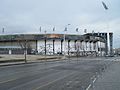
PAOK's current home ground is Toumba Stadium, which was built in 1959. During the years, this artifact of modern architecture has been used as an owned country house by fellow citizens of Thessaloniki, commemorating the actual roots of this great club.
New Toumba Stadium project
PAOK administration have already presented to the Greek public authorities an architecture study of a new at Toumba Stadium. The Greek Council of State (CoS), the country's supreme court, in April 2022 approved a proposal to set up the complete redevelopment of Toumba Stadium, with the CoS deeming legal a draft Presidential Decree concerning the approval of a Special Urban Plan for the district of Toumba, where the venue is located. On 21 June 2022, PAOK has formalized the beginning of a collaboration with a team consisting of domestic engineering and consulting firm SALFO and global architectural design company Populous to deliver the project.[121][122] It is estimated that PAOK will be granted a building permit in 2023 and the new stadium will be completed by 2026 and will have a capacity of 41,926 spectators.[123] PAOK would probably move to Kaftanzoglio Stadium until the new Stadium is built.
New Toumba Stadium project plans present some significant changes to the original stadium, notably a giant roof covering the entire stadium which counters a common criticism of the current ground regarding exposure to weather and elements outside of Gates 1 and 2. The existing stands would be demolished and reconstructed, moving closer to the pitch and eliminating the distance from the former running track. However, as of early 2024, the project has been in a continuous stalemate.

 External view
 Inside view
 Inside view
 PAOK FC bus


.jpg)


Training ground PAOK FC Sport Center in Nea Mesimvria
PAOK FC Sport Center is the training ground of the first team and Academy, located in Nea Mesimvria area of Thessaloniki. The construction started under the presidency of Theodoros Zagorakis.[124]
New PAOK FC Sport Center in the municipality of Thermi
On 19 January 2024, a blessing of the land where the club's new training center will be built took place. The newly acquired plot of land is located on the 8th road of the Tagarades farmland in the community of the Thermi municipality.[125]
Remove ads
Supporters
Summarize
Perspective
.jpg)

PAOK FC is the most widely supported football club in Northern Greece[126] and with the 3rd largest fanbase in the country, according to the latest polls and researches.[127][128][129][130][131]
PAOK's traditional fanbase comes from the city of Thessaloniki, where the club is based, as well as from the rest of Macedonia region and Northern Greece. They also have fans all over the country and in the Greek Diaspora (Germany, Australia, USA, etc.). Research by Marca in August 2018 reported that PAOK are the most popular Greek football team on social media.[132][133][134]
Toumba Stadium is infamous for its hostile atmosphere, a factor that led to the attribution of the Stadium as "The Black Hell".[135][136] On high-profile encounters, when the players walk out of the tunnel, the song Hells Bells by AC/DC is heard from the stadium's speakers.[137] The notorious Gate 4 is home to many PAOK organized supporters' groups from around the globe, with the homonymous Gate 4 fan club which was founded in April 1976, being the most familiar everywhere.[138][139] The supporters' group from Neapoli district of Thessaloniki that was founded in 1963 is the oldest one.[140] One of the biggest banners in the world was created by PAOK's fan club in Michaniona.[141]
No 12 jersey is dedicated to the fans, the symbolic 12th man on the pitch. It was permanently retired by the club on 16 August 2000.[142][143]
Vale of Tempe tragedy (1999)
3,000 PAOK fans descended to the Olympic Stadium of Athens for the game against Panathinaikos on 3 October 1999. A few hours later, on its way back to Thessaloniki, the double-decker bus of the Kordelio fan club collided with a truck and fell into a ditch in the Vale of Tempe, Thessaly. The aftermath of the bus crash was devastating. Six PAOK fans lost their lives (Kyriakos Lazaridis, Christina Tziova, Anastasios Themelis, Charalampos Zapounidis, Georgios Ganatsios, Dimitris Andreadakis) and many others were injured. A roadside memorial was erected at the site of the crash bearing the following inscription: "Their love for PAOK brought them here, left them here and went beyond".[52]
Supporters friendships


PAOK fans maintain a strong friendship with the supporters of Serbian club Partizan, the Grobari. On many occasions, fans from both clubs traveled to watch each other's games.[144][145][146]
A good rapport exists between PAOK and OFI fans, a friendship that started in October 1987 when OFI faced Atalanta for 1987–88 Cup Winners' Cup at Toumba Stadium and numerous PAOK fans supported the Cretans.[147][148][149] A mutual respect stands between PAOK and Panionios fans.[150][151][152]
Rivalries
.jpg)
The rivalry between Olympiacos and PAOK is the fiercest intercity football rivalry in Greece and is long-standing, emerging in the 1960s, when Olympiacos unsuccessfully tried to acquire Giorgos Koudas from PAOK, approaching him directly without going into a negotiation with his club.[153][154] A longtime heated rivalry exists between PAOK and local rivals Aris.[155][156] Panathinaikos and AEK, Athens' two big clubs, are also considered major rivals.[157][158] There are also some less intense rivalries, like those with Iraklis (local conflict) and AEL.
Remove ads
Honours
Domestic
.png)
Continental
- European Cup:
- Last 16 (1): 1976–77
- UEFA Cup Winners' Cup:
- Quarter-finalists (1): 1973–74
- UEFA Conference League
Regional
- Macedonia FCA Championship:
- Winners (7): 1936–37, 1947–48, 1949–50, 1953–54, 1954–55, 1955–56, 1956–57
- Macedonia–Thrace FCA Championship:[159][160]
- Winners (1): 1939–40
Other
- Greater Greece Cup (defunct)
- Winners (1): 1973
Remove ads
European record
Summarize
Perspective
Last updated: 11 December 2025
UEFA Club Ranking
- As of 21 Aug 2025


Remove ads
Players
Summarize
Perspective
Current squad
- As of 22 December 2025[161]
Note: Flags indicate national team as defined under FIFA eligibility rules; some limited exceptions apply. Players may hold more than one non-FIFA nationality.


Reserves and Academy
Note: Flags indicate national team as defined under FIFA eligibility rules; some limited exceptions apply. Players may hold more than one non-FIFA nationality.
Source: PAOK Squad
Out on loan
Note: Flags indicate national team as defined under FIFA eligibility rules; some limited exceptions apply. Players may hold more than one non-FIFA nationality.

Captains (since 1959)


- Notes
- Giorgos Koudas, Stavros Sarafis, Koulis Apostolidis and Giannis Gounaris were co-captains.
MVP of the Season


Remove ads
Management
Summarize
Perspective
Coaching staff

Source: PAOK Staff
Notable managers
The following managers won at least one trophy when in charge of PAOK:


Club personnel

Source: PAOK Board
Chairmen history

Remove ads
Records and statistics
Summarize
Perspective
One-club men
Player records
Giorgos Koudas holds the record for most PAOK league appearances, having played 504 matches (607 overall) from 1963 to 1984.[163]
Stavros Sarafis is the club's top goalscorer with 169 goals overall (136 in league matches), from 1967 to 1981.[164]

Domestic records
Remove ads
See also
- P.A.O.K.
- History of PAOK FC
- List of PAOK FC managers
- PAOK B
- Greek refugees
- PAOK F.C. in European football
- List of PAOK FC records and statistics
- List of PAOK FC seasons
- PAOK FC (women)
- Thessaloniki
- Toumba (Thessaloniki)
- Toumba Stadium
- PAOK FC Sport Center
- PAOK Academy
- P.A.O.K. H.C.
- P.A.O.K H.C Women's Handball
Bibliography
- Kanotas, Miltiadis (2005). 80 χρόνια, αυτός είναι ο ΠΑΟΚ (in Greek). Ελλάδα: Εκδόσεις Εκδοτική Θεσσαλονίκης.
- Κυρίτσης, Δημήτρης; Στεφανίδης, Ανέστης; Τσιομπανούδη, Ελένη (2005). ΠΑΟΚ, Πανθεσσαλονίκειος Αθλητικός Όμιλος Κωνσταντινοπουλιτών 1926–2005 (in Greek). Ελλάδα: Εκδόσεις Κέντρο Ιστορίας Θεσσαλονίκης. ISBN 978-960-88595-2-4.
- Μπλιάτκας, Κώστας (2005). Γιώργος Κούδας, της ζωής μου το παιχνίδι (in Greek). Ελλάδα: Εκδόσεις Ιανός. ISBN 978-960-7827-35-7.
- Συλλογικό έργο (2009). Για πάντα πρωταθλητές, Π.Α.Ο.Κ. Ποδόσφαιρο-Μπάσκετ (in Greek). Ελλάδα: Εκδόσεις Σκάι. ISBN 978-960-482-020-7.
- Τσάλλος, Αλέξιος (2010). Το αλφαβητάρι του ΠΑΟΚ (in Greek). Ελλάδα: Εκδόσεις Δίαυλος. ISBN 978-960-531-259-6.
- Τσιώλης, Σταύρος (2011). Ταξιδεύοντας με τον ΠΑΟΚ (in Greek). Ελλάδα: Εκδόσεις Αιγόκερως. ISBN 978-960-322-419-8.
- Πετρακόπουλος, Σταύρος (2016). Τα «μυθικά» του ΠΑΟΚ (in Greek). Ελλάδα: Εκδόσεις Friends Press. ISBN 978-618-82397-0-8.
- Ζαμπούνης, Χρήστος (2016). ΠΑΟΚ αφού (in Greek). Ελλάδα: Εκδόσεις Φερενίκη. ISBN 978-960-9513-58-6.
- Ιωαννίδης, Νίκος (2017). Μια εποχή στο τσιμέντο (in Greek). Ελλάδα: Εκδόσεις Τόπος. ISBN 978-960-499-192-1.
- Εδίρνελης, Σωκράτης (2018). Το κλεμμένο πρωτάθλημα (in Greek). Ελλάδα: Εκδόσεις ΑΛΔΕ. ISBN 978-960-9451-89-5.
- Παππούς, Μιχάλης (2019). Ο ΠΑΟΚ του '70 (in Greek). Ελλάδα: Εκδόσεις University Studio Press. ISBN 978-960-12-2421-3.
- Βασιλόπουλος, Κώστας (2023). Ραζβάν Λουτσέσκου, Double PAOK (in Greek). Ελλάδα: Εκδόσεις Φερενίκη. ISBN 978-960-9513-89-0.
Remove ads
Filmography
References
External links
Wikiwand - on
Seamless Wikipedia browsing. On steroids.
Remove ads