Niger
sovereign state in western Africa From Wikipedia, the free encyclopedia

Remove ads
Niger or the Niger[13][14] (/niːˈʒɛər/ or /ˈnaɪdʒər/;[15][16] French: [niʒɛʁ]), officially the Republic of the Niger,[13][14] is a country in western Africa. The capital is Niamey, and the official language is Hausa.[17] It is surrounded by Algeria and Libya to the north, Chad to the east, Nigeria and Benin to the south, and Burkina Faso and Mali to the west. Niger is landlocked, meaning it has no coastline. Niger gets its name from the Niger River, whose name possibly comes from the Berber word "River of Rivers".[18]

.svg)
The Mali Empire and the Songhai Empire both had land in what is now Niger. Later France controlled the land that is now Niger. Niger has a population, or the number of people living in an area, of 15,306,252 and an area of 1,267,000 square kilometres. Much of Niger is desert.
Most of the people live in rural areas, and have little access to advanced education.
Niger is one of the poorest countries in the world with a lack of contraception. 41.4% live in poverty. Hunger plagues the country.
Niger’s main exports are uranium ore, livestock, cowpeas and onions. Millet and sorghum are grown in the south, as well as cassava and sugarcane. Rice is grown in the Niger River valley. Peanuts are the most important cash crop. Other important crops are cotton and pulses.
Niger is home to the critically endangered addax antelope. West African giraffes are the only giraffes in West Africa that exist in Niger.
History: There was a military coup in 2010. The 2023 Niger coup d'état happened.
Remove ads
Geography
Niger is on the border between the Sahara and Sub-Saharan regions. Niger's area is 1,267,000 square kilometres (489,191 sq mi) of which 300 square kilometres (116 sq mi) is water. It is the world's twenty-second largest country. Niger borders seven countries. The longest border is with Nigeria to the south.
The lowest point is the Niger River, with an elevation of 200 metres (656 ft). The highest point is Mont Idoukal-n-Taghès in the Aïr Mountains at 2,022 m (6,634 ft).
Regions
- Northern Niger: Agadez Region
- South-Central Niger: Maradi Region, Tahoua Region, Zinder Region
- South-Eastern Niger: Diffa Region, Zinder Region
- South-Western Niger: Tillabéri Region, Dosso Region, Niamey, Tahoua Region
Zinder Region and Tahoua Region are intermediates between Central Niger.
Cities
This table shows cities with a population over 10,000, according to 2001 census.
Climate
Niger's subtropical climate is mainly very hot and dry. Much of it is covered by desert. In the extreme south there is a tropical climate on the edges of the Niger River basin. The land is mostly desert plains and sand dunes. There is flat to rolling savanna in the south and hills in the north.
Wildlife
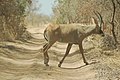 Gazelle
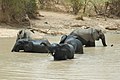 Elephants
 Violet turaco
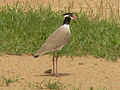 Black-headed lapwing
 Blue-naped mousebird


Remove ads
Demographics
There are several ethnic groups in Niger:
Education
The literacy rate (the amount of the adult population who can read or write) of Niger is among the lowest in the world. In 2005 it was estimated to be only 28.7% (42.9% male and 15.1% female).[21] Primary education in Niger is required for six years.[22] The primary school enrollment and attendance rates are low, particularly for girls.[22] Children are often made to work rather than attend school. This is particularly true during planting or harvest periods.
Related pages
Notes
- Disputed by Hassoumi Massaoudou[4]
References
Other websites
Wikiwand - on
Seamless Wikipedia browsing. On steroids.
Remove ads