| Genus |
Authors |
Year |
Status |
Age |
Location |
Notes |
Images |
| Abyssosaurus[3] |
Berezin |
2011 |
Valid |
Early Cretaceous |
 Russia Russia |
Had a uniquely short, triangular skull with extremely large eye sockets |
 |
| Acostasaurus[4] |
Gómez-Pérez & Noè |
2017 |
Valid |
Early Cretaceous |
 Colombia Colombia |
Noted for its unusually caniniform dentition compared to other pliosaurids |
 |
| Albertonectes[5] |
Kubo et al. |
2012 |
Valid |
Late Cretaceous |
 Canada Canada |
Had the longest neck of any known plesiosaur, made up of seventy-six vertebrae |
 |
| Alexandronectes |
Otero et al. |
2016 |
Valid |
Late Cretaceous |
 New Zealand New Zealand |
The first aristonectine from which a stapes is known[6] |
 |
| Alexeyisaurus |
Sennikov & Arkhangelsky |
2010 |
Dubious |
Late Triassic |
Russia |
Although originally described as an elasmosaurid plesiosaur, it was suggested to be an undiagnostic sauropterygian taxon by subsequent analyses |
|
| Alzadasaurus |
Welles & Bump |
1949 |
Jr. synonym |
N/A |
N/A |
Junior synonym of Styxosaurus |
|
| Anguanax[7] |
Cau & Fanti |
2015 |
Valid |
Late Jurassic |
 Italy Italy |
Several features of its skull would indicate a diet of soft or small-bodied prey |
 |
| Anningasaura[8] |
Vincent & Benson |
2012 |
Valid |
Early Jurassic |
 United Kingdom United Kingdom |
Known from a partial skeleton belonging to a juvenile animal |
 |
| Apatomerus |
Williston |
1903 |
Dubious? |
Early Cretaceous |
 United States United States |
Originally identified as a crocodilian and later reinterpreted as a pterosaur, although it may very likely be a plesiosaur |
|
| Aphrosaurus |
Welles |
1943 |
Valid |
Late Cretaceous |
United States |
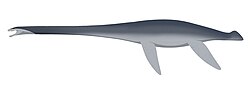
Distinguished by the presence of a deepened ventral notch along the centra of its cervical vertebrae |
 |
| Apractocleidus |
Smellie |
1915 |
Jr. synonym |
N/A |
N/A |
Junior synonym of Cryptoclidus |
|
| Aptychodon |
von Reuss |
1855 |
Valid |
Late Cretaceous |
 Czech Republic Czech Republic |
Some studies suggest this genus may be a potential junior synonym of Polyptychodon |
 |
| Archaeonectrus |
Novozhilov |
1964 |
Valid |
Early Jurassic |
United Kingdom |
Originally mistakenly believed to be a species of Plesiosaurus |
 |
| Aristonectes |
Cabrera |
1941 |
Valid |
Late Cretaceous |
Antarctica
 Argentina Argentina
 Chile Chile |
This genus would have migrated regularly between Patagonia and Antarctica as implied by its fossil record |
 |
| Arminisaurus |
Sachs & Kear |
2017 |
Valid |
Early Jurassic |
 Germany Germany |
Shares some features of its skeleton with leptocleidian plesiosauroids |
 |
| Attenborosaurus |
Bakker |
1993 |
Valid |
Early Jurassic |
United Kingdom |
Named in honor of British broadcaster and naturalist David Attenborough |
 |
| Atychodracon |
Smith |
2015 |
Valid |
Late Triassic to Early Jurassic |
United Kingdom |
Has been assigned to four different genera before its formal description |
 |
| Avalonnectes[9] |
Benson, Evans & Druckenmiller |
2012 |
Valid |
Early Jurassic |
United Kingdom |
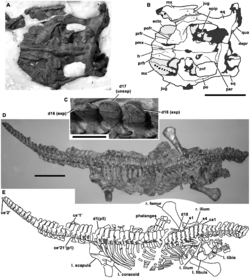
One of the oldest plesiosaurs known to date |
 |
| Bathyspondylus |
Delair |
1982 |
Valid |
Late Jurassic |
United Kingdom |
Possesses an unusual mix of pliosauroid and plesiosauroid features |
 |
| Bishanopliosaurus |
Dong |
1980 |
Valid |
Early Jurassic to Middle Jurassic |
 China China |
Could be distinguished by the bifurcated ribs of its sacrum |
 |
| Borealonectes |
Sato & Wu |
2008 |
Valid |
Middle Jurassic |
Canada |
One of the few North American plesiosaurs that lived during the Jurassic |
|
| Boyacasaurus[10] |
Benavides-Cabra et al. |
2025 |
Valid |
Early Cretaceous |
Colombia |
Known from two specimens found in association with ammonites |
|
| Brachauchenius |
Williston |
1903 |
Valid |
Late Cretaceous |
 Morocco Morocco
United States |
Several pliosaurid specimens of same age had been referred to this genus, although they were either renamed as new taxa or considered dubious |
 |
| Brancasaurus |
Wegner |
1914 |
Valid |
Early Cretaceous |
Germany |
Its cervical vertebrae are noted for having shark fin-shaped neural spines |
 |
| Brimosaurus |
Leidy |
1854 |
Dubious |
Late Cretaceous |
United States |
May be synonymous with Cimoliasaurus |
|
| Callawayasaurus |
Carpenter |
1999 |
Valid |
Early Cretaceous |
Colombia |
Has no pectoral bars, a trait shared with Terminonatator |
 |
| Cardiocorax[11] |
Araújo et al. |
2015 |
Valid |
Late Cretaceous |
 Angola Angola |
The morphology of its scapula suggests a relatively unique swimming style for this genus |
 |
| Ceraunosaurus |
Thurmond |
1968 |
Jr. synonym |
N/A |
N/A |
Junior synonym of Trinacromerum |
|
| Chubutinectes[12] |
O'Gorman et al. |
2023 |
Valid |
Late Cretaceous |
Argentina |
Larger than the contemporary Kawanectes due to its marine habitat |
|
| Cimoliasaurus |
Leidy |
1851 |
Valid |
Late Cretaceous |
United States |
Discovered in sediments that superficially resemble the chalk deposits found in the Western Interior Seaway |
 |
| Colymbosaurus |
Seeley |
1874 |
Valid |
Middle Jurassic to Late Jurassic |
 Norway Norway
United Kingdom |
The holotype humerus was originally misidentified as a femur |
 |
| Crymocetus |
Cope |
1869 |
Dubious |
Late Cretaceous |
United Kingdom |
Today seen as an indeterminate plesiosaur. Only known from a single vertebra |
 |
| Cryonectes[13] |
Vincent, Bardet & Mattioli |
2012 |
Valid |
Early Jurassic |
 France France |
Possessed a relatively elongated snout |
 |
| Cryptoclidus |
Seeley |
1892 |
Valid |
Middle Jurassic to Late Jurassic |
United Kingdom |
Would have preyed on small, soft-bodied animals as indicated by the delicate build of its skull and teeth |
 |
| Discosaurus |
Leidy |
1851 |
Valid |
Late Cretaceous |
United States |
Has been argued to be the same taxon as Elasmosaurus |
 |
| Djupedalia[14] |
Knutsen, Druckenmiller & Hurum |
2012 |
Valid |
Late Jurassic |
Norway |
Named after former Minister of Education and Research Øystein Djupedal |
 |
| Dolichorhynchops |
Williston |
1902 |
Valid |
Late Cretaceous |
Canada
United States |
Described two years after its discovery |
 |
| Dravidosaurus |
Yadagiri & Ayyasami |
1979 |
Dubious |
Late Cretaceous |
 India India |
Suggested to be either an ornithischian (potentially stegosaurian) dinosaur or a plesiosaur |
|
| Eardasaurus |
Ketchum & Benson |
2022 |
Valid |
Middle Jurassic |
United Kingdom |
Had prominent enamel ridges in its teeth, which would indicate a diet of large prey |
 |
| Edgarosaurus |
Druckenmiller |
2002 |
Valid |
Early Cretaceous |
United States |
One of the first polycotylids to become native to the Western Interior Seaway |
 |
| Eiectus |
Noè & Gómez-Pérez |
2021 |
Valid? |
Early Cretaceous |
 Australia Australia |
Potentially synonymous with Kronosaurus |
|
| Elasmosaurus |
Cope |
1868 |
Valid |
Late Cretaceous |
United States |
Originally erroneously reconstructed with its skull placed at the end of its tail |
 |
| Embaphias |
Cope |
1894 |
Dubious |
Late Cretaceous |
United States |
Based on three cervical vertebrae |
|
| Eoplesiosaurus[9] |
Benson, Evans & Druckenmiller |
2012 |
Valid |
Early Jurassic |
United Kingdom |
May have been the basalmost known member of the Plesiosauroidea |
 |
| Eopolycotylus[15] |
Albright et al. |
2007 |
Valid |
Late Cretaceous |
United States |
Known from a single partial skeleton |
 |
| Eretmosaurus |
Seeley |
1874 |
Valid |
Early Jurassic to Middle Jurassic |
Russia
United Kingdom |
Two species are known |
 |
| Eromangasaurus |
Kear |
2005 |
Valid |
Early Cretaceous |
Australia |
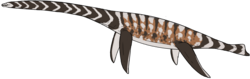
The holotype skull is almost complete although badly crushed |
 |
| Eurycleidus |
Andrews |
1922 |
Valid |
Early Jurassic |
United Kingdom |
May have made a powerful forward stroke for fast swimming as suggested by its relatively large shoulder bones |
|
| Eurysaurus |
Gaudry |
1878 |
Valid |
Early Jurassic |
France |
Formerly misidentified as a nothosaur |
|
| Fluvionectes |
Campbell et al. |
2021 |
Valid |
Late Cretaceous |
Canada |
The holotype specimen may have died in a log jam as suggested by the pieces of coalified wood found alongside it |
 |
| Franconiasaurus[16] |
Sachs, Eggmaier & Madzia |
2024 |
Valid |
Early Jurassic |
Germany |
Its cervical and dorsal vertebrae possessed short neural spines |
 |
| Fresnosaurus |
Welles |
1943 |
Valid |
Late Cretaceous |
United States |
Coexisted with at least three other plesiosaurs |
 |
| Futabasaurus |
Sato, Hasegawa & Manabe |
2006 |
Valid |
Late Cretaceous |
 Japan Japan |
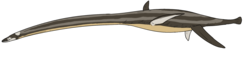
Most of its bones preserve bite marks caused by Cretalamna, indicating it would have been scavenged or hunted by the shark |
 |
| Gallardosaurus |
Gasparini |
2009 |
Valid |
Late Jurassic |
 Cuba Cuba |
The only known individual was discovered in a concretion in dark shale |
 |
| "Georgia" |
Otschev |
1976 |
Preoccupied |
N/A |
N/A |
Preoccupied by a genus of snake, later renamed Georgiasaurus |
|
| Georgiasaurus |
Otschev |
1977 |
Valid |
Late Cretaceous |
Russia |
The holotype skeleton was damaged during preparation of the quarry stone |
 |
| Goniosaurus |
Meyer |
1860 |
Valid |
Late Cretaceous |
 Netherlands Netherlands |
The striations of its tooth meet each other under an angle pointing to the root instead of the apex |
|
| Gronausaurus[17] |
Hampe |
2013 |
Jr. synonym |
N/A |
N/A |
Junior synonym of Brancasaurus |
|
| Hastanectes[18] |
Benson et al. |
2012 |
Valid |
Early Cretaceous |
United Kingdom |
Originally named as a species of Cimoliasaurus |
 |
| Hauffiosaurus |
O'Keefe |
2001 |
Valid |
Early Jurassic |
Germany
United Kingdom |
The holotype specimen is preserved lying on its back |
 |
| Hydralmosaurus |
Welles |
1943 |
Jr. synonym |
N/A |
N/A |
Junior synonym of Styxosaurus |
|
| Hydrorion |
Großmann |
2007 |
Valid |
Early Jurassic |
Germany |
Several individuals are known |
 |
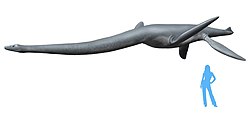
| Hydrotherosaurus |
Welles |
1943 |
Valid |
Late Cretaceous |
United States |
Multiple vertebrae were the first remains to be found. More bones had been unearthed afterwards |
 |
| Ischyrodon |
von Meyer |
1838 |
Dubious |
Middle Jurassic |
 Switzerland Switzerland |
Has been considered a junior synonym of Liopleurodon, but a 2022 revision found some differences that would make it separate from that genus[19] |
 |
| Jucha |
Fischer et al. |
2020 |
Valid |
Early Cretaceous |
Russia |
One of the earliest known confirmed elasmosaurids |
 |
| Kaiwhekea |
Cruickshank & Fordyce |
2002 |
Valid |
Late Cretaceous |
New Zealand |
Preserved inside a large, roughly 6.5 m (21 ft) long concretion |
 |
| Kawanectes[20] |
O'Gorman |
2016 |
Valid |
Late Cretaceous |
Argentina |
Previously identified as a species of Trinacromerum |
 |
| Kimmerosaurus |
Brown |
1981 |
Valid |
Late Jurassic |
Norway?
United Kingdom |
Its skull was overall similar to that of the related Cryptoclidus but much broader |
 |
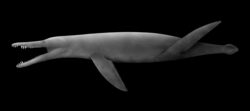
| Kronosaurus |
Longman |
1924 |
Valid |
Early Cretaceous |
Australia |
One of the largest pliosaurids ever identified, likely the apex predator of its environment |
 |
| Lagenanectes |
Sachs, Hornung & Kear |
2017 |
Valid |
Early Cretaceous |
Germany |
One of the most well-preserved plesiosaurs known from the Early Cretaceous of Europe |
 |
| Leivanectes |
Páramo-Fonseca et al. |
2019 |
Valid |
Early Cretaceous |
Colombia |
Differs from the contemporary Callawayasaurus, hence its classification as a separate genus |
|
| Leptocleidus |
Andrews |
1922 |
Valid |
Early Cretaceous |
Australia
 South Africa South Africa
United Kingdom |
Like other members of its family and unlike most other plesiosaurs, it inhabited freshwater environments |
 |
| Leurospondylus |
Brown |
1913 |
Valid |
Late Cretaceous |
Canada |
Its exact taxonomic placement is uncertain |
 |
| Libonectes |
Carpenter |
1997 |
Valid |
Late Cretaceous |
Morocco
United States |
Originally referred to as a species of Elasmosaurus, but it was named as a distinct genus due to morphological differences |
 |
| Lindwurmia |
Vincent & Storrs |
2019 |
Valid |
Early Jurassic |
Germany |
Possessed five pairs of premaxillary teeth |
 |
| Liopleurodon |
Sauvage |
1873 |
Valid |
Middle Jurassic to Late Jurassic |
France
Germany
 Mexico Mexico
United Kingdom |
Several analyses suggest that this genus may have been an ambush predator |
 |
| Lorrainosaurus[21] |
Sachs et al. |
2023 |
Valid |
Middle Jurassic |
France |
Originally assigned to Simolestes but it has been found to be more derived |
 |
| Luetkesaurus |
Kiprijanoff |
1883 |
Dubious |
Late Cretaceous |
Russia |
No species name has ever been assigned |
|
| Luskhan |
Fischer et al. |
2017 |
Valid |
Early Cretaceous |
Russia |
Unlike other pliosaurids, it had a slender snout, small teeth, and short tooth rows, convergent with polycotylids |
 |
| Lusonectes |
Smith, Araújo & Mateus |
2012 |
Valid |
Early Jurassic |
 Portugal Portugal |
The first plesiosaur named from Portugal |
 |
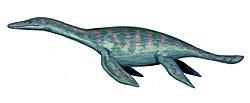
| Macroplata |
Swinton |
1930 |
Valid |
Early Jurassic |
United Kingdom |
Its neck is comparatively longer than its head |
 |
| Makhaira[22] |
Fischer et al. |
2015 |
Valid |
Early Cretaceous |
Russia |
Unusually, its teeth were triangular in cross-section |
 |
| Manemergus |
Buchy et al. |
2005 |
Valid |
Late Cretaceous |
Morocco |
May have been contemporaneous with Thililua |
 |
| Marambionectes[23] |
O'Gorman et al. |
2024 |
Valid |
Late Cretaceous |
Antarctica |
Closely allied to the aristonectines |
 |
| Maresaurus |
Gasparini |
1997 |
Valid |
Middle Jurassic |
Argentina |
The first plesiosaur identified from the Los Molles Formation |
|
| Marmornectes |
Ketchum & Benson |
2011 |
Valid |
Middle Jurassic |
United Kingdom |
Would have been very similar to Peloneustes |
|
| Martinectes[24] |
Clark, O'Keefe & Slack |
2023 |
Valid |
Late Cretaceous |
Russia?
United States |
Initially named as species of Trinacromerum and then assigned to Dolichorhynchops until its reclassification as a new genus in 2023 |
 |
| Mauisaurus |
Hector |
1874 |
Dubious |
Late Cretaceous |
New Zealand |
Several specimens had been referred to this genus, but a 2017 review restricts it only to the lectotype[25] |
 |
| Mauriciosaurus |
Frey et al. |
2017 |
Valid |
Late Cretaceous |
Mexico |
Similarly to Cryptoclidus, it is noted for the unusual arrangement of gastralia |
 |
| Megacephalosaurus[26] |
Schumacher et al. |
2013 |
Valid |
Late Cretaceous |
United States |
One of the last known pliosaurids prior to their extinction |
 |
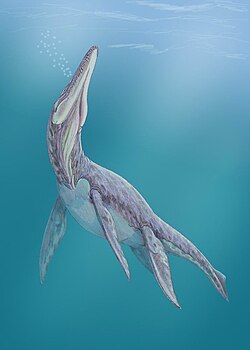
| Megalneusaurus |
Knight |
1898 |
Valid |
Late Jurassic |
United States |
One specimen preserves stomach contents, including cephalopods and fish |
 |
| Meyerasaurus |
Smith & Vincent |
2010 |
Valid |
Early Jurassic |
Germany |
Represented by a complete, articulated skeleton |
 |
| Microcleidus |
Watson |
1909 |
Valid |
Early Jurassic |
Germany
 Luxembourg Luxembourg
United Kingdom |
Possessed at least forty vertebrae in its neck |
 |
| Monquirasaurus |
Noè & Gómez-Pérez |
2021 |
Valid |
Early Cretaceous |
Colombia |
Originally known as a South American species of Kronosaurus |
 |
| Morenosaurus |
Welles |
1943 |
Valid |
Late Cretaceous |
United States |
The only described specimen is nearly complete, missing only the skull and some parts of the neck and paddles |
 |
| Morturneria |
Chatterjee & Creisler |
1994 |
Valid |
Late Cretaceous |
Antarctica |
Once considered to be a juvenile Aristonectes, but a 2017 study found it to be distinct enough to warrant recognition as separate[27] |
 |
| Muraenosaurus |
Seeley |
1874 |
Valid |
Middle Jurassic |
United Kingdom |
May have possessed an increased muscle attachment towards its neck as indicated by its elongated cervical vertebrae with broad neural spines |
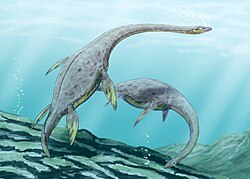 |
| Nakonanectes |
Serratos et al. |
2017 |
Valid |
Late Cretaceous |
United States |
Its overall morphology was exceptionally similar to that of aristonectines despite being less derived |
 |
| Nichollssaura[28] |
Druckenmiller & Russell |
2009 |
Valid |
Early Cretaceous |
Canada |
Fills a temporal gap of approximately 40 million years in the fossil record of North American plesiosaurs |
 |
| "Nichollsia" |
Druckenmiller & Russell |
2008 |
Preoccupied |
N/A |
N/A |
Preoccupied by a genus of isopod, renamed Nichollssaura |
|
| Occitanosaurus |
Bardet et al. |
1999 |
Jr. synonym |
N/A |
N/A |
Junior synonym of Microcleidus |
|
| Ogmodirus |
Williston & Moodie |
1913 |
Dubious |
Late Cretaceous |
United States |
May be an elasmosaurid |
 |
| Oligosimus |
Leidy |
1872 |
Jr. synonym |
N/A |
N/A |
Junior synonym of Cimoliasaurus |
|
| Opallionectes |
Kear |
2006 |
Valid |
Early Cretaceous |
Australia |
Hypothesized to live on a cold habitat |
 |
| Ophthalmothule |
Roberts et al. |
2020 |
Valid |
Late Jurassic to Early Cretaceous |
Norway |
May have possibly hunted at night in deep waters as suggested by its relatively large eye sockets |
 |
| Orophosaurus |
Cope |
1851 |
Dubious |
Late Cretaceous |
United States |
Named based only on portions of three neck vertebrae |
|
| Pachycostasaurus |
Cruickshank et al. |
1996 |
Valid |
Middle Jurassic |
United Kingdom |
Its skeleton bears several unique features in most of the bones |
 |
| Pahasapasaurus |
Schumacher |
2007 |
Valid |
Late Cretaceous |
United States |
Distinguishable by characters of its epipodial and palate bones |
 |
| "Palmula"[15] |
Albright et al. |
2007 |
Preoccupied |
N/A |
N/A |
Preoccupied by a genus of foraminifer, renamed Palmulasaurus |
|
| Palmulasaurus |
Albright et al. |
2007 |
Valid |
Late Cretaceous |
United States |
Shared its environment with three other polycotylids |
 |
| Pantosaurus |
Marsh |
1893 |
Valid |
Late Jurassic |
United States |
One fossil preserves a partially digested ichthyosaur embryo within its stomach cavity |
 |
| Peloneustes |
Lydekker |
1889 |
Valid |
Middle Jurassic |
United Kingdom |
Multiple specimens are known, including fairly complete material, which make it one of the most well-known pliosaurids |
 |
| Peyerus |
Stromer |
1935 |
Jr. synonym |
N/A |
N/A |
Junior synonym of Leptocleidus |
|
| Picrocleidus |
Andrews |
1910 |
Valid |
Middle Jurassic |
United Kingdom |
Previously synonymized with the coeval Muraenosaurus, but this has been cast into doubt |
 |
| Piptomerus |
Cope |
1887 |
Jr. synonym |
N/A |
N/A |
Junior synonym of Cimoliasaurus |
|
| Piratosaurus |
Leidy |
1865 |
Dubious |
Late Cretaceous |
Canada |
Solely known from a single tooth which may have come from a polycotylid |
 |
| Plesioelasmosaurus |
Schumacher & Everhart |
2022 |
Valid |
Late Cretaceous |
United States |
Would have been relatively basal for an elasmosaurid |
 |
| Plesionectes |
Sachs & Madzia |
2025 |
Valid |
Early Jurassic |
Germany |
Preserved patches of soft tissue impressions that may indicate a dark coloration for this taxon |
 |
| Plesiopharos |
Puértolas-Pascual et al. |
2021 |
Valid |
Early Jurassic |
Portugal |
The holotype was discovered next to a lighthouse |
 |
| Plesiopleurodon |
Carpenter |
1996 |
Valid |
Late Cretaceous |
United States |
Initially believed to be a member of the Pliosauroidea |
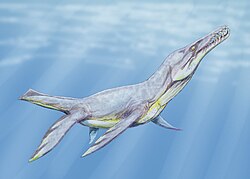 |
| Plesiopterys |
O'Keefe |
2004 |
Valid |
Early Jurassic |
Germany |
Displays an unusual combination of primitive and derived traits |
 |
| Plesiosaurus |
De la Beche & Conybeare |
1821 |
Valid |
Early Jurassic |
United Kingdom |
The first plesiosaur genus scientifically named and described. May be the most commonly found member in the Lias Group |
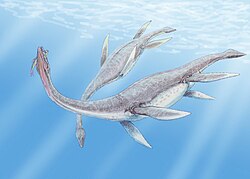 |
| Pliosaurus |
Owen |
1841 |
Valid |
Late Jurassic to Early Cretaceous |
Norway
Russia
 Ukraine Ukraine
United Kingdom |
The second specimen of P. funkei has been nicknamed "Predator X" |
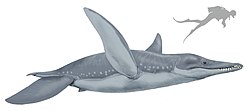 |
| Polycotylus |
Cope |
1869 |
Valid |
Late Cretaceous |
Russia
United States |
One particular specimen preserves a fetus inside of it, suggesting it gave live birth |
 |
| Polyptychodon |
Owen |
1841 |
Dubious |
Late Cretaceous |
Argentina?
France?
United Kingdom |
The sauropod dinosaur Dinodocus had been mistakenly attributed to this genus |
 |
| "Raptocleidus" |
Evans |
2012 |
Nomen nudum |
Early Jurassic |
United Kingdom |
Two species have been named, albeit informally |
|
| Rhaeticosaurus[29] |
Wintrich et al. |
2017 |
Valid |
Late Triassic |
Germany |
One of the few plesiosaurs known from the Triassic |
|
| Rhomaleosaurus |
Seeley |
1874 |
Valid |
Early Jurassic |
United Kingdom |
One of the largest early predatory marine reptiles. Four species are known |
 |
| Sachicasaurus |
Páramo-Fonseca et al. |
2018 |
Valid |
Early Cretaceous |
Colombia |
One of the most completely known pliosaurids yet described |
 |
| Scalamagnus[24] |
Clark, O'Keefe & Slack |
2023 |
Valid |
Late Cretaceous |
United States |
Once believed to be a species of Dolichorhynchops |
 |
| Scanisaurus |
Persson |
1959 |
Dubious |
Late Cretaceous |
Russia
 Sweden Sweden |
Although it is now considered dubious, this genus continues to be used in practice |
 |
| Seeleyosaurus |
White |
1940 |
Valid |
Early Jurassic |
Germany
Russia? |
Remains originally identified as Plesiosaurus |
 |
| Serpentisuchops |
Persons, Street & Kelley |
2022 |
Valid |
Late Cretaceous |
United States |
Had an exceptionally long neck, a unique trait among polycotylids |
 |
| Simolestes |
Andrews |
1909 |
Valid |
Middle Jurassic to Late Jurassic |
India?
United Kingdom |
Possessed an unusually short, high skull |
 |
| Sinopliosaurus |
Young |
1944 |
Dubious |
Early Cretaceous |
China |
Based only on a tooth and three vertebrae |
|
| Spitrasaurus[30] |
Knutsen, Druckenmiller & Hurum |
2012 |
Valid |
Late Jurassic |
Norway
United Kingdom? |
Two species have been named |
 |
| Spondylosaurus |
Fischer |
1845 |
Jr. synonym |
N/A |
N/A |
Junior synonym of Pliosaurus |
|
| Stenorhynchosaurus |
Páramo-Fonseca et al. |
2016 |
Valid |
Early Cretaceous |
Colombia |
Originally identified as a specimen of Brachauchenius |
 |
| "Stereosaurus" |
Seeley |
1869 |
Nomen nudum |
Late Cretaceous |
United Kingdom |
An informally named plesiosaur |
|
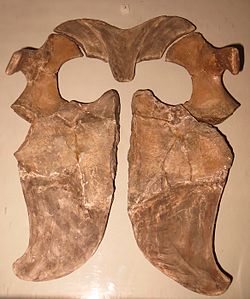
| Sthenarosaurus |
Watson |
1909 |
Valid |
Early Jurassic |
United Kingdom |
Its pelvis was relatively broad and strong |
 |
| Stratesaurus[9] |
Benson, Evans & Druckenmiller |
2012 |
Valid |
Early Jurassic |
United Kingdom |
Possibly the basalmost known rhomaleosaurid |
 |
| Stretosaurus |
Tarlo |
1959 |
Jr. synonym |
N/A |
N/A |
Junior synonym of Pliosaurus |
|
| Strongylokrotaphus |
Novozhilov |
1964 |
Jr. synonym |
N/A |
N/A |
Junior synonym of Pliosaurus |
|
| Styxosaurus |
Welles |
1943 |
Valid |
Late Cretaceous |
United States |
Closely related to Elasmosaurus, but can be differentiated from it based on morphological features |
 |
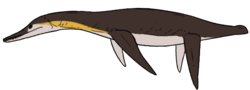
| Sulcusuchus |
Gasparini & Spalletti |
1990 |
Valid |
Late Cretaceous |
Argentina |
Originally mistakenly believed to be a pseudosuchian |
 |
| Taphrosaurus |
Cope |
1870 |
Dubious |
Late Cretaceous |
United States |
Poorly known |
|
| Tatenectes[31] |
O'Keefe & Wahl |
2003 |
Valid |
Late Jurassic |
United States |
Its unusual body shape and pachyostotic gastralia would have made it more suitable to turbulence |
 |
| Terminonatator |
Sato |
2003 |
Valid |
Late Cretaceous |
Canada |
One of the youngest plesiosaurs known from the Western Interior Seaway |
 |
| Thalassiodracon |
Storrs & Taylor |
1996 |
Valid |
Late Triassic to Early Jurassic |
United Kingdom |
Its maxillae had heterodont dentition |
 |
| Thalassiosaurus |
Welles |
1953 |
Jr. synonym |
N/A |
N/A |
Junior synonym of Styxosaurus |
|
| Thalassomedon |
Welles |
1943 |
Valid |
Late Cretaceous |
United States |
The type specimen has stones preserved in its stomach cavity |
 |
| Thalassonomosaurus |
Welles |
1943 |
Jr. synonym |
N/A |
N/A |
Junior synonym of Styxosaurus |
|
| Thaumatodracon |
Smith & Araújo |
2017 |
Valid |
Early Jurassic |
United Kingdom |
Relatively large for a rhomaleosaurid |
|
| Thaumatosaurus |
von Meyer |
1841 |
Jr. synonym |
N/A |
N/A |
The holotype is dubious and not diagnostic, as it can be referred to as an indeterminate pliosauroid. The specimens that were assigned to this genus now belong to different taxa |
|
| Thililua |
Bardet, Suberbiola & Jalil |
2003 |
Valid |
Late Cretaceous |
Morocco |
The first polycotylid plesiosaur named from Africa |
 |
| Traskasaura[32] |
O'Keefe et al. |
2025 |
Valid |
Late Cretaceous |
Canada |
Before its formal scientific description, it has been variously referred to as the "Courtenay elasmosaur", "Puntledge elasmosaur", or "Haslam elasmosaur". Officially recognized as the Provincial Fossil of British Columbia |
 |
| Tremamesacleis |
White |
1940 |
Jr. synonym |
N/A |
N/A |
Junior synonym of Muraenosaurus |
|
| Trematospondylus |
Quenstedt |
1858 |
Dubious |
Middle Jurassic |
Germany |
One of the first described plesiosaurs. Known only from seven large vertebrae |
|
| Tricleidus |
Andrews |
1909 |
Valid |
Middle Jurassic |
United Kingdom |
One referred species has been later found to belong to Colymbosaurus[33] |
 |
| Trinacromerum |
Cragin |
1888 |
Valid |
Late Cretaceous |
Canada
United States |
May have preyed on small fish as suggested by its dentition |
 |
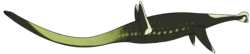
| Tuarangisaurus |
Wiffen, Wiffen & Moisley |
1986 |
Valid |
Late Cretaceous |
New Zealand |
Possesses two features in its skeleton that are otherwise unknown in other elasmosaurids |
 |
| "Turneria" |
Chatterjee & Small |
1989 |
Preoccupied |
N/A |
N/A |
Preoccupied by a genus of ant, renamed Morturneria |
|
| Umoonasaurus |
Kear, Schroeder & Lee |
2006 |
Valid |
Early Cretaceous |
Australia |
Uniquely for a plesiosaur, its skull features three crest-ridges that were likely covered in keratin |
 |
| Unktaheela[24] |
Clark, O'Keefe & Slack |
2023 |
Valid |
Late Cretaceous |
United States |
The smallest adult polycotylid yet known |
 |
| Uronautes[34] |
Cope |
1876 |
Dubious |
Late Cretaceous |
United States |
Described as a rhomaleosaurid but its extremely late age casts doubt into this |
|
| Vectocleidus[18] |
Benson et al. |
2012 |
Valid |
Early Cretaceous |
United Kingdom |
Previously thought to belong to its relative Leptocleidus |
 |
| Vegasaurus[35] |
O'Gorman et al. |
2015 |
Valid |
Late Cretaceous |
Antarctica |
May be closely related to Morenosaurus |
 |
| Vinialesaurus[36] |
Gasparini et al. |
2002 |
Valid |
Late Jurassic |
Cuba |
Originally referred to as a species of Cryptoclidus, but it was distinct enough from that genus to be named as its own taxon |
 |
| Westphaliasaurus |
Schwermann & Sander |
2011 |
Valid |
Early Jurassic |
Germany |
Known from an articulated, almost complete skeleton |
 |
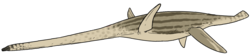
| Woolungasaurus |
Persson |
1960 |
Dubious |
Early Cretaceous |
Australia |
Today considered an indeterminate elasmosaurid |
 |
| Wunyelfia |
Otero et al. |
2021 |
Valid |
Late Cretaceous |
Chile |
One of the few Patagonian plesiosaurs described from outside Argentina |
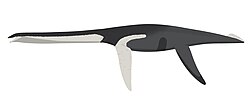 |
| Yuzhoupliosaurus[37] |
Zhang |
1985 |
Valid |
Middle Jurassic |
China |
Distinguishable by its long coracoids and well-developed clavicles |
|
| Zarafasaura |
Vincent et al. |
2011 |
Valid |
Late Cretaceous |
Morocco |
Unlike other elasmosaurids, its skull was unusually short |
 |
|


.png)


