White wine
wine that is fermented without grape skin, with a yellowish color From Wikipedia, the free encyclopedia

Remove ads
White wine is a wine made without maceration. This means the grape juice does not stay in contact with the skins, seeds, or pulp for a long time. The colour can be straw-yellow, yellow-green, or yellow-gold.[1] It is made by the alcoholic fermentation of the clear pulp of grapes. These grapes can have skins of any colour.

There are many kinds of white wine. This is because there are many varieties of grapes, different ways of winemaking, and different amounts of residual sugar (sweetness). Most white wine comes from "white" grapes, which are actually green or yellow. Examples include Chardonnay, Sauvignon blanc, and Riesling.[2] Some white wine is made from grapes with dark skins, as long as the must (juice) is not stained. For example, Pinot noir is often used to make champagne.
Dry white wine is the most common type. It is tangy and has a strong smell. It is made by letting the juice ferment completely. Sweet wines are made by stopping the fermentation before all the sugar turns into alcohol. This is called Mutage. There are many ways to make the juice sweeter, such as letting the grapes ripen longer on the vine or using noble rot. Sparkling wines are also mostly white. These wines keep the carbon dioxide inside the bottle so they become fizzy when opened.[3]
White wines are often served as an apéritif before a meal, with dessert, or as a refreshing drink. They are usually lighter and more refreshing than red wine. Because they are acidic and smell good, they are also used in cooking to soften meat or make sauces.[4]
Remove ads
History

Antiquity
The oldest form of wine was found in modern-day Iran from 7,500 years ago.[5] However, we do not know exactly when people first started making it. Ancient writings show that wine existed in the Middle East. It was made in the mountains of Anatolia and Armenia and then moved to Mesopotamia. Old clay tablets from the Hittites and Sumerians use different words for wine, such as red, light (which might be white), good, honeyed, or sour.[6][7]
In Ancient Greece, the doctor Hippocrates used white wine as a medicine for his patients.[8]
In Roman times, the Romans copied the Greek way of making wine. Rich people held big parties where expensive wine was a sign of power.[9] The richest citizens had villas near the Bay of Naples where they grew grapes to make a sweet white wine. As the Romans moved north, they planted vines along the Rhine river to give their soldiers a safe drink, since the water was often dirty.[10]
Middle Ages

After the Western Roman Empire fell, the wine trade almost disappeared. Germanic tribes liked beer more than wine. Later, Vikings and Saracens made it dangerous to trade or live in wine-growing areas like Provence or Southern Italy.[11]
The Catholic Church saved the knowledge of how to grow grapes because wine was needed for the Mass. Monks planted vines in many new places. Later, kings and nobles vbegan to buy wine again to show off their wealth.[a 1]
Rivers like the Rhine and Danube were used to move wine to different countries. King Charlemagne made rules to make sure wine was made cleanly.[12] This was a busy time for white wine in Germany and Austria. By the 15th century, people called high-quality wine "Fränkisch" (after the Franks) and cheaper wine "Heunisch" (after the Huns).[13]
Modern era

In 1453, the Ottoman Empire captured Constantinople. This disrupted the traditional wine trade in the Mediterranean, causing many Greek vineyards to fall into decay.[14] In response, Spain began exporting its own wines to England and the Netherlands. One of the most famous exports was a white wine called "sack," which was the early version of modern sherry.[15]
In the 16th century, European explorers brought the first grapevines to the Americas. Vineyards were successfully planted in Mexico by 1524, and reached Peru and Chile by 1548.[16][17]
During the Little Ice Age (a period of very cold weather from the 14th to the 19th centuries), northern vineyards in places like England and Germany struggled. Because red grapes would not ripen in the cold, white grapes—which handle cool weather better—became the primary choice for northern winemakers.[18] The freezing winters also led to the accidental discovery of champagne. The cold would stop fermentation in the winter, only for it to start again in the spring. This trapped carbon dioxide in the bottles, creating bubbles.[19]

The 17th century saw the rise of famous sweet white wines. Around 1650, winemakers in Hungary discovered how to use noble rot (a helpful fungus) to make Tokaji wine.[20]
This secret eventually spread to other regions. By the 18th and 19th centuries, winemakers in Schloss Johannisberg, Germany and Sauternes, France created the art of "late harvest" wines, where grapes are left on the vine until they are dried and sweet.[21][22]
Contemporary era

In the 19th century, champagne became famous globally. It was a favorite of European royalty and was often used during important political meetings, such as the Congress of Vienna.[23]
Improvements in the glass industry were crucial. Before this, bottles often exploded from the pressure of the bubbles. New coal-fired furnaces created stronger glass that could safely hold the carbon dioxide.[24] During the Industrial Revolution, production started using machines, making champagne more affordable for the growing middle class.
In the 20th century, white wine production expanded to "New World" regions like California, Australia, and New Zealand. However, winemakers in these warm climates faced a problem: if the juice got too hot during fermentation, the wine would lose its fresh flavor or spoil.[25]
Scientists, particularly at the University of California, Davis, developed ways to control fermentation temperatures.[26] They introduced stainless steel tanks with "cooling jackets" that kept the wine at a steady, cool temperature. [27] It also allowed high-quality white wine to be made in hot places like California and Australia.[28]
This technology changed white wine, allowing it to stay crisp and fruity regardless of the weather outside. Today, these refrigeration methods are used in almost every white wine region in the world.[29]
Remove ads
Geographical distribution
| Country | % |
| World average | 40.6% |
 Australia Australia | 60% |
 Czech Republic Czech Republic | 60% |
 New Zealand New Zealand | 56% |
 Luxembourg Luxembourg | 53% |
 United Kingdom United Kingdom | 47% |
 United States United States | 40% |
 France France | 21% |
Climatic zones
White grapes do not need as much heat as red grapes to ripen. This is because white wine does not use the bitter tannins from the skins. Because of this, white wine is often made in colder or more mountainous areas.[31]
In Europe, Germany, Switzerland, and Luxembourg mostly produce white wine. In France, the northern regions like Alsace and Champagne are the main producers. In Spain, a large area called Castile-La Mancha produces a lot of white wine, and Catalonia makes a sparkling white wine called Cava.[32]
In the Americas, Canada is famous for making ice wine in its cold climate. Canada is now the biggest producer of ice wine in the world.[33] Warmer areas in the south also make white wine, but they often make it sweet or add extra alcohol to it (fortified wine).[34] Examples include Madeira or Marsala.
Remove ads
Cooking features
The temperature at which wine is served is important for enjoying it. White wine should be chilled, but it should not be served with ice.[b 1][35]
At a cold temperature (between 8 and 9 °C), the chill makes bubbles stand out and makes sweet or fortified wines taste less sugary. For dry wines with a strong smell, serving them between 10 and 12 °C makes them taste fresh.[36] Very high-quality white wines are best served at 12 to 14 °C, which helps the drinker notice the complex flavours and the body of the wine.[37]
Pairing white wine and food
The acidity (tartness) of dry white wine is balanced by food that is slightly salty or sweet. At the same time, the wine can make salty food taste stronger and help balance out heavy, fatty foods.[38] Sweet wine works well with both sweet and savoury dishes because it cuts through sugar and brings out the taste of fruit.[39]
Dry or sparkling white wine is often served as an aperitif (a drink before a meal). Experts believe[b 2][40] that because some wines have a lot of sugar or alcohol, they can fill up the taste buds. However, the fresh, fruity taste of white wine helps prepare the mouth for the meal.[41]

During a meal, very dry wines are recommended for oysters and seafood because the acidity brings out the salinity of the shellfish.[42] Very fragrant wines go well with fish or white meats like chicken.[b 1] In stews, the acidity of the wine helps balance the fat in the meat.[43] Sweet wines are a good choice for spicy exotic dishes that use cinnamon or vanilla.[44] Fortified white wines are often served with foie gras.[b 2] Sparkling wines can be served throughout the entire meal.
Many people prefer white wine over red wine when eating cheese. This is because the acid in the wine goes well with the fat in dairy products.[b 3][45] Dry wines like Chardonnay or Sauvignon blanc bring out the taste of goat cheese. Strong-smelling wines and some sparkling wines work well with washed-rind cheeses that have a very strong smell like Munster.[46] Hard cheeses, like Comté cheese, pair perfectly with the yellow wine from the Jura. Fortified wines are best for blue cheeses like Roquefort.[47]
White wine is also used with desserts. Sweet and fortified wines go well with fruit salads or tarts. Rich desserts made with cream or butter pair well with sparkling wines. For chocolate, which has a very strong taste, an amber sweet wine is usually the best choice.[48]
White wine as an ingredient
White wine is a common ingredient in cooking. Its acidity balances out fat and makes heavy dishes feel lighter.[39] This acid also helps break down the fibres in meat to make it more tender.[49] In this way, white wine is used much like lemon juice.
White wine is used to make many sauces, such as béarnaise sauce or marinara sauce. It is also used to deglaze a pan, which means picking up the leftover juices from cooked meat to make a sauce.[50] In cheese fondue, the wine's acidity keeps the melted cheese smooth.
In marinades, wine is used to soften meat or fish. It is also used as a liquid for slow-cooking dishes. It helps keep the meat moist and balances the fat in the sauce.[51] It is used in dishes like risotto, sauerkraut (cabbage), osso buco, and many chicken or rabbit stews. It is also the main liquid used to cook mussels and other seafood.
A common rule for cooks is to serve the same wine at the table that was used to cook the food.[52]
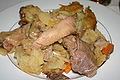 Baeckeoffe cooked in white wine
 Mussels in white wine and chips
 Chicken marsala
 Aveyron tripe
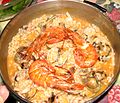 Risotto with prawns
 Alsatian sauerkraut
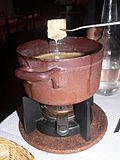 Swiss cheese fondue
 Osso bucco


Nutrition facts
Source: US government
Remove ads
Health effects
Because white wine spends less time in contact with grape skins, it has very little tannin and fewer antioxidants than red wine. However, a group of researchers from Montpellier has created a white wine that contains extra polyphenols.[53]
Sulphur dioxide is a common additive in wine. It is usually safe, but it can be dangerous for people with asthma:[54] it can start an asthma attack.[55] Some people may also experience trouble breathing, migraines, or a warm feeling in the stomach. It is very rare for a person to not have sulfite oxidase, the enzyme that breaks down sulphur. Scientists are currently studying whether these symptoms are caused by sulphur or by something else in the wine.[56]
White wine is an acidic drink with a pH between 2.8 and 3.6.[57]
This high acidity can damage tooth enamel.[58]
The wine also contains ethanol (alcohol). Drinking alcohol regularly can lead to cirrhosis of the liver. This risk increases if women drink more than 20 grams a day or if men drink more than 40 grams a day.[59] However, some studies from California suggest that a small daily dose of wine might actually help people with certain liver conditions.[60]
Recent studies show that white wine may have benefits for the lungs and the cardiovascular system (the heart and blood vessels).[61] While red wine has more antioxidants, white wine still contains enough to be helpful.[62] Both types of wine help prevent LDL (bad cholesterol) from breaking down in a way that harms the body.[63]
Remove ads
Notes and references
Bibliography
 Yves Renouil (dir.), Dictionary of Wine, Féret et fils, Bordeaux, 1962
- Sopexa, Wine and Spirits of France, Le Carrousel, Paris, 1989, ISBN 2-907504-00-2
- Collective work, The Vine and the Wine, Éditions la manufacture et la cité des sciences et de l'industrie, 1988, Lyon, ISBN 2-7377-0120-1, Part "Vinification in white" written by Denis Dubourdieu, p. 170 and 171
- Jean-Luc Berger, The Procedures of Wine-making, The vine and the wine, pages 76–77, No. 155, Science & Vie magazine, September 1986, Éditions Exelsior, Paris, ISSN 0151-0282
- Pascal Ribéreau-Gayon, Yves Glories, Alain Maujean, Denis Dubourdieu; Traits of Oenology : Chemistry of Wine, stabilisation and treatments, Dunod, October 2000, ISBN 2-10-003948-2
Notes
Main Sources
- Hugh Johnson, A World History of Wine from Antiquity to Modern Times, Hachette, 1990, ISBN 2-01-015867-9, 464 pages
- p. 129-137
- Collective work, The Hachette Guide to the Wines of France 2010, Hachette pratique, August 2009, ISBN 978-2-01-237514-7
Remove ads
References
Other websites
Wikiwand - on
Seamless Wikipedia browsing. On steroids.
Remove ads