Top Qs
Timeline
Chat
Perspective
c
From Wiktionary, the free dictionary
Remove ads
See also: C and Appendix:Variations of "c"
 | ||||||||
Character variations
 | ||||||||
 | ||||||||
| ||||||||
Languages (59)
Translingual • English
Afar • Albanian • Azerbaijani • Basque • Blin • Catalan • Central Mazahua • Comox • Czech • Danish • Dutch • Esperanto • Estonian • Fijian • Finnish • French • Fula • Heiltsuk • Hungarian • Ido • Indonesian • Interlingua • Irish • Italian • Japanese • Kankanaey • Kashubian • Kwak'wala • Latin • Latvian • Lower Sorbian • Lushootseed • Malay • North Frisian • Norwegian Bokmål • Nupe • Old English • O'odham • Polish • Portuguese • Romagnol • Romani • Romanian • Scottish Gaelic • Serbo-Croatian • Silesian • Skolt Sami • Slovak • Slovene • Somali • Spanish • Swedish • Tagalog • Turkish • Vietnamese • Welsh • Zulu
Page categories
Afar • Albanian • Azerbaijani • Basque • Blin • Catalan • Central Mazahua • Comox • Czech • Danish • Dutch • Esperanto • Estonian • Fijian • Finnish • French • Fula • Heiltsuk • Hungarian • Ido • Indonesian • Interlingua • Irish • Italian • Japanese • Kankanaey • Kashubian • Kwak'wala • Latin • Latvian • Lower Sorbian • Lushootseed • Malay • North Frisian • Norwegian Bokmål • Nupe • Old English • O'odham • Polish • Portuguese • Romagnol • Romani • Romanian • Scottish Gaelic • Serbo-Croatian • Silesian • Skolt Sami • Slovak • Slovene • Somali • Spanish • Swedish • Tagalog • Turkish • Vietnamese • Welsh • Zulu
Page categories
Remove ads
Translingual
Etymology 1
Modification of upper case letter C, from Etruscan 𐌂 (c), from Ancient Greek Γ (G, “Gamma”), from Phoenician 𐤂 (g, “gimel”).
Pronunciation
Pronunciation of IPA [cɑː, ɑccɑː] with the sound [c]: (file)
Letter
c (upper case C)
- The third letter of the basic modern Latin alphabet.
Usage notes
- Not to be confused with ϲ (s) (the lunate sigma).
- In many languages, the letter c represents both a “hard” /k/ sound and a “soft” sound (/s/, /ts/, /tʃ/, or /θ/), based on the following letter.
- In a number of languages, it is used only for the /tʃ/ sound.
- In many languages, it occurs frequently in the digraph with ch.
- In some romanization systems of non-Latin scripts, it represents /tʃ/, /θ/, or /tsʰ/.
See also
- (Latin script): Aa Bb Cc Dd Ee Ff Gg Hh Ii Jj Kk Ll Mm Nn Oo Pp Qq Rr Sſs Tt Uu Vv Ww Xx Yy Zz
- (Variations of letter C): Ćć Ĉĉ Čč Ċċ C̄c̄ Çç Ḉḉ Ȼȼ Ƈƈ ɕ ᴄ Cc
- Other scripts: г (g, “ge”), ג (g, “gimel”), ʗ
- Letters and symbols with similar shapes: Ɔ (open O), с (s, “es”)
- For more variations, see Appendix:Variations of "c".
- Appendix:Roman script
 c on Wikipedia.Wikipedia

Symbol
c
- (IPA) voiceless palatal plosive.
- May stand in for palatalized [kʲ], [tʲ], or as a more economical transcription of [t͜ʃ] or a similar ch-like sound.
- (NAPA, UPA) the IPA affricate [t͜s].
- Synonym: ȼ
- (superscript ⟨ᶜ⟩, IPA) [c]-onset (prestopping / preocclusion / preplosion), [c]-release, [c]-coloring, or a weak, fleeting or epenthetic [c].
- (superscript ⟨ᶜ⟩) A common rendering of the Semitic ayin, graphically resembling both Somali c and Semiticist ⟨ʿ⟩.
Further reading
- Voiceless palatal plosive on Wikipedia.Wikipedia
Etymology 2
Lower case form of upper case roman numeral C, a standardization of Ɔ and C because the latter happens to be an abbreviation of Latin centum (“hundred”), from abbreviation of ƆIC, an alternative form of >I<, from tally stick markings resembling Ж (a superimposed X and I), from the practice of designating each tenth X notch with an extra cut.
Alternative forms
Numeral
c (lower case Roman numeral, upper case C)
- cardinal number one hundred (100).
Usage notes
With a bar over the numeral, i.e., as c̅, it represents one hundred thousand.
Derived terms
- English: c-note
See also
- Lesser roman numeral symbol: l (“50”)
- Greater roman numeral symbol: d (“500”)
- Roman numerals
Etymology 3
From centi-, from Latin centum (“hundred”).
Symbol
c
Etymology 4
From Latin celeritās (“speed”).
Symbol
c
- (physics) The speed of light in a vacuum, 2.99792458 × 10⁸ m/s.
- (oceanography, meteorology) The speed of a fluid wave (water or air).
Etymology 5
(This etymology is missing or incomplete. Please add to it, or discuss it at the Etymology scriptorium.)
Symbol
c
- (mathematics) The space of convergent sequences.
Etymology 6
From circle or circumference
Symbol
c
- (rare, superscript, trigonometry, mathematics) radian (angular unit)
- Synonym: rad
- 0.785c or 0.785rad are equivalent to 45°
See also
Other representations of C:


Further reading
Gallery
- Letter styles
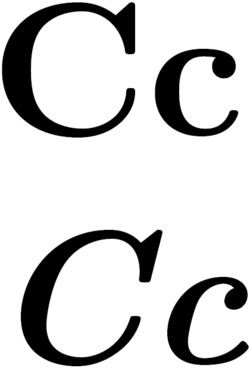 Uppercase and lowercase versions of C, in normal and italic type
 Uppercase and lowercase C in Fraktur


Remove ads
English
Etymology 1
 Old English lower case letter c, from 7th century replacement by Latin lower case c of the Anglo-Saxon Futhorc letter ᚳ (c, “cen”).
Pronunciation
- (phoneme): IPA(key): /k/, /s/, /tʃ/, ...
- Usage notes: In English, c is usually pronounced as /k/ ("crack", "climb", "clone"), sometimes pronounced as /s/ ("cereal", "celebrity", "citron"), and rarely pronounced as /tʃ/ ("ciao", "cello", "vermicelli"). Sometimes c is pronounced as /tʃ/ due to English words that came from Italian. (Italian has a rule that states that c before i or e is pronounced as /tʃ/.)
Letter
c (lower case, upper case C, plural cs or c's)
- The third letter of the English alphabet, called cee and written in the Latin script.
Number
c (lower case, upper case C)
- The ordinal number third, derived from this letter of the English alphabet, called cee and written in the Latin script.
Derived terms
See also
Etymology 2
Abbreviations.
Adverb
c
- Alternative form of c..
Noun
c
- Alternative form of c..
Etymology 3
Noun
- (music) The middle tone in either one of the sets of seven white keys on a keyboard or a set of seven strings on a stringed instrument.
Etymology 4
Verb
c
- (Internet slang, text messaging) Abbreviation of see.
- Alternative form: C
- 2012, Josephine Angelini, Dreamless, Macmillan Children’s Books, →ISBN:
- C u 2nite as planned.
Remove ads
Afar
Pronunciation
Letter
c
- The sixth letter of the Afar alphabet, written in the Latin script.
See also
Albanian
Pronunciation
Letter
c (upper case C, lower case c)
- The third letter of the Albanian alphabet, written in the Latin script.
See also
- (Latin-script letters) shkronjë; A a, B b, C c, Ç ç, D d, Dh dh, E e, Ë ë, F f, G g, Gj gj, H h, I i, J j, K k, L l, Ll ll, M m, N n, Nj nj, O o, P p, Q q, R r, Rr rr, S s, Sh sh, T t, Th th, U u, V v, X x, Xh xh, Y y, Z z, Zh zh
- (Arvanitic)
- Greek script letters (script appendix): Α α, Β β, B b, Γ γ, Γϳ γϳ, Δ δ, D d, Ε ε, Ε̱ ε̱, Ζ ζ, Ζ̇ ζ̇, Θ θ, Ι ι, Ϳ ϳ, Κ κ, Κ̇ κ̇, Λ λ, ΛΛ λλ, Λ̇ λ̇, Μ μ, Ν ν, Ν̇ ν̇, Ο ο, Π π, Ρ ρ, Ρ̇ ρ̇, Σ σ, Σ̈ σ̈, Τ τ, Ȣ ȣ, Υ υ, Φ φ, Χ χ, Χ̇ χ̇, ΤΣ τσ, ΤΣ̈ τσ̈, DΣ dσ, DΣ̈ dσ̈ [edit]
Remove ads
Azerbaijani
Pronunciation
Letter
c lower case (upper case C)
- The third letter of the Azerbaijani alphabet, written in the Latin script.
See also
Remove ads
Basque
Pronunciation
Letter
c (lower case, upper case C)
- The third letter of the Basque alphabet, called ze and written in the Latin script.
Usage notes
- Used chiefly in recent loanwords and foreign proper nouns.
See also
Further reading
- “c”, in Euskaltzaindiaren Hiztegia [Dictionary of the Basque Academy] (in Basque), Euskaltzaindia [Royal Academy of the Basque Language]
Remove ads
Blin
Pronunciation
Letter
c (uppercase C)
Catalan
Pronunciation
Letter
c (lower case, upper case C)
- The third letter of the Catalan alphabet, written in the Latin script.
See also
Remove ads
Central Mazahua
Pronunciation
Letter
c (upper case C)
- A letter of the Mazahua alphabet.
See also
- (Latin-script letters) A a, Ⱥ ⱥ, A̱ a̱, B b, C c, Cꞌ cꞌ, Cj cj, Cu cu, Cꞌu cꞌu, Cju cju, Ch ch, Chꞌ chꞌ, Chj chj, D d, Dy dy, E e, Ɇ ɇ, E̱ e̱, G g, Gu gu, Hu hu, ꞌHu ꞌhu, I i, I̱ i̱, J j, Jꞌ jꞌ, Jm jm, Jn jn, Jñ jñ, Ju ju, Jy jy, L l, M m, Mꞌ mꞌ, N n, Nꞌ nꞌ, Ñ ñ, Ñꞌ ñꞌ, O o, Ø ø, O̱ o̱, P p, Pj pj, R r, S s, T t, Tꞌ tꞌ, Tj tj, Ts ts, Tsꞌ tsꞌ, Tsj tsj, U u, Ꞹ ꞹ, U̱ u̱, X x, Z z, Zh zh, ꞌ
Comox
Pronunciation
Letter
c (no case)
- A letter of the Comox alphabet, written in the Latin script.
See also
Czech
Letter
c (lower case, upper case C)
- The fourth letter of the Czech alphabet, written in the Latin script.
See also
Remove ads
Danish
Letter
c (uppercase C)
- the third letter of the Danish alphabet
See also
- (Latin-script letters) bogstav; A a (Á á), B b, C c, D d, E e (É é), F f, G g, H h, I i (Í í), J j, K k, L l, M m, N n, O o (Ó ó), P p, Q q, R r, S s, T t, U u (Ú ú), V v, W w, X x, Y y (Ý ý), Z z, Æ æ (Ǽ ǽ), Ø ø (Ǿ ǿ), Å å
Dutch
Pronunciation
Letter
c (lower case, upper case C)
- The third letter of the Dutch alphabet, written in the Latin script.
See also
Esperanto
Pronunciation
Letter
c (lower case, upper case C)
- The third letter of the Esperanto alphabet, called co and written in the Latin script.
See also
Estonian
Pronunciation
Letter
c (lower case, upper case C)
- The third letter of the Estonian alphabet, called tsee and written in the Latin script.
Usage notes
- Used only in foreign words.
See also
Fijian
Pronunciation
Letter
c (upper case C)
- The third letter of the Fijian alphabet, written in the Latin script.
See also
Finnish
Etymology 1
The Finnish orthography using the Latin script was based on those of Swedish, German and Latin, and was first used in the mid-16th century. No earlier script is known. See the Wikipedia article on Finnish for more information, and c for information on the development of the glyph itself.
Pronunciation
Letter
c (lower case, upper case C)
- The third letter of the Finnish alphabet, called see and written in the Latin script.
Usage notes
- Used only in loanwords. In more established loanwords replaced with k or s.
See also
Etymology 2
Noun
c
Usage notes
Capitalized for the great octave or any octave below that, or in names of major keys; not capitalized for the small octave or any octave above that, or in names of minor keys.
Declension
Derived terms
French
Pronunciation
Letter
c (lower case, upper case C)
- The third letter of the French alphabet, written in the Latin script.
- 1837, Louis Viardot, L’Ingénieux Hidalgo Don Quichotte de la Manchefr.Wikisource, translation of El ingenioso hidalgo Don Quijote de la Mancha by Miguel de Cervantes Saavedra, Chapter I:
- Avec ces propos et d’autres semblables, le pauvre gentilhomme perdait le jugement. Il passait les nuits et se donnait la torture pour les comprendre, pour les approfondir, pour leur tirer le sens des entrailles, ce qu’Aristote lui-même n’aurait pu faire, s’il fût ressuscité tout exprès pour cela.
- With these passages and other similar ones, the poor gentleman lost his judgement. He spent his nights and tortured himself to understand them, to consider them more deeply, to take from them their deepest meaning, which Aristotle himself would not have been able to do, had he been resurrected for that very purpose.
Contraction
c
- (text messaging, Internet slang) Informal spelling of c'est
- C nul ici sans George
- It's rubbish here without George
Fula
Pronunciation
Letter
c (lower case, upper case C)
- A letter of the Fula alphabet, written in the Latin script.
Usage notes
See also
Heiltsuk
Pronunciation
Letter
c (upper case C)
- A letter of the Heiltsuk alphabet, written in the Latin script.
See also
- (Latin-script letters) A a, Á á, A̓ a̓, B b, C c, C̓ c̓, D d, , G g, Gv gv, Ǧ ǧ, Ǧv ǧv, H h, H̓ h̓, Ħ ħ, I i, Í í, I̓ i̓, K k, Kv kv, K̓ k̓, K̓v k̓v, L l, ʼL l̓, Ḷ ḷ, Ḷ́ ḷ́, ʼḶ ḷ̓, Ɫ ɫ, M m, ʼM m̓, Ṃ ṃ, Ṃ́ ṃ́, ʼṂ ṃ̓, N n, ʼN n̓, Ṇ ṇ, Ṇ́ ṇ́, ʼṆ ṇ̓, P p, P̓ p̓, Q q, Qv qv, Q̓ q̓, Q̓v q̓v, S s, T t, T̓ t̓, ƛ, ̓ ƛ̓, U u, Ú ú, U̓ u̓, W w, ʼW w̓, X x, Xv xv, X̌ x̌, X̌v x̌v, Y y, ʼY y̓, Z z, ʔ
Hungarian
Alternative forms
Pronunciation
Letter
c (lower case, upper case C)
- The fourth letter of the Hungarian alphabet, called cé and written in the Latin script.
Declension
Derived terms
See also
- (Latin-script letters) betű; A a, Á á, B b, C c, Cs cs, D d, Dz dz, Dzs dzs, E e, É é, F f, G g, Gy gy, H h, I i, Í í, J j, K k, L l, Ly ly, M m, N n, Ny ny, O o, Ó ó, Ö ö, Ő ő, P p, R r, S s, Sz sz, T t, Ty ty, U u, Ú ú, Ü ü, Ű ű, V v, Z z, Zs zs. Only in the extended alphabet: Q q W w X x Y y. Commonly used: ch. Also defined: à ë. In surnames (selection): ä aa cz ds eé eö ew oe oó th ts ÿ.
Further reading
- (sound, letter, item, or abbreviation): c , (musical note, its symbol or key/position): c , (interjection expressing surprise or disparagement): c , (interjection for calling cats): c , (interjection for calling pigs or horses): c in Géza Bárczi, László Országh, et al., editors, A magyar nyelv értelmező szótára [The Explanatory Dictionary of the Hungarian Language] (ÉrtSz.), Budapest: Akadémiai Kiadó, 1959–1962. Fifth ed., 1992: →ISBN.
- c in Nóra Ittzés, editor, A magyar nyelv nagyszótára [A Comprehensive Dictionary of the Hungarian Language] (Nszt.), Budapest: Akadémiai Kiadó, 2006–2031 (work in progress; published a–ez as of 2024).
Ido
Pronunciation
Letter
c (upper case C)
- The third letter of the Ido alphabet, written in the Latin script.
See also
Indonesian
Pronunciation
Letter
c (lower case, upper case C)
- The third letter of the Indonesian alphabet, written in the Latin script.
See also
Interlingua
Pronunciation
Letter
c (lower case, upper case C)
- The third letter of the Interlingua alphabet, written in the Latin script.
See also
Irish
Letter
c (lower case, upper case C)
- The third letter of the Irish alphabet, written in the Latin script.
See also
- (Latin-script letters) litir; A a (Á á), B b (Bh bh, bhF bhf, bP bp), C c (Ch ch), D d (Dh dh, dT dt), E e (É é), F f (Fh fh), G g (gC gc, Gh gh), H h, I i (Í í), L l, M m (mB mb, Mh mh), N n (nD nd, nG ng), O o (Ó ó), P p (Ph ph), R r, S s (Sh sh), T t (Th th, tS ts), U u (Ú ú), V v
- (diacritics) ◌́ ◌̇
- (dotted letters used chiefly in Gaelic type) Ḃ ḃ, Ċ ċ, Ḋ ḋ, Ḟ ḟ, Ġ ġ, Ṁ ṁ, Ṗ ṗ, Ṡ ẛ ṡ, Ṫ ṫ
Italian
Letter
c f or m (invariable, lower case, upper case C)
- The template Template:Latn-def does not use the parameter(s):
langname=Italian
Please see Module:checkparams for help with this warning.The third letter of the Italian alphabet, called ci and written in the Latin script.
Japanese
Alternative forms
Etymology
Short of ちゃん (chan).
Suffix
Related terms
- s (san)
Kankanaey
Etymology 1
Borrowed from Tagalog c. Letter pronunciation is influenced by English c.
Pronunciation
Letter
c (lower case, upper case C)
- The third letter of the Kankanaey alphabet, called si and written in the Latin script.
See also
Etymology 2
Homophonous to si.
Pronunciation
Particle
c
- (text messaging) abbreviation of si
References
- Komisyon ng Wikang Filipino (2016), Ortograpiya di Kankanaëy [Kankanaey Orthography] (in Kankanaey and Tagalog), →ISBN, pages 10-11
Kashubian
Etymology
The Kashubian orthography is based on the Latin alphabet. No earlier script is known. See the Kashubian alphabet article on Wikipedia for more, and c for development of the glyph itself.
Letter
c (lower case, upper case C)
- The fifth letter of the Kashubian alphabet, written in the Latin script.
See also
Kwak'wala
Alternative forms
- ⟨ts⟩ in Uʼmista orthography (standard Kwakʼwala)
Pronunciation
Letter
c (upper case C)
- (Liqʼwala dialect) A letter of the Kwak'wala alphabet, written in the Latin script.
See also
- Uʼmista
- (Latin-script letters) A a, A̱ a̱, B b, D d, Dł dł, Dz dz, E e, G g, Gw gw, G̱ g̱, G̱w g̱w, H h, I i, K k, Kw kw, K̓ k̓, K̓w k̓w, Ḵ ḵ, Ḵw ḵw, Ḵ̓ ḵ̓, Ḵ̓w ḵ̓w, L l, ʼL ʼl, Ł ł, M m, ʼM ʼm, N n, ʼN ʼn, O o, P p, P̓ p̓, S s, T t, T̓ t̓, Tł tł, T̓ł t̓ł, Ts ts, T̓s t̓s, U u, W w, ʼW ʼw, X x, Xw xw, X̱ x̱, X̱w x̱w, Y y, ʼY ʼy, ʼ
- Liq̓ʷala
- (Latin-script letters) A a, Ə ə, B b, D d, , Dᶻ dᶻ, E e, G g, Gʷ gʷ, Ǧ ǧ, Ǧʷ ǧʷ, H h, I i, K k, Kʷ kʷ, K̓ k̓, K̓ʷ k̓ʷ, Q q, Qʷ qʷ, Q̓ q̓, Q̓ʷ q̓ʷ, L l, L̓ l̓, Ł ł, M m, M̓ m̓, N n, N̓ n̓, O o, P p, P̓ p̓, S s, T t, T̓ t̓, ƛ, ̓ ƛ̓, C c, C̓ c̓, U u, W w, W̓ w̓, X x, Xʷ xʷ, X̌ x̌, X̌ʷ x̌ʷ, Y y, Y̓ y̓, ʔ
Latin
Letter
c (lower case, upper case C)
- A letter in the Latin alphabet, representing the sound /k/
See also
Latvian
Etymology
Proposed in 1908 as part of the new Latvian spelling by the scientific commission headed by K. Mīlenbahs, which was accepted and began to be taught in schools in 1909. Prior to that, Latvian had been written in German Fraktur, and sporadically in Cyrillic.
Pronunciation
Letter
c (lower case, upper case C)
- The fourth letter of the Latvian alphabet, called cē and written in the Latin script.
See also
Lower Sorbian
Pronunciation
Letter
c (upper case C)
- The third letter of the Lower Sorbian alphabet, called cej and written in the Latin script.
See also
Lushootseed
Pronunciation
Letter
c
- The fifth letter of the Lushootseed alphabet.
Malay
Pronunciation
Letter
c (lower case, upper case C)
- The third letter of the Malay alphabet, written in the Latin script.
See also
North Frisian
Pronunciation
Letter
c (lower case, upper case C)
- A letter of the North Frisian alphabet, written in the Latin script.
Usage notes
- The letter occurs only in ⟨ch⟩. This digraph is pronounced as in German, thus [x] after back vowels, otherwise [ç]. The same sound is also represented by ⟨g⟩ in some positions (see there). Moreover, ⟨j⟩ becomes [ç] prevocalically after voiceless obstruents, whereas ⟨r⟩ may become [x] before voiceless stops.
- The trigraph ⟨sch⟩ represents [ʃ]. Chiefly in Sylt Frisian, ⟨sj⟩ is used instead.
See also
Norwegian Bokmål
Alternative forms
Etymology 1
From Latin c, from the uppercase letter C, from Etruscan Etruscan 𐌂 (c), from Ancient Greek Γ (G, “Gamma”), from Phoenician 𐤂 (g, “gimel”).
Pronunciation
- (letter name) IPA(key): /seː/
- (phoneme) IPA(key): /s/, /k/, /tʃ/, /ʃ/
Audio: (file) - Rhymes: -eː
- Hyphenation: c
- Homophones: C, se
- Usage notes: In Norwegian, c is pronounced as /k/ before the vowel letters a, o, and u, as well as all consonants ("campus", "corner", "cue", "credo"), it is pronounced as /s/ before the vowel letters i, e, y and æ ("cicerone", "cellete", "cyste", cæsar), and rarely pronounced as /tʃ/ or /ʃ/ in some Italian loanwords ("cembalo", "ciabatta", "cello").
Letter
c (uppercase C)
- The third letter of the Norwegian Bokmål alphabet, written in the Latin script.
See also
Noun
c m (definite singular c-en, indefinite plural c-er, definite plural c-ene)
- the letter c, the third letter of the Norwegian alphabet
- indicates the third entry in a list, order or rank
- 1857, Henrik Wergeland, Samlede Skrifter VIII, page 515:
- [jeg har] allerede sagt A. Traditionen vil nok lægge B. og C. til
- [I have] already said A. Tradition will probably add B. and C. to
- 1939, Knut Hamsun, Artikler, page 100:
- historie er, hvad A mener til forskel fra B, og hvad C igen mener til forskel fra A og B
- history is what A means as a difference from B, and what C in turn means as a difference from A and B
- (music) C, c-note (the first note in the C chromatic and major scales; the lowest note of an instrument, written below the staff and the D note)
- den høye C ― high C
- 1997, Tove Nilsen, G for Georg, page 42:
- så gal at man virkelig tror at svaler er g-nøkler og bass-nøkler og a’er og c’er som svever rundt hverandre og lager konsert i himmelen
- so crazy that you really think swallows are g-keys and bass-keys and a's and c's floating around each other and making a concert in the sky
- 1939, Knut Hamsun, Artikler, page 100:
- [de] larmet ikke og gik ikke og tok det høie C
- [they] did not make noise and did not go and did the high C
- 1999, Børre Qvamme, Opera, operette og ballett gjennom tidene, page 70:
- Duprez vakte sensasjon ved sine ut de poitrine, høy c tatt som brysttone
- Duprez aroused sensation by his out de poitrine, high c taken as chest tone
- 2000, Pål Gerhard Olsen, Fredstid:
- han gjør stolen hennes tobent så hun når den høye c av forskrekkelse
- he makes her chair two-legged so she reaches the high c out of fright
- (grammar) abbreviation of genus commune
Usage notes
- Only used in words of foreign origin, usually English. Even rare in loanwords, as this letter does not represent a sound of its own.
- Still kept in many Christian names, therefore Caroline and Karoline are both acceptable spellings.
Etymology 2
Abbreviation of centi- (“centi-”), from Latin centum (“hundred”), from Proto-Italic *kentom (“hundred”), from Proto-Indo-European *ḱm̥tóm (“hundred”), from *déḱm̥ (“ten”).
Pronunciation
Symbol
c
Etymology 3
Abbreviation of cent, from English cent, from Middle English cent, from Old French cent (“one hundred”), from Latin centum (“hundred”), from Proto-Italic *kentom (“hundred”), from Proto-Indo-European *ḱm̥tóm (“hundred”), from *déḱm̥ (“ten”).
Pronunciation
Symbol
c
- abbreviation of cent
Etymology 4
Abbreviation of centime, from French centime, from cent (“hundred”), from Middle French cent, from Old French cent (“hundred”), from Latin centum (“hundred”), from Proto-Italic *kentom (“hundred”), from Proto-Indo-European *ḱm̥tóm (“hundred”), from *déḱm̥ (“ten”).
Pronunciation
Symbol
c
Etymology 5
Abbreviation of centavo, from Spanish centavo (from ciento, from Old Spanish) and Portuguese centavo (from cento, from Old Galician-Portuguese cento), both stemming from Latin centum (“hundred”), from Proto-Italic *kentom (“hundred”), from Proto-Indo-European *ḱm̥tóm (“hundred”), from *déḱm̥ (“ten”).
Pronunciation
Symbol
c
Etymology 6
Abbreviation of cykel, from Ancient Greek κῠ́κλος (kŭ́klos), from Proto-Indo-European *kʷékʷlos (“circle, wheel”), from *kʷel- (“to turn”).
Pronunciation
Symbol
c
- (physics) abbreviation of cykel
References
- “c” in The Bokmål Dictionary.
- “c” in Det Norske Akademis ordbok (NAOB).
- “C (Bokstav)” in Store norske leksikon
- “C (Forkortelse)” in Store norske leksikon
- “C (Tone)” in Store norske leksikon
- “C (Mynter)” in Store norske leksikon
Anagrams
Nupe
Pronunciation
Letter
c (lower case, upper case C)
- The third letter of the Nupe alphabet, written in the Latin script.
See also
Old English
Pronunciation
Letter
c (lowercase, uppercase c)
- a letter of the Old English alphabet, representing /k/ and /tʃ/
O'odham
Verb
c
- alternative form of 'ac
See also
Polish
Etymology
The Polish orthography is based on the Latin alphabet. No earlier script is known. See the history of Polish orthography article on Wikipedia for more, and c for development of the glyph itself.
Pronunciation
Letter
c (upper case C, lower case)
- The fourth letter of the Polish alphabet, called ce and written in the Latin script.
See also
Portuguese
Etymology 1
Pronunciation
Letter
c (lower case, upper case C)
- The third letter of the Portuguese alphabet, written in the Latin script.
See also
Etymology 2
Pronunciation
Pronoun
c m or f by sense (plural 6)
- (Brazil, Internet slang, text messaging) abbreviation of cê
Etymology 3
Preposition
c
Further reading
- “c”, in Dicionário Aulete Digital (in Portuguese), Rio de Janeiro: Lexikon Editora Digital, 2008–2025
- “c”, in Dicionário Priberam da Língua Portuguesa (in Portuguese), Lisbon: Priberam, 2008–2025
Romagnol
Letter
c f or m (invariable, lower case, upper case C)
- The third letter of the Romagnol alphabet, called cé and written in the Latin script.
See also
Romani
Pronunciation
Letter
c (lower case, upper case C)
- The third letter of the Romani alphabet, written in the Latin script.
See also
- (Latin-script letters) A a, B b, C c, D d, E e, F f, G g, H h, X x, I i, J j, K k, Kh kh, L l, M m, N n, O o, P p, Ph ph, R r, S s, T t, Th th, U u, V v, Z z International Standard: (À à, Ä ä, Ǎ ǎ), Ć ć, Ćh ćh, (È è, Ë ë, Ě ě), (Ì ì, Ï ï, Ǐ ǐ), (Ò ò, Ö ö, Ǒ ǒ), Rr rr, Ś ś, (Ù ù, Ü ü, Ǔ ǔ), Ź ź, Ʒ ʒ, Q q, Ç ç, ϴ θ. Pan-Vlax: Č č, Čh čh, Dž dž, (Dź dź), Ř ř, Š š, (Ś ś), Ž ž, (Ź ź).
References
- Yūsuke Sumi (2018), “C, c”, in ニューエクスプレス ロマ(ジプシー)語 [New Express Romani (Gypsy)] (in Japanese), Tokyo: Hakusuisha, →ISBN, page 13
Romanian
Pronunciation
Letter
c (lower case, upper case C)
- The fifth letter of the Romanian alphabet, called ce or cî and written in the Latin script.
Usage notes
See C for pronunciation notes.
See also
Scottish Gaelic
Pronunciation
Letter
c (lower case, upper case C)
- The third letter of the Scottish Gaelic alphabet, written in the Latin script. It is preceded by b and followed by d. Its traditional name is coll (“hazel”).
See also
Serbo-Croatian
Alternative forms
- C (uppercase)
Pronunciation
Letter
c (Cyrillic spelling ц)
Silesian
Etymology
The Silesian orthography is based on the Latin alphabet. No earlier script is known. See the Silesian language article on Wikipedia for more, and c for development of the glyph itself.
Letter
c (lower case, upper case C)
- The fourth letter of the Silesian alphabet, written in the Latin script.
See also
Skolt Sami
Pronunciation
Letter
c (upper case C)
- The fourth letter of the Skolt Sami alphabet, written in the Latin script.
See also
Slovak
Pronunciation
Letter
c (upper case C)
- The fifth letter of the Slovak alphabet, written in the Latin script.
See also
Slovene
Alternative forms
Etymology
From Gaj's Latin alphabet c, from Czech alphabet c, from latin c, which is a modification of upper case letter C, from Etruscan 𐌂 (c), from Ancient Greek Γ (G, “Gamma”), from Phoenician 𐤂 (g, “gimel”). Pronunciation as /cə/ is initial Slovene (phoneme plus a fill vowel) and the second pronunciation is probably taken from German c.
Pronunciation
Letter
c (lower case, upper case C)
- The third letter of the Slovene alphabet, written in the Latin script.
- The fourth letter of the Slovene alphabet (Resian), written in the Latin script.
- The third letter of the Slovene alphabet (Natisone Valley dialect), written in the Latin script.
Symbol
c
- (SNPT) Phonetic transcription of sound [t͡s].
Noun
c m inan
- The name of the Latin script letter C / c.
- (linguistics) The name of the phoneme /t͡s/.
Declension
- Overall more common
- More common when with a definite adjective
Derived terms
See also
Further reading
- “c”, in Slovarji Inštituta za slovenski jezik Frana Ramovša ZRC SAZU (in Slovene), 2014–2025
Somali
Etymology
Pronunciation
Letter
c lower case (upper case C)
- The twelfth letter of the Somali alphabet, called cayn and written in the Latin script.
See also
Spanish
Pronunciation
- IPA(key): (phoneme) /k/ [k], /θ/ [θ] (Spain)
- IPA(key): (phoneme) /k/ [k], /s/ [s] (Latin America, Philippines)
- IPA(key): (letter name) /ˈθe/ [ˈθe] (Spain)
- IPA(key): (letter name) /ˈse/ [ˈse] (Latin America, Philippines)
Letter
c (lower case, upper case C)
- The third letter of the Spanish alphabet, written in the Latin script.
Swedish
Pronunciation
Etymology 1
See the etymology at #Translingual.
Letter
c (lower case, upper case C)
- The third letter of the Swedish alphabet, written in the Latin script.
Etymology 2
Abbreviations.
Proper noun
c n (genitive c:s)
- abbreviation of Centerpartiet (“Centre Party”)
- Anna Anderson (c)
- Anna Anderson ([of the] Centre Party)
Alternative forms
Noun
c ?
- abbreviation of centrum (“city centre”)
- abbreviation of centralstation (“central station”)
- Stockholm C
- Stockholm Central Station
Tagalog
Etymology 1
Borrowed from Spanish c. Each pronunciation has a different source:
- Filipino alphabet pronunciation is influenced by English c.
- Abecedario pronunciation is from Spanish c.
Pronunciation
Letter
c (lower case, upper case C)
- The third letter of the Tagalog alphabet (the Filipino alphabet), called si and written in the Latin script.
- (historical) The third letter of the Tagalog alphabet (the Abecedario), called ce and written in the Latin script.
Usage notes
- This letter is mostly used only in Spanish-based spellings, proper nouns, or unadapted loanwords.
See also
Etymology 2
Borrowed from English c (cee), homophonous to si.
Pronunciation
- (Standard Tagalog) IPA(key): /si/ [sɪ]
- Rhymes: -i
Particle
c (Baybayin spelling ᜐᜒ)
- (text messaging) abbreviation of si
Further reading
- “c”, in Pambansang Diksiyonaryo | Diksiyonaryo.ph, Manila, 2018.
Turkish
Pronunciation
Letter
c (lower case, upper case C)
- The third letter of the Turkish alphabet, called ce and written in the Latin script.
See also
- (Latin-script letters) harf; A a (Â â), B b, C c, Ç ç, D d, E e, F f, G g, Ğ ğ, H h, I ı, İ i (Î î), J j, K k, L l, M m, N n, O o, Ö ö, P p, R r, S s, Ş ş, T t, U u (Û û), Ü ü, V v, Y y, Z z
Vietnamese
Pronunciation
Letter
c (lower case, upper case C)
- The fifth letter of the Vietnamese alphabet, called xê or cờ and written in the Latin script.
See also
- (Quốc ngữ letters) chữ cái; A a (À à, Ả ả, Ã ã, Á á, Ạ ạ), Ă ă (Ằ ằ, Ẳ ẳ, Ẵ ẵ, Ắ ắ, Ặ ặ), Â â (Ầ ầ, Ẩ ẩ, Ẫ ẫ, Ấ ấ, Ậ ậ), B b, C c (Ch ch), D d, Đ đ, E e (È è, Ẻ ẻ, Ẽ ẽ, É é, Ẹ ẹ), Ê ê (Ề ề, Ể ể, Ễ ễ, Ế ế, Ệ ệ), G g (Gh gh, Gi gi), H h, I i (Ì ì, Ỉ ỉ, Ĩ ĩ, Í í, Ị ị), K k (Kh kh), L l, M m, N n (Ng ng, Ngh ngh, Nh nh), O o (Ò ò, Ỏ ỏ, Õ õ, Ó ó, Ọ ọ), Ô ô (Ồ ồ, Ổ ổ, Ỗ ỗ, Ố ố, Ộ ộ), Ơ ơ (Ờ ờ, Ở ở, Ỡ ỡ, Ớ ớ, Ợ ợ), P p (Ph ph), Q q (Qu qu), R r, S s, T t (Th th, Tr tr), U u (Ù ù, Ủ ủ, Ũ ũ, Ú ú, Ụ ụ), Ư ư (Ừ ừ, Ử ử, Ữ ữ, Ứ ứ, Ự ự), V v, X x, Y y (Ỳ ỳ, Ỷ ỷ, Ỹ ỹ, Ý ý, Ỵ ỵ)
Pronoun
c
- (slang, Internet, text messaging) abbreviation of cậu
- (slang, Internet, text messaging) abbreviation of chị
Welsh
Pronunciation
Letter
c (lower case, upper case C)
See also
- (Latin-script letters) llythyren; A a (Á á, À à, Â â, Ä ä), B b, C c, Ch ch, D d, Dd dd, E e (É é, È è, Ê ê, Ë ë), F f, Ff ff, G g, Ng ng, H h, I i (Í í, Ì ì, Î î, Ï ï), J j, L l, Ll ll, M m, N n, O o (Ó ó, Ò ò, Ô ô, Ö ö), P p, Ph ph, R r, Rh rh, S s, T t, Th th, U u (Ú ú, Ù ù, Û û, Ü ü), W w (Ẃ ẃ, Ẁ ẁ, Ŵ ŵ, Ẅ ẅ), Y y (Ý ý, Ỳ ỳ, Ŷ ŷ, Ÿ ÿ)
Mutation
- c at the beginning of words mutates to g in a soft mutation, to ngh in a nasal mutation and to ch in an aspirate mutation, for example with the word cath (“cat”):
Note: Certain mutated forms of some words can never occur in standard Welsh.
All possible mutated forms are displayed for convenience.
Further reading
- R. J. Thomas, G. A. Bevan, P. J. Donovan, A. Hawke et al., editors (1950–present), “c”, in Geiriadur Prifysgol Cymru Online (in Welsh), University of Wales Centre for Advanced Welsh & Celtic Studies
Zulu
Pronunciation
Letter
c (lower case, upper case C)
- The third letter of the Zulu alphabet, written in the Latin script.
See also
Wikiwand - on
Seamless Wikipedia browsing. On steroids.
Remove ads